


Think of your interior design proposal as more than just a document outlining scope, timelines, and costs. It’s your firm’s handshake, your opening argument, and the very first tangible piece of your brand a potential client will hold in their hands. It needs to do more than just list services; it must tell a story and convince them you’re the only one for the job.
Crafting a Proposal That Captures Attention
When you’re dealing with the luxury market, a generic proposal is a non-starter. This audience expects a bespoke experience from the very beginning, and your proposal is ground zero. It’s a preview of the meticulous attention to detail and personalized service you’re promising.
This isn’t the time for a one-size-fits-all template. Your proposal should feel like the opening chapter of the client’s design story—one that is compelling, visually stunning, and crafted specifically around their dreams and desires. This is where you set the tone for the entire relationship.
From First Glance to a Firm Handshake
That initial meeting was great, but the journey from a promising conversation to a signed contract hinges on the strength of this document. A powerful, thoughtful proposal builds immediate trust. It shows you were not just hearing them, but truly listening.
It’s your chance to separate your firm from the competition by proving you can translate their abstract vision into a concrete, exciting plan.
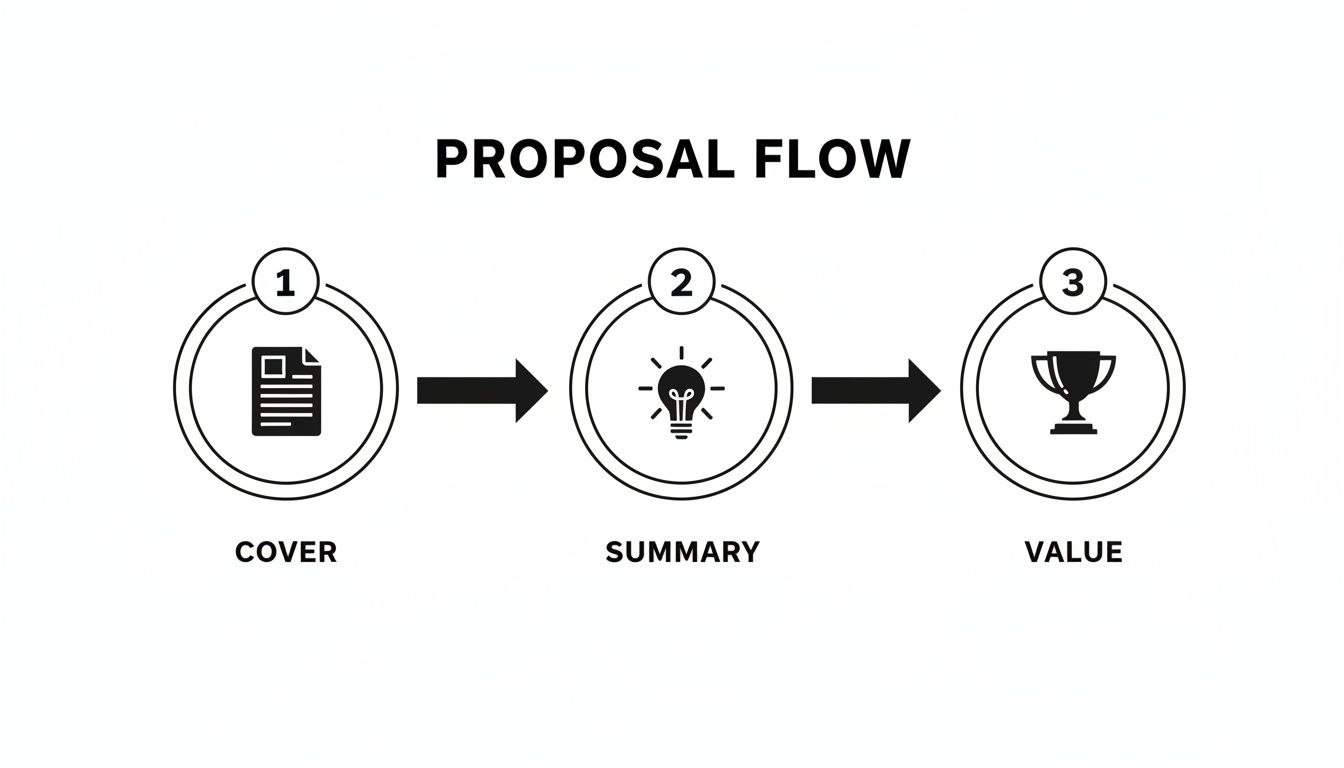
The best proposals follow a natural narrative. They start with a strong first impression, summarize the core understanding of the project, and then clearly articulate the value you bring. Each section builds on the last, guiding the client confidently toward saying “yes.”
A great proposal doesn’t just outline logistics; it sells a feeling. It makes the client feel understood, valued, and genuinely excited about the transformation you’re about to create together. This emotional connection is often the real deciding factor.
The timing couldn’t be better. The global interior design services market is projected to hit USD 186.61 billion by 2030. The premium segment, your target market, is growing at an incredible 11.79% CAGR starting in 2025. This shows a massive opportunity for designers who can perfect their pitch.
A sharp, well-crafted proposal is just as critical as your visual work. For designers aiming to capture a piece of this expanding market, it’s an essential business tool, much like knowing how to build a design portfolio that stops high-end clients in their tracks.
Translating Vision into a Tangible Scope of Work
The initial consultation is all about capturing the dream. The Scope of Work, on the other hand, is where we get our hands dirty and start building the foundation for that dream. Think of this section as the bridge between your client’s abstract ideas and your concrete plan of action.
Its real job is to prevent scope creep before it even starts and to set crystal-clear expectations. A vague scope is a recipe for misunderstandings and budget battles later on. Being meticulously detailed here isn’t just about being thorough; it’s about showing your professionalism and giving that high-end client the confidence that you’ve got everything under control.
Breaking Down the Project into Digestible Phases
Luxury clients are often short on time and appreciate a logical, easy-to-follow plan. Don’t just throw a monolithic task list at them. Instead, break your process down into distinct, manageable phases. This approach not only makes the entire project feel less daunting but also demonstrates that you have a clear, strategic roadmap.
I’ve found that segmenting the work into these key stages works wonders:
- Conceptual & Schematic Design: This is the creative deep dive. We’re talking mood boards, initial sketches, and space planning to nail down the overall aesthetic and functional layout.
- Design Development & Sourcing: Now we get specific. This is where we refine the concepts into detailed drawings and start selecting the exact furniture, fixtures, and finishes.
- Procurement & Project Management: The logistical powerhouse phase. It covers the intricate dance of ordering, tracking, and receiving every item, plus coordinating with vendors and managing the budget.
- Installation & Styling: The grand finale! This is the exciting part where everything comes together, from placing the furniture to adding those final decorative touches that truly make a space feel like home.
Structuring your scope this way creates natural checkpoints for client feedback and approvals, keeping everyone aligned. If you want to dive deeper into this critical first step, understanding what is schematic design offers some fantastic insight into turning those initial sparks of inspiration into a workable plan.
Using Evocative Language to Describe Your Vision
Your proposal should never read like a technical manual or an inventory list. When you describe your design concepts, go beyond simply listing furniture and colors. You need to use evocative language that speaks directly to the experience and lifestyle your client is yearning for.
Instead of writing, “We will place a blue sofa in the living room,” try something more compelling: “We envision a serene living area anchored by a custom velvet sofa in a deep sapphire hue, creating an inviting atmosphere for evening relaxation and intimate conversations.”
This technique helps the client feel the space before a single item has been ordered. Your words should paint a vivid picture of the life they’ll live in their new home, connecting your design directly to their personal aspirations. You’re not just selling a list of items; you’re selling a feeling, an outcome.
Making the Vision Feel Real with Visuals
Words are incredibly powerful, but visuals are what make the vision truly tangible. This is where you can make a huge impact. Strategically placing mood boards, preliminary sketches, or even simple 3D renderings within this section can be a complete game-changer. These elements give the client a tantalizing preview of the aesthetic you’re proposing.
A beautifully curated mood board instantly communicates the texture, color palette, and overall feeling you’re aiming for. It’s definitive proof that you’ve listened carefully and can translate their desires into a cohesive design language. For a luxury client, seeing this initial visual confirmation is often the final piece of the puzzle they need to sign on with complete confidence.
Presenting Your Fees as a Smart Investment

Let’s talk about the part that makes many designers nervous: the money. It doesn’t have to be an awkward conversation. For a luxury client, a clear, confident, and completely transparent investment section is one of the quickest ways to build trust. They aren’t just looking for the cheapest option; they value directness and want to understand the logic behind the numbers.
Your goal here is to completely reframe the discussion. Move it away from “How much does this cost?” and toward “What is the return on this investment?” This part of your proposal shouldn’t be a simple list of charges. Think of it as a detailed breakdown of the expertise, access, and peace of mind you bring to their project. It’s your chance to show how your involvement protects their investment, saves them invaluable time, and delivers a home they simply couldn’t create on their own.
Choosing the Right Fee Structure
The way you structure your fees says a lot about how you operate. There’s no magic bullet here—the best choice really depends on the project’s scope, your own business model, and what gives the client the most comfort.
Choosing a pricing model is a strategic decision that impacts both client trust and project flow. Each common structure has its place, and understanding their nuances will help you select the right one for each unique project.
Comparison of Common Interior Design Fee Structures
| Fee Structure | How It Works | Best For | Client Perception |
|---|---|---|---|
| Fixed Fee (Flat Rate) | A single, all-inclusive price for the entire scope of design services agreed upon upfront. | Projects with a very clear, defined scope and predictable timeline. Think a single room design or a full-home furnishing project with a set budget. | High. Clients love the budget certainty and predictability. It feels transparent and eliminates fears of spiraling hourly costs. |
| Hourly Rate | You bill the client for every hour your firm spends on their project, from concept development to site visits and procurement. | Consultations, projects with an undefined or evolving scope, or for clients who need design guidance in phases without a full-service commitment. | Mixed. While it feels fair (they pay for what they use), it can create anxiety about unknown final costs. Requires meticulous time tracking and transparent invoicing. |
| Cost-Plus (% of Project Cost) | Your fee is a set percentage added to the net/trade cost of all furnishings, materials, and contractor services you procure. | Large-scale renovations and new builds where you are managing significant procurement and construction elements. | Generally positive, as your fee is directly tied to the project’s scale. They see you as a partner whose compensation is linked to the project’s success. |
Ultimately, the structure you choose should align with the project’s complexity and provide the client with a sense of control and clarity. Many seasoned designers even use a hybrid model, like a fixed fee for the initial design concept followed by an hourly or cost-plus model for implementation.
Framing Your Value with Confidence
How you word this section is just as important as the numbers themselves. This is no time for apologetic or hesitant language. You need to be direct and use value-driven phrasing that positions your expertise as the project’s single greatest asset.
For example, when presenting a remodeled luxury kitchen, you can point out that it often yields a 50-70% return on investment. You can also highlight your expertise in smart home integrations, which 85% of affluent clients now expect in their homes. Backing up your value with hard data reinforces that you’re in tune with the market. For a deeper dive into these trends, you can explore more insights about the global interior design market.
Here’s an example of how to present a fixed fee with authority:
Our design fee is a fixed investment of $35,000. This covers the comprehensive design, procurement, and project management required to execute your project from initial concept to final installation. This approach ensures a seamless process and a meticulously curated result, all managed by our expert team.
This phrasing is professional and positions your service as an all-inclusive solution. It shifts the focus from individual costs to the holistic, high-touch experience you provide, justifying the investment and reinforcing the premium quality of your work.
Mapping Out the Project Timeline and Milestones
In the world of luxury interior design, time is the ultimate currency. A vague, open-ended schedule is one of the biggest red flags for discerning clients who value precision and expect masterful project management. This is exactly why a detailed, realistic timeline isn’t just a nice-to-have; it’s a non-negotiable part of your proposal that builds immediate trust.
Your goal here is to prove you have a firm grasp of the entire project journey, from the first creative spark to placing the final accessory. It needs to be clear you’ve thought through potential delays, understand the logistical chess game involved, and, most importantly, respect your client’s time. A solid timeline proves your value extends far beyond aesthetics and deep into the realm of meticulous execution.
Segmenting the Project into Clear Phases
The best way to present a complex project is to break it down into digestible phases. This simple act makes the entire process feel far more manageable and transparent for the client. Instead of staring at a single, intimidating end date months away, they see a logical progression with clear checkpoints, which helps set expectations and keep momentum.
Most high-end residential projects naturally fall into a few key phases. I always recommend organizing your timeline visually around these core stages:
- Phase 1: Design & Development (4-6 weeks) This is where the magic begins. It covers all the initial creative work, from finalizing the concept and creating mood boards to drafting detailed drawings and selecting materials. Crucially, you need to build in buffer time for client feedback and revisions.
- Phase 2: Procurement & Ordering (8-16 weeks) This is often the longest stretch of the project, and its duration is almost entirely dependent on vendor lead times for custom pieces. It’s vital to state clearly that these timelines are estimates.
- Phase 3: Construction & Renovation (If applicable) While your general contractor will provide this timeline, you absolutely must include it here. It shows the client you see the full picture and are coordinating all the moving parts.
- Phase 4: Installation & Styling (1-2 weeks) The grand finale! This is the exciting phase where everything arrives, is placed according to plan, and styled to perfection.
Defining Key Milestones and Approval Deadlines
Within each of those phases, you need to pinpoint the key milestones. Think of these as the critical decision points where you absolutely need client input or a formal sign-off to keep the project moving forward. Outlining these from the start shows you’re a proactive partner who understands this is a collaboration.
A well-structured timeline does more than just list dates; it maps out the client’s role in the project. By defining specific approval deadlines for things like floor plans or fabric selections, you empower them to be an efficient partner in their own project’s success.
For example, you might specify milestones like “Final Floor Plan Approval: Week 3” or “Upholstery Selections Due: Week 5.” This approach doesn’t just keep the project on track; it also gently underscores the client’s responsibility in hitting their own deadlines.
Suddenly, the timeline is no longer just a schedule. It’s a shared roadmap, proving your firm is organized, professional, and ready to lead their project to a successful, on-time completion.
Weaving in the Essential Terms and Agreements
While the creative vision and stunning visuals are what get a client excited, the Terms and Agreements section is what truly solidifies the professional relationship. This isn’t just a block of legal jargon. It’s the operational spine of your entire project. I like to think of it as a pre-project alignment tool, a way to show you’ve thought through every contingency and are protecting both your firm and your client from any future gray areas.
By building these terms directly into your interior design proposal template, you make the entire onboarding process smoother. You’re not springing a separate, often intimidating, legal document on them later. Instead, you’re presenting a single, cohesive package that covers everything from inspiration to installation and invoicing. This immediately signals to a luxury client that you are organized, transparent, and have a proven process—all things they expect.
Detailing Payment Schedules and Procedures
Nothing sours a client relationship faster than ambiguity around money. Vague payment terms create anxiety and can breed distrust before a single swatch is even selected. Your proposal absolutely must outline the payment schedule with crystal clarity, tying each installment to a specific, tangible project milestone. This structure just makes sense to clients; they can see exactly what they’re paying for as the project moves forward.
Here’s a common, effective structure I’ve used for years:
- Initial Retainer: Due upon signing the proposal, which officially kicks off the project and reserves your time.
- Design Phase Payment: Due once the final design concept and floor plans get the green light.
- Procurement Deposit: Required before any purchasing begins for furniture, fixtures, and materials.
- Final Balance: Due just before the final installation phase starts.
This milestone-based schedule takes all the guesswork out of the equation and keeps your cash flow healthy and predictable.
Managing Changes and Revisions Gracefully
Let’s be realistic: projects evolve. A client might fall in love with a different fabric, or a custom piece of furniture could hit a supply chain snag. This is exactly why your proposal needs a clearly defined Change Order process. This clause should spell out precisely how any revisions requested outside the original scope will be managed—how they’ll be documented, approved, and, of course, billed.
This isn’t about being rigid or difficult. It’s about maintaining control and complete transparency. Having a formal process turns a potentially awkward conversation into a structured, professional one. Every change is acknowledged, and its impact on the timeline and budget is understood and signed off on by the client in writing. No surprises, no misunderstandings.
Protecting Your Intellectual Property
Your design concepts, drawings, mood boards, and renderings are the valuable output of your creative mind and professional expertise. It’s absolutely critical to include a clause that clearly states your firm retains ownership of all intellectual property until the project is paid for in full.
Your proposal needs to specify that all design documents are licensed to the client for use on this specific project only. They cannot be replicated or handed off to other designers or architects without your explicit written consent. This is how you protect your creative assets and reinforce their inherent value.
The interior design market is absolutely booming, with a projected value of USD 208.16 billion by 2033. In this crowded field, I’ve seen that as many as 80% of successful luxury bids include these kinds of detailed terms. It demonstrates a level of business savvy that high-end clients not only respect but actively look for. For a deeper dive into structuring these agreements, our professional interior design contract template guide offers some fantastic additional insights.
Common Proposal Questions from Top Designers
Even the most seasoned designers get tripped up now and then when putting together a proposal for a new luxury client. It’s all about striking that perfect balance—you want to showcase your incredible expertise without giving away the farm, all while respecting the client’s need to make an informed decision. Getting this right often means thinking ahead and addressing the common sticking points before you even hit send.
Think of your proposal template as a flexible framework, not a rigid form. It’s a strategic tool that you’ll need to adapt for each unique project and personality. Here are some of the most frequent questions we hear from top designers, along with some practical advice to help you navigate them with confidence.
How Much Detail Is Too Much in an Initial Proposal?
This is a delicate dance, for sure. With a luxury client, you have to prove you’re the expert without handing over your entire design concept for free. The secret is to focus on selling your process and professionalism, not just the final pretty pictures.
Your proposal should absolutely include a detailed scope of work, a completely transparent fee structure, and a professional, realistic timeline. These are the elements that show you’re a serious business owner. To bring the vision to life, I always recommend including one or two high-level mood boards that masterfully capture the project’s intended essence—the feeling, the color story, the textures.
What you hold back on are the nitty-gritty details. No detailed floor plans, no specific furniture SKUs, and definitely no full 3D renderings at this stage.
The point of the proposal is to get the contract signed, not to deliver the finished design. It’s a compelling preview that makes the client feel understood and excited to hire you for the complete, bespoke experience.
What Is the Best Way to Present My Proposal?
Your presentation is a direct reflection of the quality of your work. For a high-end audience, a simple Word doc or a basic email just isn’t going to cut it. Your proposal needs to be a beautifully designed, branded PDF that reinforces your firm’s aesthetic on every single page.
Whenever you can, present the proposal in person or over a video call. This is your chance to build that personal rapport, walk the client through your vision, and handle any questions right then and there. It turns a static document into a collaborative conversation, which is infinitely more persuasive. Things like high-quality imagery, an elegant layout, and easy-to-read typography are simply non-negotiable.
How Should I Handle Requests for Revisions?
It’s completely normal for a client to ask for adjustments after seeing the initial proposal—in fact, it shows they’re engaged! The key is to handle these requests like the expert partner you are.
First, acknowledge their feedback right away and set up a quick call to talk it through. Use that conversation to clearly explain how their requested changes might affect the project’s timeline, scope, or overall investment. From there, issue a revised document, clearly labeled something like “Proposal v2,” that transparently highlights the updates. This approach frames the process not as a negotiation but as a collaborative effort to get the project perfectly aligned with their goals.
Should I Include Client Testimonials?
Absolutely. In a market built on reputation and trust, social proof is one of your most powerful tools. Including one or two impactful testimonials from past high-end clients can be the final nudge a potential client needs to say yes.
Choose quotes that specifically mention your professionalism, your seamless process, or your ability to deliver incredible results on time and on budget. I find it’s most effective to place them strategically toward the end of the proposal, just before your final call to action. A glowing review from a peer can be the ultimate piece of assurance a client needs to feel confident in their decision to hire you. Just always remember to get explicit permission before using a client’s name or words.
Ready to elevate your proposals and attract the clients you deserve? The Haute Design network connects top-tier design professionals with an exclusive audience of affluent homeowners actively seeking luxury design services. Join a curated community of the industry’s best and gain the visibility your brand needs to thrive. Learn more about joining Haute Design.