


Before you even think about demolition, the most critical work of your remodel happens with a pen and paper. This is where you translate your daydreams into a concrete plan, defining not just what you want, but why you want it. Getting this foundation right is the single best way to prevent budget overruns and ensure the final result truly matches your vision.
Defining Your Remodel Vision and Scope
A successful remodel starts with some serious introspection, long before you interview a single contractor. This isn’t about picking out tile just yet; it’s about articulating the real purpose behind the project. You have to move beyond a simple wish list item like “a bigger kitchen” and dig into the core motivations for the change.
Is your home no longer working for your growing family? Is your primary goal to boost your property’s resale value in a hot market? Or are you finally creating that dream space for entertaining you’ve always wanted? Your answers here will become the guiding principles for every decision that follows.
From Vague Ideas to a Detailed Brief
Your first real task is to create what we call a “Remodel Brief.” Think of it as the constitution for your project. This document is where you capture the practical, emotional, and financial goals driving your renovation. It will be the north star for you and your entire design-build team.
A solid brief should clearly outline:
- Core Objectives: What are the top 3-5 problems this remodel absolutely must solve? (e.g., fix the terrible kitchen workflow, bring in more natural light, create a functional home office).
- Functional Needs: Get specific about how you need the space to perform. Think about traffic patterns, storage needs, and the exact activities that will happen there.
- Inspirational Elements: This is the fun part. Gather images, material samples, and notes that convey the look and feel you’re after. This visual vocabulary is incredibly powerful when communicating with designers.
The Power of “Must-Haves” vs. “Nice-to-Haves”
Once your core vision is on paper, it’s time to get pragmatic with your wish list. This exercise is absolutely essential for keeping your scope—and your budget—in check. Split your list into two columns: “Must-Haves” (the non-negotiables) and “Nice-to-Haves” (items you’d love but could live without).
This simple act of prioritizing brings immediate clarity. It empowers you to make smart trade-offs down the road and serves as your best defense against “scope creep”—that slow, insidious addition of features that can derail your budget and timeline.
Your project’s scope is its most valuable asset. A tightly defined scope protects your budget, timeline, and sanity. It ensures that every dollar and every decision serves your primary goals, eliminating costly distractions along the way.
It’s no surprise that thoughtful renovations are in high demand. The residential remodeling market is projected to grow by approximately 5% in the next year, with another 3% increase the following year. A big driver for this is our aging housing stock; over 80% of U.S. homes are now more than 20 years old. As you can find in expert analysis from the NAHB, this makes meticulous planning more critical than ever to see a real return on your investment.
High-Level Remodel Planning Roadmap
To give you a clearer picture of the journey ahead, here’s a high-level look at the typical phases of a high-end remodeling project. While every project is unique, this roadmap provides a solid framework for what to expect.
| Phase | Key Objective | Typical Duration |
|---|---|---|
| 1. Vision & Scope | Define project goals, “must-haves,” and an initial budget range. | 2-4 Weeks |
| 2. Team Assembly | Research, interview, and hire an architect, designer, and/or builder. | 3-6 Weeks |
| 3. Design & Schematics | Develop initial floor plans, elevations, and conceptual designs. | 4-8 Weeks |
| 4. Selections & Bidding | Finalize all materials and finishes; obtain detailed bids from contractors. | 4-12 Weeks |
| 5. Permitting & Prep | Submit plans to the city for approval; order long-lead-time materials. | 4-16+ Weeks |
| 6. Construction | The active build-out phase, from demolition to final installations. | 3-12+ Months |
| 7. Punch List & Handover | Final walkthrough, address minor fixes, and receive project documentation. | 1-3 Weeks |
Understanding these stages helps you set realistic expectations for the timeline and appreciate the critical importance of the upfront planning work. The more thorough you are in Phase 1, the smoother the rest of the process will be.
Building a Realistic Remodeling Budget
Once you have a clear vision for your project, it’s time to tackle the numbers. Let’s be honest—this is where the dream meets reality. A well-thought-out budget is much more than a spreadsheet; it’s the financial roadmap that guides every single decision, keeps expectations in check, and ultimately dictates whether your project is a resounding success.
We need to move past ballpark figures and into a detailed, line-item financial plan.
This starts with some serious homework. The cost of materials, labor, and permits swings wildly from one city to the next. So, start digging for real-world data in your area. Talk to local contractors, walk through showrooms, and use online estimators to get a feel for what big-ticket items truly cost. Kitchens, for instance, are famous for their vast price range. To get a better handle on this, check out our guide on the cost to redo a kitchen.
Deconstructing Your Budget
A truly comprehensive budget isn’t just one big number. It’s a collection of smaller, specific costs that you’ve anticipated ahead of time. Breaking it down this way is the best insurance against overlooking a major expense down the road.
Your financial plan absolutely must account for:
- Design Fees: What you’ll pay your architect, interior designer, and structural engineer.
- Permits and Inspections: These are the non-negotiable fees from your local municipality.
- Labor Costs: This is the big one—the total for your general contractor and all their subcontractors, like plumbers and electricians.
- Materials and Finishes: Think everything from the bones of the project (lumber, drywall) to the beautiful finishes (custom cabinets, countertops, flooring).
- Fixtures and Appliances: All the final touches, including sinks, faucets, lighting, and kitchen appliances.
With the U.S. home remodeling industry pulling in roughly $164.5 billion annually across nearly 691,000 businesses, you can see why prices and quality vary so much. You’re navigating a massive, competitive market. For a deeper look, you can find more insights into the remodeling industry on ibisworld.com.
The Non-Negotiable Contingency Fund
If you only take one piece of advice from this guide, let it be this: you must have a contingency fund. This isn’t “extra” money for upgrades or a nice-to-have slush fund. It is a protected, untouchable part of your budget set aside for the surprises that are practically guaranteed to pop up.
The industry standard for a high-end renovation is a contingency fund of 15-20% of your total construction cost. This is your financial shock absorber for when the crew opens a wall and finds faulty wiring or discovers the subfloor is rotten and needs to be completely replaced.
Without it, one unexpected problem could force you to compromise on a feature you love or, even worse, bring the project to a screeching halt. Plan for it from day one, and you’ll turn a potential crisis into a manageable bump in the road.
Exploring Your Financing Options
While paying from savings is the most direct path, it’s certainly not the only one. For a large-scale project, it often makes more sense to explore financing that doesn’t completely drain your liquid assets.
Here are a few of the most common routes homeowners take:
- Home Equity Line of Credit (HELOC): This is a revolving line of credit that uses your home’s equity as collateral. The flexibility is great—you only draw what you need, when you need it, and only pay interest on what you’ve used.
- Home Equity Loan: Unlike a HELOC, this gives you a single lump-sum payment. It comes with a fixed interest rate and a predictable monthly payment, which is perfect if you already have a firm, final quote from your contractor.
- Renovation Loan: Certain loans, like the FHA 203(k), are designed to bundle the cost of buying a home and renovating it into one mortgage. This is a fantastic tool if you’re buying a fixer-upper with a clear plan to remodel right away.
Each of these has its own set of pros and cons when it comes to interest rates, closing costs, and payback terms. I always recommend sitting down with a financial advisor to map out which option aligns with your long-term goals and gives you the financial breathing room to actually enjoy the process.
Assembling Your Dream Team for the Remodel
With a clear vision and a budget in place, the success of your high-end remodel now hinges on one thing: the people you hire. This is where you shift from being the dreamer to the CEO of your project. Putting together the right team isn’t just about finding qualified professionals; it’s about creating a collaborative powerhouse with the right chemistry and expertise to bring your vision to life.
Make no mistake, the quality of your finished home will be a direct reflection of the talent you hire. This is probably the most critical decision you’ll make during the entire remodel.
Who’s Who on a High-End Remodel
A project of this scale isn’t a one-person job. You’re building a specialized team, and knowing who does what is the first step toward a smooth process.
- The Architect: This is your structural visionary. If you’re changing the home’s footprint, moving load-bearing walls, or adding on, an architect is non-negotiable. They create the detailed blueprints that serve as the structural and legal backbone of your entire project.
- The Interior Designer: Your designer is the one who translates your aesthetic into a livable, beautiful reality. They’re focused on the interior flow, space planning, and every last finish—from cabinetry and countertops to light fixtures and doorknobs—ensuring the final look is cohesive and functional.
- The General Contractor (GC): Think of the GC as your on-the-ground project manager. They hire and orchestrate all the subcontractors (plumbers, electricians, painters), manage the daily schedule, and are ultimately responsible for executing the architect’s plans and the designer’s vision.
Understanding these distinct roles is crucial. A great team works in sync, with each expert respecting the others’ domain.
Before we dive deeper, let’s break down how these key players compare. Choosing the right professional at the right time can make all the difference in how smoothly your project unfolds from concept to completion.
Comparing Key Remodeling Professionals
| Professional | Primary Role | When to Hire | Common Fee Structure |
|---|---|---|---|
| Architect | Designs the structure, floor plans, and exterior. Ensures building code compliance and structural integrity. | At the very beginning, for projects involving structural changes, additions, or new construction. | Percentage of total construction cost (8-15%), hourly rate, or a fixed fee. |
| Interior Designer | Focuses on the interior aesthetic, space planning, material selection, furnishings, and finishes. | Early in the planning phase, often alongside the architect, to ensure the interior flows logically and beautifully. | Hourly rate, fixed fee, or a cost-plus model on furnishings and materials. |
| General Contractor | Manages the construction process, hires subcontractors, sources materials, and oversees the day-to-day work on-site. | After the initial design and blueprints are near completion. They provide bids based on the detailed plans. | Fixed-price (lump sum) or a cost-plus model (cost of work plus a 15-25% fee). |
Each professional brings a unique and vital skill set to the table. For a truly high-end result, you’ll often have all three working together, ensuring a seamless bridge between the structural shell and the final interior details.
How to Vet Your Candidates Like an Insider
Finding names is the easy part. Finding the right people requires you to think like an investigator. A glossy portfolio is just the starting point; you need to understand their process, communication style, and track record. A pretty picture won’t tell you if the project was a nightmare that finished six months late and 20% over budget.
Start by looking for portfolios that showcase projects with a similar scope and style to yours. A firm known for sleek, modern beach houses might not be the best fit for your historic brownstone renovation.
When you call their references, go beyond the standard “Were you happy?” Ask this instead: “If you were to do another project with them, what would you do differently in your working relationship?” The answer to that question reveals everything about their communication, problem-solving skills, and transparency.
Next, it’s time for due diligence. This part is not optional. Confirm that every professional you’re seriously considering is licensed and insured in your state. Ask for copies of their license, general liability insurance, and workers’ compensation certificate. This isn’t about distrust; it’s about protecting yourself from massive financial and legal risks should anything go wrong.
Getting the Contract Right
Once you’ve made your selections, it’s time to talk contracts. The type of agreement you sign will have a huge impact on your budget, flexibility, and financial risk. It’s vital to understand the two most common structures before you put pen to paper.
The Fixed-Price Contract This is exactly what it sounds like: you agree on a single, all-in price for the entire scope of work. It offers a wonderful sense of budget security. The catch? Any deviation—from wanting a different faucet to discovering unforeseen issues—requires a formal “change order,” which always comes with added costs. This model works best when every single decision has been made before the first hammer swings.
The Cost-Plus Contract With this approach, you pay the contractor for the actual costs of labor and materials, plus an agreed-upon percentage or fee for their overhead and profit. It offers much more flexibility for making decisions as you go. The trade-off is that you assume more financial risk, as the final price isn’t set in stone. Smart homeowners will often negotiate a “guaranteed maximum price” (GMP) to create a cost ceiling.
Which one is right for you? It really boils down to your personal comfort with risk and how much of the project is defined upfront. No matter which path you take, having an attorney review the contract is a smart, and relatively small, investment that can save you a world of trouble later.
Crafting a Realistic Project Timeline
Let’s be honest: a detailed timeline is your best defense against the soul-crushing anxiety of a renovation that seems to have no end in sight. A realistic schedule, created in lockstep with your contractor, is what separates a smooth-running project from a chaotic, budget-busting nightmare. It’s less of a wish list and more of a strategic roadmap that keeps everyone accountable.
Think of it like a set of dominoes. You can’t start hanging drywall until the plumbing and electrical guts of the wall have been inspected and signed off on. And those custom cabinets you’ve been dreaming of? They can’t go in until the drywall is finished and painted. This chain of dependencies is the absolute bedrock of a timeline that actually works in the real world.
Proper project management for home renovation hinges on this schedule to keep costs in check and manage everyone’s expectations.
Mapping Out the Core Construction Phases
While your general contractor is the ultimate owner of the master schedule, you need to understand the fundamental sequence of events. Every project has its own quirks, but the general order of operations is surprisingly consistent. It’s a logical flow, moving from the heavy, structural work to the delicate finishing touches.
Most high-end remodels follow these critical stages:
- Demolition & Site Prep: This is the messy but thrilling phase where the old space is stripped away to make room for the new.
- Framing & Structural: Walls start going up (or coming down), and you get the first real sense of the new layout.
- The “Rough-Ins”: This is all the critical behind-the-scenes work for plumbing, electrical, and HVAC. This phase always concludes with crucial city inspections.
- Insulation & Drywall: The walls are finally closed, creating a “white box” and turning the skeleton into a room.
- Flooring & Tile: Hard surfaces go down, laying the true foundation for your design vision.
- Cabinetry & Millwork: Kitchens, bathrooms, and custom built-ins begin to take their final, beautiful form.
- Painting & Finishes: Finally, color! This is where the personality of the space truly starts to emerge.
- Final Installations: Light fixtures are hung, faucets are installed, and appliances are hooked up.
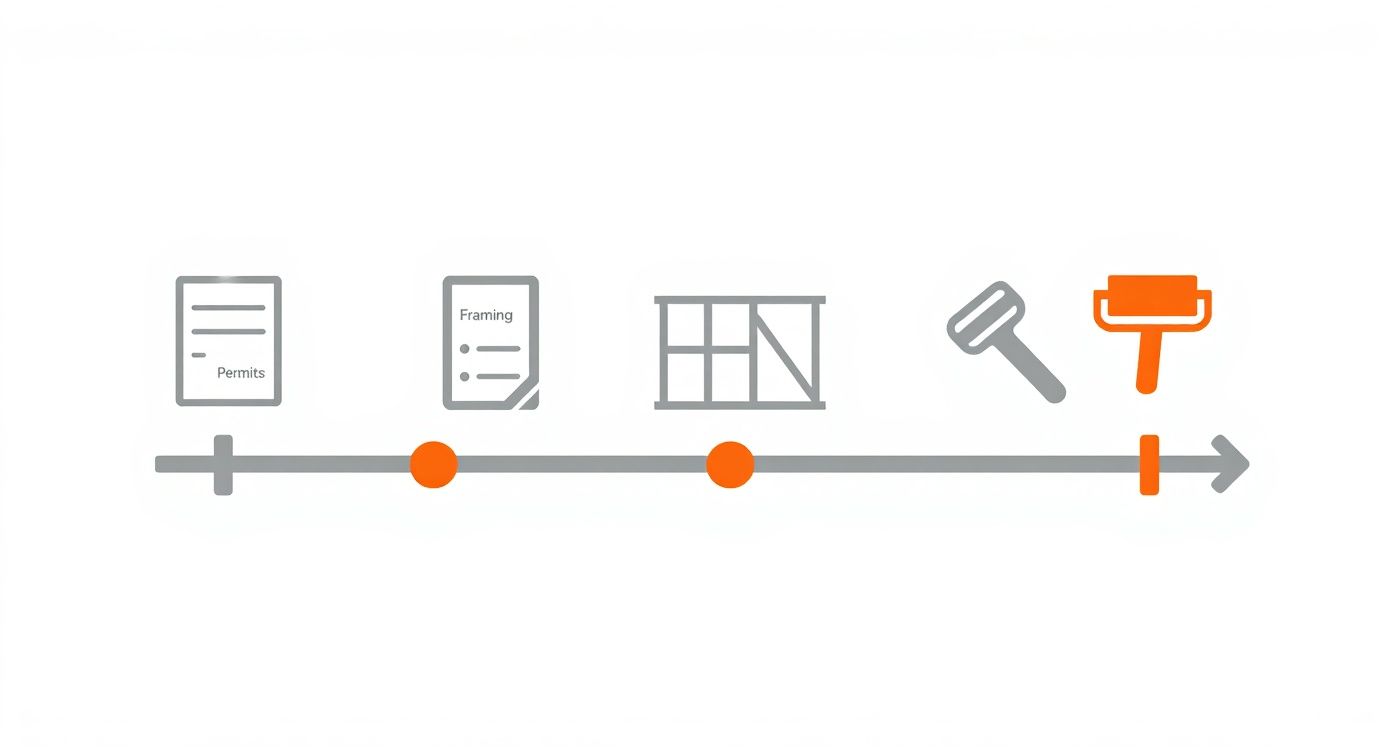
This visual really drives home the point that the “invisible” work—upfront planning and backend finishing—takes up a significant chunk of time, not just the noisy construction phase.
Anticipating the Inevitable Bottlenecks
If there’s one mistake I see homeowners make over and over, it’s underestimating lead times. This is the waiting game—the time it takes for your chosen materials to be made and delivered. A long lead time can bring a perfectly managed project to a screeching halt.
A project timeline lives or dies by its longest lead time. If your custom windows take 16 weeks to arrive and your contractor can’t close the walls without them, then your entire project is on a 16-week pause.
Get ahead of this by working with your designer and builder to identify and order these long-lead items the moment your design plans are set in stone.
Here are the usual suspects for project delays:
- Custom Cabinetry: It’s not uncommon for these to take 8-12 weeks (or more) from final field measurements to delivery day.
- Windows and Doors: Specialty finishes or custom sizes can easily stretch into a 12-20 week wait.
- High-End Appliances: That top-of-the-line oven or integrated refrigerator? Popular models can have surprisingly long backorders.
- Imported Tile or Stone: Sourcing unique materials from overseas means building in extra time for shipping and customs.
Navigating Permits and Inspections
Don’t think of building permits as just bureaucratic red tape. They are a critical safety net, ensuring your project is structurally sound and up to code. While your architect and contractor will navigate the submission process, you need to factor its impact into your timeline.
Getting a permit approved can take a few weeks for a simple interior job or drag on for several months for a complex addition. Nothing can happen on-site until that permit is officially issued.
Then come the inspections. Your project will hit planned pauses at key milestones where a city inspector needs to sign off on the work—think framing, electrical, and plumbing—before anything can be covered up by drywall. If you fail an inspection, it means rework and another waiting period for the re-inspection. A seasoned contractor knows this and bakes buffer days into the schedule to absorb these potential hiccups without derailing the entire project.
Selecting Materials and Finishes with Confidence
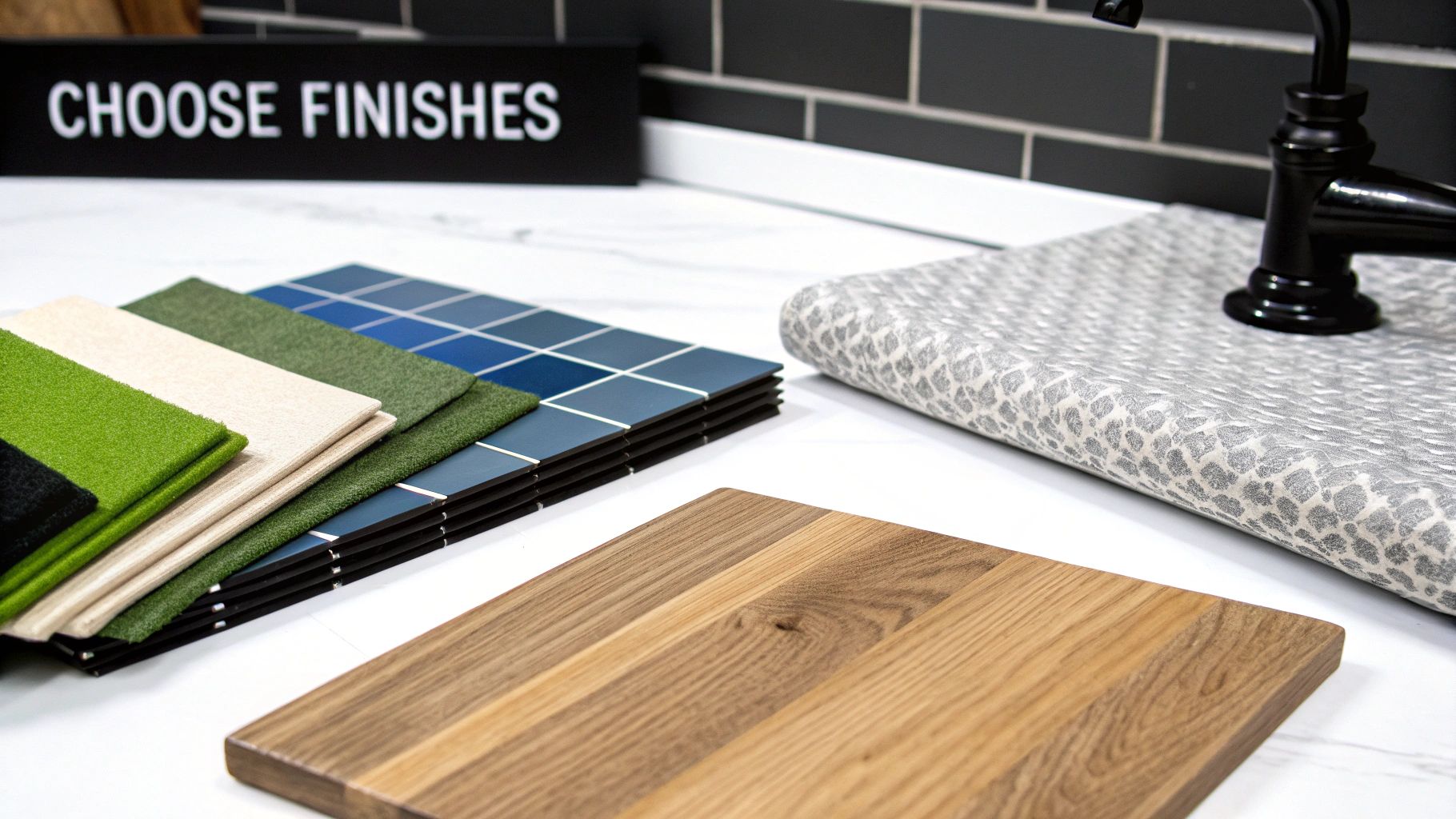
This is where your vision really starts to take shape—the point where you move from abstract plans to the tangible elements that will define your home. Choosing the stone for your countertops, the grain of the hardwood, or the finish on your cabinet pulls is what brings a project’s personality to life.
It’s an exciting phase, but it’s also where many people get overwhelmed by the sheer volume of choices. The key is to approach it methodically. Rather than picking things one by one, think of your materials as a complete palette that needs to feel cohesive and intentional. This is where leaning on your interior designer’s expertise becomes so critical; they’re masters at translating inspiration into a curated collection of finishes that tick all the boxes for beauty, durability, and budget.
Keeping It All Straight with a Selections Sheet
To keep this creative process from turning into chaos, your design team will build out a selections sheet. Think of this as the master bible for every single finish and fixture going into your home. It’s a meticulously detailed document that tracks everything from the exact faucet model for the powder room sink to the specific grout color for the laundry room tile.
Typically, this document will detail:
- Item: A clear description (e.g., Kitchen Island Pendants, Master Bath Floor Tile).
- Manufacturer & Model Number: The precise information needed to order correctly.
- Finish/Color: The exact specification (e.g., “Aged Brass,” “Carrara Honed”).
- Supplier: Where each item is being sourced from.
- Lead Time: How long it takes from order to delivery—a crucial piece of the scheduling puzzle.
- Approval Status: A space for your sign-off, which officially locks in the decision.
This document is your best defense against mistakes. It ensures everyone—from your contractor to the plumber to the painter—is working from the same script.
Where to Splurge and Where to Be Sensible
Let’s be realistic: not every single item in your remodel needs to be the most expensive option available. The secret to a high-impact, beautifully designed space is strategic investment. You want to put your money where you’ll feel it the most.
Invest in what you touch. Focus a larger portion of your budget on things you interact with every day: high-quality kitchen countertops, solid-core doors with substantial hardware, and beautiful, durable flooring. These are the elements that create a lasting impression of quality.
On the other hand, you can often find smart savings on things like decorative lighting for secondary spaces, certain tile backsplashes, or even paint. With so many great options on the market, a good designer knows how to find alternatives that look fantastic without breaking the bank. For a deeper dive, our guide on how to choose paint colors is a great resource for making impactful choices.
The Real-World Impact of Samples and Lead Times
Never, ever make a final decision based on a picture on a screen. A monitor can’t capture the true color, texture, or feel of a material. Always get physical samples of everything—wood, fabric, tile, and stone.
Bring them into your home. Look at them in the morning light and again in the evening. See how they look next to each other. This simple step can save you from a very expensive and disappointing surprise down the road.
Just as important is understanding the logistics behind getting those materials to your doorstep. The global home improvement market is massive and complex. Custom cabinetry can easily take 12 weeks to arrive, specialty stone from overseas might take even longer, and popular appliances are often back-ordered for months.
Your selections sheet and your project manager are essential for tracking these lead times. They allow your contractor to build the schedule around material availability, ensuring that products arrive right when they’re needed and preventing the kind of delays that can derail a project and drive up costs.
Answering Your Top Remodeling Questions
Even with the best-laid plans, every remodel throws a few curveballs. Knowing what to expect and how to react is half the battle. Here are some of the most common questions I hear from clients, along with the straightforward advice I give them.
What Do I Do About Unexpected Costs?
Let’s be clear: unexpected issues aren’t a possibility in a remodel; they’re a guarantee. That’s precisely why your 15-20% contingency fund is non-negotiable. It’s your safety net for the inevitable surprises lurking behind the drywall.
So, what happens when your contractor opens a wall and finds old knob-and-tube wiring or evidence of a past leak? First, don’t panic. The next step is to ask for a formal change order.
This isn’t a casual text message. It’s a professional document that formally amends your contract. It should spell out:
- A clear description of the new problem.
- The proposed solution to fix it.
- An itemized breakdown of new labor and material costs.
- How this change will affect the project timeline.
Review this document carefully, ask questions, and sign off on it before any new work begins. Tackling these issues head-on in your regular meetings prevents them from snowballing into much bigger headaches later.
How Should I Communicate with My Contractor?
Great communication doesn’t just happen; you have to design a system for it before demolition day. The single biggest mistake I see is homeowners trying to manage a project through a chaotic mix of texts, emails, and random phone calls.
Before the first hammer swings, agree on a single, primary channel for all project updates. It could be a project management platform like Buildertrend, a detailed weekly email summary, or a standing on-site meeting every Friday at 8 a.m. Pick one and stick to it. This discipline keeps crucial details from falling through the cracks.
Pro Tip: Designate one person in your household as the single point of contact. This simple move prevents the contractor from getting mixed signals or conflicting requests, which keeps the project moving efficiently.
And one last thing: if you have a verbal conversation about a decision—no matter how small—follow it up with a quick email. “Hi John, just confirming our conversation that we’re going with the brushed nickel hardware.” This creates a simple paper trail that eliminates any “he said, she said” confusion.
When Is the Best Time of Year to Remodel?
There’s no single “best” season; it really hinges on what you’re doing.
For purely interior projects like a kitchen overhaul or a primary suite renovation, the fall and winter months can be a strategic choice. Many top-tier contractors have more availability in their schedules during this “off-season,” which can sometimes mean a quicker start date. You get to endure the disruption when you’re stuck inside anyway and have a stunning new space ready for spring.
On the other hand, if your project involves the exterior—think a home addition, replacing all your windows, or building a new covered patio—you’ll want to aim for late spring through early fall. Good weather is your best friend, minimizing the risk of delays. Just know that this is prime time for construction. You’ll need to book your team and order materials with long lead times well in advance to secure a spot.
No matter when you want to start, back up your calendar. A good rule of thumb is to begin the serious planning and design phase a good 3-6 months before you hope to break ground.
How Can I Prepare My Home (and My Sanity)?
Living through a major renovation is tough, but a bit of prep work makes a world of difference. Your goal is to create a firm boundary between your living space and the work zone.
First, completely empty the rooms being renovated. Don’t just pile furniture in the middle; move everything out. In the adjacent rooms, relocate anything fragile or valuable and then cover what’s left with heavy-duty plastic sheeting, taping it down securely.
If you’re losing your kitchen for a few months, your sanity will thank you for setting up a temporary kitchen elsewhere. A microwave, coffee maker, mini-fridge, and a big stack of paper plates can be an absolute lifesaver.
Finally, have a logistics chat with your contractor before they start. Settle the ground rules: Where will the crew park? Which door will they use? Where will materials be stored? Which bathroom is designated for their use? Setting these expectations on day one shows mutual respect and helps the whole process run that much more smoothly.
Finding the right professionals who have the experience to see these challenges coming is the cornerstone of a successful high-end remodel. At Haute Design, we connect discerning homeowners with the industry’s most respected architects, designers, and builders who specialize in turning complex visions into extraordinary realities.
Explore our network of vetted professionals and start assembling your dream team today at https://hauteliving.com/designnetwork.