


Before you even start looking for an architect, the most critical work happens. It’s all about getting your own thoughts in order and creating a clear project brief. This document is your North Star—it’s the single most important tool you’ll use to attract and evaluate the right kind of talent for a luxury home.
Without a solid brief, your search will be all over the place. You’ll struggle to explain what you want, and architects will struggle to understand if they’re the right fit. It’s the difference between saying “I want a nice, modern house” and presenting a thoughtful plan for a five-bedroom home with specific views, materials, and a clear vision for how your family will live in it.
Translating Your Vision into a Project Brief
Think of this as your homework. An architect is a brilliant interpreter of ideas, but they can only work with what you give them. The clearer you are, the better the outcome. This initial deep-dive transforms a vague dream into a concrete set of requirements that forms the foundation of a successful partnership.
This isn’t about having all the answers right now. It’s about asking the right questions. What feeling do you want to walk into? How do you see your family using these spaces five, or even ten, years from now? Answering these questions first ensures your initial conversations with potential architects are productive and substantive, not just a series of abstract ideas.
Defining Your Aesthetic and Functional Needs
First, let’s get that vision out of your head and onto paper. You need to create a visual language for your project that goes deeper than just “modern” or “traditional.” This is where a good mood board becomes your best friend. Start collecting images—exteriors, interiors, materials, lighting, and even landscapes that capture the essence of what you’re after.
But a beautiful home that doesn’t work for your life is just a sculpture. The project’s function is just as important as its form. Get practical and think through the day-to-day realities.
- How do you want the space to flow? Are you picturing a wide-open great room for entertaining, or do you prefer cozier, more defined spaces for privacy and quiet?
- What are your family’s daily routines? Where will the kids do their homework? Where will you have your morning coffee? How does the mudroom need to function to handle sports gear and pets?
- Is the design future-proof? Consider what’s down the road. Will you need a dedicated home office, an in-law suite, or a gym? A great design anticipates these needs.
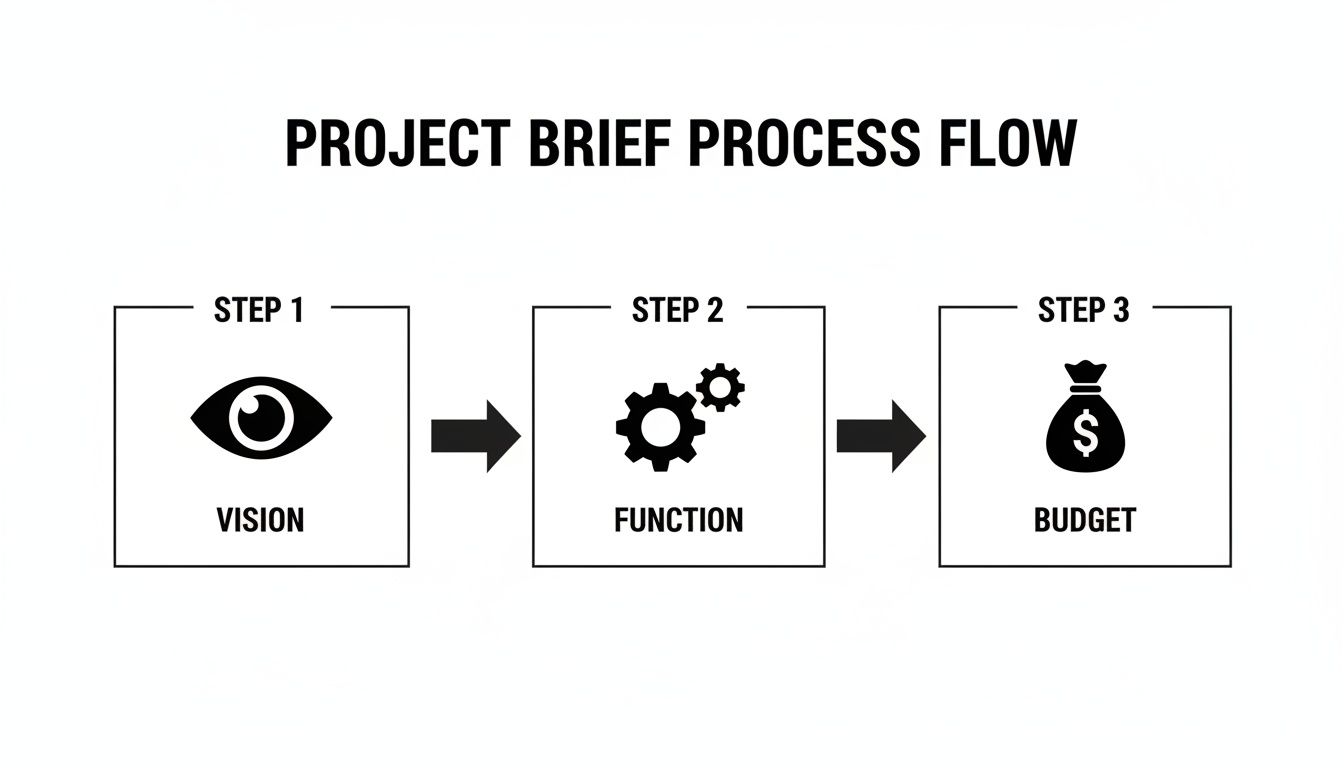
This simple framework helps you balance the emotional, practical, and financial pillars of your project before you ever speak to a professional. It’s about building a complete picture.
To help you get started, here’s a quick checklist to organize your thoughts. Going through these questions will give you the clarity needed to write a brief that truly reflects your goals.
Your Pre-Search Project Definition Checklist
| Checklist Item | Key Questions to Answer | Example |
|---|---|---|
| Project Vision | What is the overarching feeling or “big idea” for the home? What are 3-5 keywords that describe it? | “A serene, light-filled sanctuary that blends indoor and outdoor living. Keywords: Calm, organic, minimalist, warm.” |
| Key Functionality | What are the 3 most important activities the home must support? | “Family cooking and dining, hosting intimate dinner parties for 8-10 people, a quiet home office for two.” |
| Must-Have Spaces | What non-negotiable rooms or features do you need? | “4 bedrooms with en-suite baths, a dedicated mudroom, a wine cellar, and a covered outdoor patio with a fireplace.” |
| Aesthetic Direction | What architectural styles or specific materials are you drawn to? | “Inspired by Japanese and Scandinavian design. Materials like light oak, natural stone, and blackened steel.” |
| Site Considerations | What are the unique aspects of your property? (e.g., views, slope, sun exposure) | “The design must maximize the western views of the valley and create a private courtyard shielded from the northern wind.” |
| Initial Budget | What is your all-in budget range, including a contingency? | “$3M – $3.5M total project cost, which includes a 15% contingency fund.” |
Completing this exercise puts you in a powerful position. You’re no longer just a client with an idea; you’re a prepared partner ready for a serious conversation.
Establishing a Realistic Financial Framework
With a clear vision in hand, it’s time to talk numbers. Your budget is more than just one figure; it’s a comprehensive financial plan that shows architects you are serious and organized.
A well-prepared budget should always account for these key areas:
- Design & Engineering Fees: These are the professional fees, often calculated as a percentage of the total construction cost.
- Construction Costs: The “hard costs” for all labor and materials to build the structure.
- Finishes, Fixtures & Furnishings: Everything from appliances and lighting to flooring and furniture. Don’t underestimate this category.
- Contingency Fund: This is non-negotiable. Set aside 10-20% of your total budget for the unexpected. It will be used, I promise.
The architectural industry is vast—projected to hit $66.7 billion in the U.S. by 2026, with over 68,479 registered firms. Navigating this landscape to find a true specialist can be overwhelming. This is precisely why curated platforms like Haute Design are so valuable. They connect discerning homeowners with vetted, top-tier professionals, saving you the guesswork and ensuring you’re only speaking with the best in the business.
Now that you have a solid project brief, the real search begins. When you’re looking for an architect to design a luxury home, a simple Google search just won’t cut it. The aim isn’t just to find any architect; it’s to find a professional whose portfolio speaks to you and who has a proven history of managing projects with the same scope and complexity as yours. This calls for a much more focused strategy.
Think of it less like casting a wide net and more like fishing in the right ponds. You need to know where the top-tier professionals are, the places they’re recognized for their best work. This approach not only saves a ton of time but also ensures that every candidate you consider is already playing in the same league your project requires.
Start with Curated Platforms and Networks
In the high-end market, reputation and exclusivity are everything. That’s why specialized platforms that carefully vet their members are such a fantastic starting point. They’ve already done the first round of screening for you, connecting clients who demand the best with professionals who consistently deliver it.
A prime example is the Haute Design network, an exclusive, invitation-only directory that pairs discerning homeowners with the country’s leading architects, interior designers, and builders. Being featured in a network like this is a powerful stamp of approval. It tells you the architect has already been assessed on their portfolio, experience, and standing in the luxury market.
Using a curated service gives you a few key advantages right out of the gate:
- Built-in Quality Control: Professionals are typically invited or have to meet stringent criteria, which guarantees a high standard of work and professionalism.
- Finding Your Style: These platforms often let you filter architects by aesthetic—modern, classical, coastal—making it much easier to find someone who gets your vision.
- A More Efficient Search: Instead of wading through endless search results, you start with a pre-qualified list of elite talent.
Ask for Referrals from Your Professional Circle
Beyond online platforms, one of the oldest and most reliable methods is a trusted referral. The world of high-end home construction is smaller than you think. The architects who consistently produce incredible results are well-known, especially among their peers.
Talk to other experts you’ve already brought on board or whose work you admire. A seasoned luxury interior designer or a top-tier custom home builder will have worked directly with a variety of architects. They can give you the real story on an architect’s communication skills, how they handle unexpected challenges, and what they’re like to collaborate with on-site—details a beautiful portfolio will never tell you.
A referral from a trusted professional is more than just a name; it’s an endorsement of an architect’s ability to be a true partner and bring a shared vision to life. These recommendations often forge the most successful partnerships.
Follow Industry Awards and Publications
Another great tactic is to see who the industry itself is celebrating. Prestigious architectural awards are a clear signal of an architect’s creative vision and respect from their peers.
Organizations like the American Institute of Architects (AIA) give out awards every year on national, state, and local levels. Take a look at the winners in the residential categories to discover firms doing groundbreaking work. In the same vein, top design magazines and journals are always featuring award-winning homes and profiling the architects behind them.
- Look for a Pattern of Excellence: Pay close attention to firms that win awards year after year. That consistency shows a sustained commitment to quality.
- Focus on the Right Categories: Zero in on awards specifically for “Custom Residential” or “Luxury Homes” to find architects whose expertise is a perfect match for your project.
This kind of research does more than just give you a list of names. It immerses you in the current trends and shows you who is really pushing the envelope in residential design. When you see a project that truly captivates you, find out who the architect was and add them to your shortlist.
Evaluating Portfolios and Vetting Your Candidates
You’ve narrowed down the field and have a shortlist of architects who caught your eye. Now, the real work begins. This is where you transition from admiring beautiful photos to performing some serious due diligence. A stunning portfolio gets a firm on the list, but it’s the deep dive into their projects, credentials, and client experiences that will tell you if they’re the right partner for your dream home.
Think of yourself as an investigator. You’re searching for consistency, a fanatical attention to detail, and a design philosophy that truly resonates with your own. It’s a methodical process, but it’s the one that ensures the people you ultimately sit down with are not just talented artists but proven, reliable professionals.

Reading Between the Lines of a Portfolio
A portfolio is so much more than a gallery of finished projects—it’s a window into an architect’s mind. Don’t just flip through the images. Look for the story they’re telling about how they solve complex problems.
Keep an eye out for these specific traits:
- A Clear Design Voice: Is there a coherent vision that ties their work together, or does it feel like a random collection of styles? A strong portfolio shows a signature approach that’s flexible enough to adapt to different sites and client needs.
- Obsessive Detail: This is where you zoom in. How do different materials meet at a corner? Look at the joinery, the alignment of light fixtures, the hardware choices. These tiny details are a massive tell; they reveal an architect who is deeply invested in the quality of the final build.
- Smart Problem-Solving: Can you see how the home responds to its surroundings? Maybe it’s built on a challenging sloped lot or designed to capture a very specific view. The best architects don’t just drop a preconceived idea onto a piece of land; they craft a thoughtful solution that feels like it truly belongs there.
A great portfolio doesn’t just show you what an architect built; it shows you how they think. Look for the narrative in their work—the story of how they translated a client’s vision into a thoughtful, functional, and beautifully executed home.
This kind of analysis helps you get past the initial “wow” and start to appreciate the intellect behind the beauty. To get a feel for what this looks like, you can browse through some top-tier architecture portfolio website examples and see how the pros tell their project stories.
Verifying Credentials and Professional Standing
Once a portfolio has passed the test, it’s time to verify professional qualifications. This isn’t just a box-ticking exercise; it’s a crucial step that confirms an architect’s legitimacy and dedication to their profession.
The absolute must-have is state licensure. An architect must be licensed to practice in the state where your project is located. This is non-negotiable, as it proves they’ve met demanding educational, experience, and examination requirements.
Another strong signal is an AIA affiliation. Membership in the American Institute of Architects (AIA) shows a commitment to a high standard of professional ethics and ongoing education. It’s not mandatory, but it’s a good sign that they take their craft seriously.
With the global architectural services market projected to grow at a 5.35% CAGR through 2033, the architects who stay on top are the ones committed to professional development—mastering everything from sustainable design to advanced building tech.
Don’t Skip the Reference Checks
This might be the most critical step of all. It’s time to talk to past clients. A portfolio shows you the final, polished result, but a reference check tells you about the journey to get there. This is your chance to get an unvarnished, honest account of what it’s really like to work with this person.
When you call, come prepared. Don’t just ask, “Were you happy with the house?” Go deeper with specific, open-ended questions.
Try asking things like:
- Communication Style: How responsive was the architect? Did you feel like your ideas and concerns were genuinely heard throughout the process?
- Budget & Timeline: How well did they manage the project’s budget and schedule? If things went off track, how did they handle it?
- Problem-Solving Skills: Construction always has surprises. When an unexpected issue came up, what was their approach? Were they proactive and solution-oriented?
- The Big Question: Knowing what you know now, would you hire them again?
The answers you get will give you invaluable insight into an architect’s management style, their reliability, and how they perform under pressure. This is the diligence that separates a good choice from a great one.
Mastering The Architect Interview
You’ve sifted through stunning portfolios and followed up on glowing references. Now comes the most critical part of the process: the face-to-face interview. This isn’t just a Q&A; it’s a chemistry check. You’re about to embark on a long, intimate, and expensive journey together. You need to know if the brilliant designer on paper is someone you can collaborate with in reality.
The goal here isn’t to re-test their design chops—their body of work should have already convinced you of that. Instead, you’re looking for a partner. How do they think on their feet? How do they really listen? And, crucially, how do they handle the tough conversations that will inevitably pop up?
Setting The Stage For A Real Conversation
Walking into this meeting unprepared is a huge mistake. To get the most out of your time, think of it less as an interview and more as the first real design conversation about your future home. It’s a two-way street.
Bring your project brief, your collection of inspiration images, and a list of questions that dig deeper than “what’s your process?” A top-tier architect will show up just as prepared, having already looked into your property (if you have one) and come with thoughtful questions for you. Their preparation level speaks volumes about their professionalism.
The best meetings feel like a creative brainstorm. Pay close attention to the vibe in the room. Are they genuinely curious about how your family lives? Do they build on your ideas, or do they seem quick to dismiss them?
Questions That Tell You More Than A Portfolio
Your questions need to be sharp enough to uncover their philosophy, problem-solving skills, and approach to the client relationship. By grouping your questions, you can make sure you cover all the important ground, from creative vision to the nuts and bolts of project management.
Here are the essential questions you should be asking, plus a guide to reading between the lines of their answers.
Essential Questions For Your Architect Interview
This isn’t an interrogation; it’s a guided conversation to see if you can build a great partnership. Use these questions as a framework to understand their approach from every angle.
| Category | Question to Ask | What to Listen For |
|---|---|---|
| Design Philosophy | “Can you walk me through a past project that feels similar to what we want to do? I’d love to hear the story from the first sketch to the final home.” | Are they passionate storytellers? A great answer focuses on solving the client’s problems and enhancing their life, not just on aesthetics. You want to hear about collaboration, not just their singular vision. |
| Communication & Collaboration | “What does the day-to-day collaboration look like? Who is our main point of contact, and what’s the rhythm for updates and meetings?” | Look for specifics. A vague “we’ll keep in touch” is a red flag. You want a clear communication plan, outlining who you’ll talk to and how often you’ll have site visits or formal check-ins. |
| Project Management | “Things always go wrong on big projects. Can you share an example of a major challenge you faced and exactly how you navigated it?” | This reveals their grace under pressure. You’re looking for a calm, solution-oriented professional who takes ownership, rather than someone who points fingers at contractors or suppliers. |
| Budget & Fees | “How do you manage a client’s budget? What systems do you have in place to keep the project on track financially?” | A true professional is comfortable talking about money. They should be able to clearly explain their fee structure and describe their process for tracking costs and flagging potential overages before they happen. |
| Team & Consultants | “Who are the engineers, landscape architects, or other specialists you bring onto your projects? How do you build the right team?” | This speaks to their network and experience. An established architect will have a roster of trusted consultants they can call on, ensuring every part of your project is handled by a proven expert. |
After the questions, what you’re really left with is your gut feeling. The right fit will feel like a comfortable, exciting conversation, not a tense evaluation.
Reading The Room: Red Flags And Green Lights
Beyond the specific answers, pay attention to the subtext. The dynamic of the meeting is just as telling as any single piece of information. You’re looking for the early signs of a healthy, respectful partnership.
Green Lights to Look For:
- They ask more about you, your family, and your lifestyle than they talk about themselves.
- They listen intently and let you finish your thoughts without jumping in.
- They start brainstorming with you, offering ideas that build on your vision, not replace it.
- They are completely transparent about their fees, process, and potential project hurdles.
A huge green flag is when an architect respectfully pushes back on one of your ideas. It shows they are thinking critically and are more committed to the project’s ultimate success than to simply agreeing with everything you say.
On the flip side, be cautious of architects who seem dismissive of your budget, are too focused on their “signature style,” or seem uninterested in the daily practicalities of your life. Trust your intuition. If the chemistry feels off, it probably is. This meeting is your single best opportunity to ensure the person you hire to create your dream home is someone you’ll actually enjoy the journey with.
Making Your Final Choice and Inking the Deal
The interviews are done, and you’re faced with a tough—but wonderful—decision. You’ve likely met a few brilliant architects, each with a compelling vision for your home. Now, it’s time to shift from assessing personalities and portfolios to a meticulous comparison of their formal proposals.
This final deep dive isn’t about chasing the lowest bid. It’s about weighing the total value, confirming creative alignment, and scrutinizing the scope of work each architect has laid out. A thoughtful, comprehensive proposal is one of the strongest indicators of the professionalism you can expect for the rest of the project.
Comparing the Final Proposals
Spread the proposals from your top two or three candidates out and look at them side-by-side. What you’re searching for is clarity, detail, and a direct answer to the project brief you shared. A generic, copy-paste proposal is a major red flag at this stage.
A professional proposal should clearly break down the project into distinct phases. Look for something like this:
- Schematic Design: The big-picture, initial concept sketches.
- Design Development: Honing the design, picking out materials, and defining the home’s systems.
- Construction Documents: The highly detailed drawings and specs used for bidding and building.
- Bidding or Negotiation: Their role in helping you choose a great contractor.
- Construction Administration: On-site observation to make sure the build aligns with the design intent.
Zero in on how they explain their fees. Whether it’s a percentage of construction cost, a fixed fee, or an hourly rate, it needs to be spelled out with zero ambiguity. If one proposal comes in significantly lower than the others, find out why. It often means a reduced scope of services that could end up costing you far more down the road.
The winning proposal should feel like a natural extension of your interview. It will show they didn’t just hear your ideas—they truly understood them—and have a clear, logical plan for bringing your vision to life.
Understanding the Architect’s Contract
Once you’ve made your decision and given a verbal “yes,” the formal contract is next. This document is the ultimate safeguard for your project, so don’t treat it like a formality. Read every single line before you sign.
Most architects in the U.S. use standard agreements from the American Institute of Architects (AIA), which are widely respected for being fair and balanced. Even so, for a high-value luxury project, it’s always smart to have your attorney review the document.
The contract is your rulebook. It manages expectations and sets the ground rules for how you’ll work together. A thorough review ensures everyone is on the same page from day one—a critical step when you need to find an architect who can deliver. For more on the legal side, check out our guide on architecture licensing requirements by state.
Your Pre-Signing Contract Checklist
Before you sign anything, do one last sweep. Make sure the contract explicitly defines these key points. It’s the best way to protect your investment and start the relationship with total transparency.
- Scope of Services: Does it list exactly what the architect will do, from first sketch to final walkthrough? Equally important, does it clarify what is not included?
- Fee and Payment Schedule: Is the total fee and payment timeline crystal clear? It should detail when payments are due (typically after each phase) and outline the process for handling any extra services.
- Project Timeline: While set-in-stone dates are impossible, the contract should have an estimated timeline for the major design phases.
- Ownership of Drawings: The architect almost always retains the copyright to the plans, but you get a license to use them for your project. Make sure this is clearly stated.
- Termination Clause: What happens if things just aren’t working out? A solid contract will outline the process and financial implications if either you or the architect needs to end the agreement.
Taking the time to nail down these details will give you the confidence to move forward, knowing you’ve built a solid foundation for a successful partnership.
Your Top Questions About Hiring an Architect, Answered
Starting the journey of building a custom luxury home naturally brings a lot of questions to the surface. It’s a significant investment of time, money, and emotion. Getting clear, honest answers from the outset is the best way to move forward with confidence and avoid costly missteps.
Let’s dive into some of the most common questions and concerns that come up when you’re looking for the right design partner.
What Is a Typical Fee for a Luxury Home Architect?
For high-end residential projects, the most common fee structure is a percentage of the total construction cost. You can generally expect this to fall somewhere between 8% and 15%. This figure can creep higher for world-renowned firms or projects with an extraordinary level of complexity and detail.
The exact percentage really depends on the project’s scope, the intricacy of the design, and just how involved the architect will be from start to finish.
Of course, that’s not the only way architects charge. Some prefer a fixed fee, which is agreed upon upfront for a very clearly defined scope of work. For smaller consultations or early-stage design exploration, an hourly rate is also an option. The key is to have this conversation early and get everything spelled out in the contract.
The fee structure itself isn’t what matters most—it’s the clarity. A great architect will be an open book about how they charge and what you get for your money, ensuring there are no financial surprises down the line.
How Long Does It Take to Find the Right Architect?
Don’t rush this. Seriously. Finding the right architect is the foundation of your entire project, and it’s a decision that deserves your full attention. Realistically, you should set aside at least two to three months for the entire search and selection process.
Giving yourself this runway allows you to move through each stage thoughtfully, without feeling pressured into a decision. A typical timeline might look something like this:
- Initial Research & Shortlisting (2–4 weeks): This is your discovery phase—digging into portfolios, asking for recommendations, and building a list of 3-5 firms that resonate with you.
- Interviews & Follow-Ups (2–3 weeks): Time for deep-dive conversations. You’ll be gauging expertise, of course, but also that all-important personal chemistry.
- Reference Checks (1–2 weeks): A non-negotiable step. Speaking with past clients gives you an unvarnished look at what it’s like to work with the firm.
- Proposal Review & Final Selection (2–4 weeks): Once proposals are in, you’ll need time to compare them carefully before making your final call and signing on the dotted line.
Investing this time upfront is the single best way to ensure you end up with a partner who truly gets your vision and has the chops to execute it perfectly.
What Are the Biggest Red Flags to Watch Out For?
While you’re looking for all the right signs, it’s just as critical to recognize the red flags. Certain behaviors can signal that an architect might not be the right fit for a smooth, collaborative, and successful project.
Poor communication is a big one. If you’re already seeing slow response times or getting vague answers to direct questions, that’s a major warning sign. Be equally cautious if a firm is evasive about its fee structure or hesitates to provide past client references. A professional who is proud of their work will be an open book.
Another deal-breaker? An architect who seems dismissive of your ideas or is completely inflexible. A great home is born from collaboration, not dictatorship. If they pressure you to make a quick decision or if your gut just tells you the chemistry is off, listen to it. The entire project rests on a foundation of mutual respect and open dialogue.
Should I Hire an Architect Before Buying Land?
Yes, a thousand times yes. Bringing an architect on board before you purchase land is one of the smartest things you can do. This early collaboration can save you from a world of headaches and unlock the true potential of your property.
An architect can perform a site analysis or feasibility study to evaluate a piece of land’s pros and cons. They’ll look at everything: zoning laws, building restrictions, topographical challenges, sun orientation, and how to maximize views. Their expert eye ensures the land you buy is actually suitable for the home you dream of building. Think of it as having your most important advisor in your corner for one of the project’s most critical decisions.
Finding the perfect architect is the first, most crucial step toward creating an extraordinary home. On platforms like Haute Design, the search is simplified by connecting you with a curated network of the nation’s most distinguished and vetted professionals. You can discover architects on the Haute Design network who share your vision and have the proven expertise to bring it to life.