


Before you even think about interviewing architects, the most critical work happens at your own desk. Finding the right professional starts not with their portfolio, but with your own clear vision and a well-defined budget. This isn’t just about listing rooms; it’s about deeply considering how you want to live in the space. A powerful vision becomes your project’s North Star, guiding every decision and naturally attracting the kind of talent that can bring it to life.
Defining Your Vision Before the Search Begins

You need to create your own blueprint before you can hire someone to draw the official ones. This initial phase is all about self-discovery and practical planning, not evaluating candidates. Skipping this step is like asking a captain to chart a course without a destination—you might end up somewhere, but it almost certainly won’t be where you intended to go.
The goal is to translate your desires into a concrete brief an architect can actually work with. It’s about articulating not just what you want, but why you want it. This clarity will be your most valuable tool when you start meeting with firms.
From Lifestyle to Layout
Great homes are designed around daily life, not just a list of features. Instead of starting with “four bedrooms, three baths,” think about the story of your life unfolding within the walls. This simple shift in perspective is what separates a generic house from a truly personal home.
To get started, consider these prompts to build out your lifestyle brief:
- Morning Rituals: Where do you have that first cup of coffee? Do you envision a quiet, sunlit nook for meditation or a bustling kitchen island where the family connects before the day begins?
- Work and Hobbies: Will you need a soundproofed home office for focused work, a gallery-like space for your art collection, or a professional-grade home gym?
- Entertaining Style: Are you known for intimate dinner parties or large, casual gatherings that spill out into the garden? This dictates the flow between your kitchen, dining areas, and outdoor spaces.
- Family Dynamics: Where will the kids do their homework? Is a separate wing needed for guests or aging parents to give everyone comfort and privacy?
This detailed narrative gives an architect the “why” behind your requests, empowering them to suggest creative solutions you might never have imagined. It’s the foundation for what the industry calls a design concept—a unified vision that informs every single choice. To see how this comes together, you can learn more about what a design concept entails and how it shapes architectural outcomes.
A great architect doesn’t just design rooms; they design experiences. The more you can articulate the experience you want to have in your home, the better they can translate that vision into a physical structure.
Establishing a Realistic and Comprehensive Budget
Your budget is the other essential pillar of your project’s foundation. An unrealistic or incomplete budget is the number one source of friction and disappointment in a luxury build. A truly comprehensive financial plan must account for far more than just the raw construction costs.
A serious budget breaks down into four key categories:
- Hard Costs: This is the physical construction—labor, materials, foundation, framing, and roofing. It’s the biggest piece of the pie.
- Soft Costs: Think of these as the professional service fees. This includes your architect (typically 8% to 15% of construction cost), but also structural engineers, landscape architects, surveyors, and interior designers.
- FF&E (Fixtures, Furniture & Equipment): This bucket covers everything that goes in the house—from Sub-Zero appliances and Waterworks fixtures to custom cabinetry, lighting, and furniture.
- Contingency Fund: This is non-negotiable. You must set aside 10% to 20% of your total construction cost. This fund is for the unknowns: supply chain issues, unforeseen site conditions, or simply that incredible slab of marble you decide you can’t live without.
Walking into a meeting with this level of financial detail shows you’re a serious, prepared client. It allows potential architects to immediately confirm if their firm is a good fit for your project’s scale and keeps the conversation grounded in reality from day one.
How to Evaluate an Architect’s Portfolio

An architect’s portfolio is more than just a gallery of pretty pictures. It’s their resume, their design philosophy, and their problem-solving track record all rolled into one. Learning to look past the stunning “hero” shots and really read a portfolio is how you find the right visionary for your home.
Your first impression is usually a gut feeling—a visceral reaction to their style. But a true evaluation goes deeper. You’re looking for the story of how they take a client’s abstract vision and shape it into a breathtaking, tangible reality.
Looking Beyond the Surface Level
A couple of spectacular projects are impressive, but consistency is what reveals true mastery. A strong portfolio showcases a high standard of quality across a variety of projects, demonstrating that they have a mature, repeatable process—not just a one-hit wonder.
Think about the unique challenges your own project presents. If you have a difficult, steeply sloped lot, look for examples of how they’ve masterfully integrated homes into challenging terrain. If you’re building in a historic district, seek out work that feels modern yet contextually sensitive. This is how you confirm they have the specific, real-world experience your project demands.
Spotting True Specialization and Expertise
This is where a firm’s true passions come to light. They might say they do it all, but their body of work tells the real story. Look for recurring themes or project types that align perfectly with what you want to achieve.
For instance, a portfolio filled with sustainable design isn’t just a nod to a trend; it signals a deep-seated commitment to building resilient, high-performance homes. This kind of specialization is a major differentiator. When you’re choosing an architect, prioritizing those with proven expertise in areas like sustainable design can be a significant advantage, as they are often more sought after for high-profile projects. In fact, firms with portfolios of certified net-zero homes often report higher client retention rates, which speaks volumes about the long-term value they deliver.
A portfolio isn’t just a record of what an architect has built; it’s a preview of what they can build. Look for evidence that they have already solved the kinds of problems your unique project will present.
Ultimately, this is where you decide if they have both the creative vision and the technical chops to bring a luxury home to life. The goal is to find a portfolio that gives you complete confidence in your future home.
Analyzing the Details That Matter
As you dig in, get granular. Zoom in on the high-resolution photos and look at the details. Are the material transitions seamless? Are the joints and alignments perfectly clean? These seemingly small elements reveal an immense amount about their standards and the caliber of builders they collaborate with.
To keep your evaluation focused, it helps to use a consistent framework. As you compare different firms, I recommend using a checklist to ensure you’re making a true apples-to-apples comparison.
Here’s a quick-reference table to guide your review.
Key Architect Evaluation Criteria
| Criteria | What to Look For | Why It Matters |
|---|---|---|
| Aesthetic Alignment | A consistent design language that truly resonates with your personal style. | This ensures the final home reflects your taste, not just the architect’s signature look. |
| Problem-Solving | Examples of creative solutions for challenging sites, zoning, or client requests. | It demonstrates their ability to navigate the inevitable complexities of a high-end build. |
| Materiality & Craft | Thoughtful use of materials and an exceptionally high level of detail in construction. | This indicates a deep commitment to quality, durability, and a sophisticated finish. |
| Scope of Services | Evidence of their involvement from the initial sketch all the way through construction. | This confirms they can manage the entire project, ensuring the design integrity is upheld. |
A great portfolio should leave you feeling both inspired and reassured. It needs to showcase not just beautiful outcomes but also the intelligent, thoughtful process that got them there.
To get a sense of what a world-class portfolio looks like online, take a look at these outstanding architecture portfolio website examples. Seeing how the best in the business present their work will give you a valuable benchmark as you begin your search.
The Architect Interview Questions That Reveal Everything
The portfolio showed you their work, but the interview reveals how they work. This is where you shift from evaluating a professional to choosing a partner. The goal here isn’t just to re-verify their skills; it’s to see if there’s real chemistry and a shared vision for what success will look like.
A great interview should feel less like a formal interrogation and more like your very first design meeting. It’s a conversation. You’re gauging their ability to listen, their creative instincts, and how they’ll handle the inevitable pressures of a high-stakes residential build. The questions you ask should be designed to open up a dialogue, not just get a simple yes or no.
Questions About Their Design Process and Philosophy
First, you need to get inside their head and understand how they think. Their design process is the roadmap they’ll follow to bring your ideas to life. Vague answers here are a major red flag; any experienced architect should be able to walk you through their methodology with absolute clarity.
These questions will tell you a lot about their creative and collaborative style:
- “Walk me through your entire process, from a conversation like this one all the way to handing over the keys. What are the key milestones for me as the client?”
- “How do you like to involve clients in the creative process? And how do you handle feedback or ideas that might push against your initial design concept?”
- “Tell me about a time a project took a completely unexpected turn during the design phase. How did you pivot, and what was the result?”
You’re listening for an approach that is both structured and flexible. You want an architect with a proven system, but one who is also ready to adapt to your specific needs and communication preferences. A rigid, “my way or the highway” attitude is a recipe for friction down the line.
Probing Their Approach to Budgets and Timelines
Even with the most generous budgets, fiscal discipline is non-negotiable. A true professional respects your investment and treats the budget not as a limitation, but as a critical design parameter. Their comfort level and honesty when discussing money is a huge tell.
This is where you separate the pure artists from the business-minded professionals who can deliver:
- “How do you develop and track project costs? What systems do you use to make sure the project stays on budget?”
- “Let’s play out a scenario: the construction bids come back 15% over our agreed-upon budget. What are your immediate next steps?”
- “What’s your philosophy on ‘value engineering’? Can you give me an example of how you’ve creatively reduced costs on a past project without gutting the design intent?”
Their answers should ooze proactive financial management. They should be talking about detailed cost estimates, regular budget reviews, and transparent reporting. If they seem cagey about money or dismissive of your budget concerns, that’s a clear signal they may not be the responsible steward your project demands.
An architect who listens more than they talk in the first meeting is a rare find. Pay close attention to who is leading the conversation. The best architects are exceptional listeners, absorbing your vision before they ever start sketching.
Understanding How They Handle Challenges and Collaboration
No luxury construction project sails through without hitting some rough water. Supply chain snarls, unforeseen site conditions, and contractor friction are all part of the territory. You aren’t hiring an architect to prevent every problem—you’re hiring them to solve them with grace and expertise.
Their answers to these questions will reveal their temperament and problem-solving skills under pressure:
- “Tell me about the most difficult client or builder relationship you’ve had to manage. What was the real issue, and how did you navigate it?”
- “How do you prefer to communicate with everyone—the client, the builder, the engineers—once construction starts? What’s your typical rhythm for meetings and site visits?”
- “Who are some of your preferred builders and engineers in the area? What makes them your go-to partners?”
What you’re listening for here is a sense of ownership, not blame. A great architect will talk about challenges with a focus on solutions and teamwork. They should speak of builders and engineers as respected collaborators. If they’re reluctant to share references or have a history of pointing fingers, consider it a serious warning. The personal chemistry you feel in this interview is often the most reliable predictor of your long-term success together.
Understanding Firm Size and Reputation
When you start your search for an architect, you’ll immediately see firms of every conceivable size—from a solo practitioner in a small studio to a global powerhouse with offices on multiple continents. Don’t underestimate this difference. The size of the firm you choose will shape your entire experience, influencing everything from day-to-day communication to the specialized resources they can bring to your project.
There’s no “right” answer here. The best choice depends entirely on your project’s scale, its complexity, and frankly, your own personality and how you prefer to work.
A large, internationally known firm comes with a built-in sense of security. These organizations have deep benches of talent, meaning they can pull in experts on sustainable building tech, historic preservation, or landscape integration as needed. Their well-oiled processes and vast portfolios offer a predictable, reliable path, which is exactly what you want for a massive, technically demanding build.
On the other hand, a smaller boutique practice offers something else entirely. You’re far more likely to have the principal architect—the very person whose vision drew you in—as your direct contact. That kind of hands-on approach fosters a deeply personal and collaborative journey, a quality many of my clients find is the most important part of the process.
Boutique Firm or Global Powerhouse?
The choice really boils down to a trade-off: personalized, principal-led service versus the sheer horsepower of a large, diversified team. A boutique firm lives and breathes on the strength of its client relationships and a bespoke design process. The principal isn’t just a figurehead; they are in the trenches with you, ensuring the vision never gets diluted.
The flip side is that a smaller firm naturally has a more limited capacity. While their network of builders and consultants is often top-notch, it might be more local. This isn’t a drawback; it’s just a different way of operating that is perfect for projects where a singular, cohesive vision and direct access to the lead creative are paramount.
Larger firms operate on a completely different level. Their reputation is often built on flawlessly executing complex, multi-million-dollar projects with a kind of logistical precision that’s truly impressive. They bring immense resources to the table, from cutting-edge modeling software to established relationships with the best global suppliers and contractors. This structure is tailor-made for projects that demand a high degree of technical expertise and airtight coordination.
The question isn’t “Which firm is better?” It’s “Which firm’s structure is the best fit for my specific needs?” Ask yourself: Do I value daily access to the principal architect, or do I need the institutional knowledge and horsepower of a large, specialized team?
The Role of Reputation and Rankings
In architecture, a solid reputation is earned over decades, one successful project at a time. For a luxury home, partnering with a firm that has a proven track record isn’t about bragging rights—it’s about managing risk. Industry awards and global rankings can be a great place to start your research, helping you identify firms known for excellence and stability.
For instance, an architect’s firm size and global standing are serious considerations, as the top players often command major markets with their scale and dependability. A glance at the WA100 2025 ‘Big List’ from Building Design reveals that the world’s largest practices handle a staggering 70% of billion-dollar projects. In a market that has seen billings decline for over a year, that kind of scale means better access to resources, financial stability, and an impressive 98% project completion rate—offering clients significant peace of mind. You can learn more from BD’s global survey for deeper insights.
The flowchart below breaks this down, showing how critical checkpoints like design fit and budget alignment are central to the process.
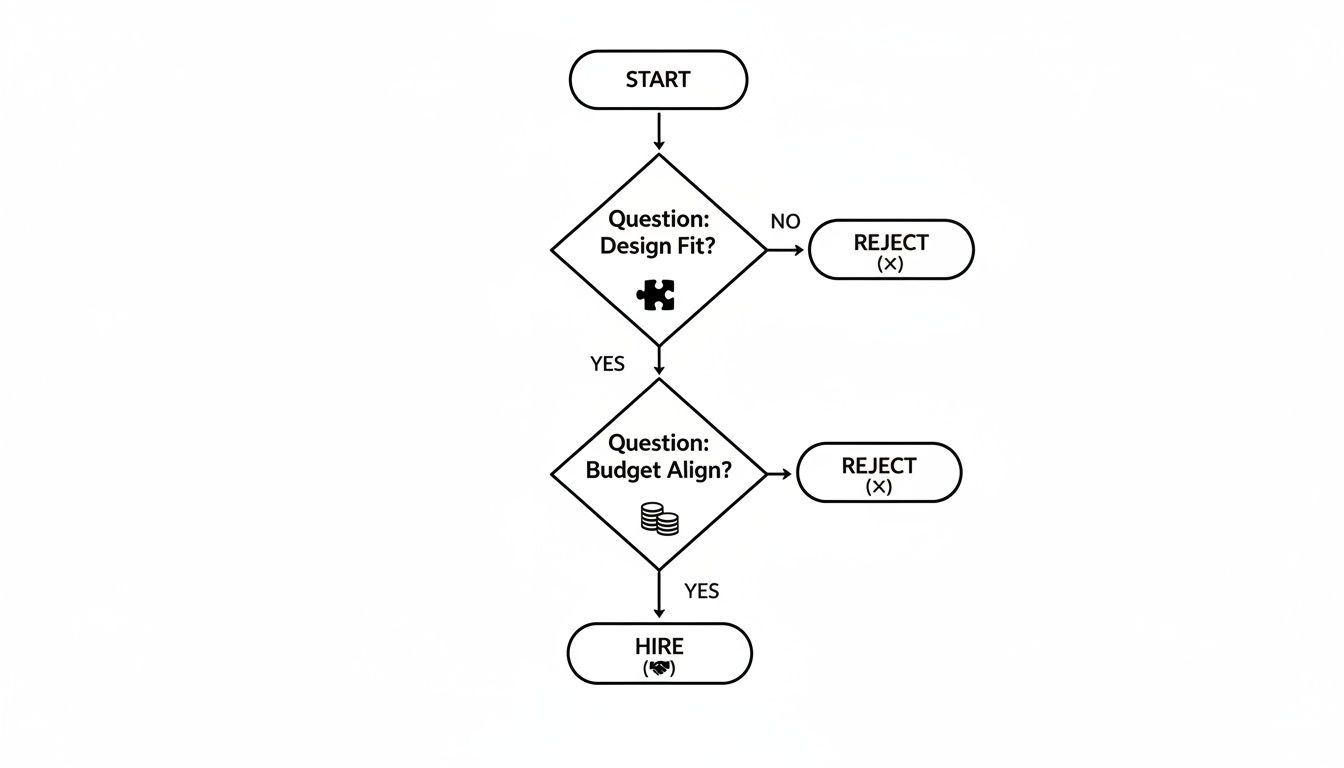
This visual really hammers home the point that regardless of a firm’s size or fame, the foundations of a great partnership are always the same: a shared aesthetic and a budget you can all stand behind. Your final decision should balance a firm’s public reputation with the genuine connection you feel in your interviews. You’re not just hiring a service; you’re choosing a partner who is both exceptionally capable and perfectly compatible with you.
Navigating Contracts, Fees, and the Design Process

You’ve found the architect. The vision clicks, the chemistry is right, and you’re ready to move forward. This is an exciting milestone, but the next step—formalizing the relationship—is where a truly successful project is built.
An architectural contract isn’t just a formality. It’s the blueprint for your entire collaboration, a detailed roadmap that protects both you and the architect. It ensures everyone is on the same page from the first sketch to the final walkthrough. Think of it as your project’s primary insurance policy against the friction, delays, and budget creep that can derail a dream home.
Demystifying Architectural Fee Structures
One of the first things you’ll discuss is how the architect will be compensated. While it might seem complicated at first, fees generally fall into one of three common models. Understanding these is crucial for feeling confident in the financial arrangement.
- Percentage-Based Fee: This is the most common model for luxury custom homes. The architect’s fee is calculated as a percentage of the total construction cost, usually in the range of 8% to 15%. This structure naturally scales with the project’s size and complexity.
- Fixed Fee (Stipulated Sum): Here, you agree on a single, flat fee for a very clearly defined scope of work. It offers cost certainty, which is attractive, but it’s best reserved for projects where the scope is locked in and unlikely to change.
- Hourly Rate: Often used for initial consultations, feasibility studies, or smaller projects with an undefined scope. This model offers great flexibility but doesn’t provide the budget predictability needed for a full-scale build.
For a new custom residence, a percentage-based fee often provides the best balance, aligning the architect’s incentives with your goal of achieving a high-quality outcome.
The Anatomy of a Rock-Solid Contract
A thorough architectural agreement should be detailed and transparent, leaving no room for interpretation. Before you sign anything, make sure it covers several critical areas that define the entire engagement. Vague terms or missing sections are major red flags.
A solid contract must clearly specify:
- A Detailed Scope of Work: This should precisely list every service the architect will provide, from schematic design and construction documents to helping with contractor bidding and overseeing construction.
- A Clear Fee and Payment Schedule: It needs to state the total fee (or how it will be calculated) and tie payments to specific project milestones, like the completion of the design development phase.
- Ownership of Documents: This clause typically clarifies that while you have the license to build this one project from the plans, the architect retains the copyright and intellectual property of the design itself.
- Process for Changes: No project goes exactly to plan. The contract must outline a formal process for “change orders,” detailing how scope adjustments will be priced, approved, and documented.
A strong contract doesn’t assume a perfect process; it provides a clear, mutually agreed-upon framework for navigating an imperfect one. It’s a tool for collaboration, not conflict.
When finalizing your choice, remember that the best ideas often come from diverse perspectives. The architectural profession is seeing a welcome demographic shift, with new data showing a record pipeline of talent. The number of active licensure candidates has hit a seven-year high of 39,000. Critically, people of color now represent 20% of architects, and women account for 29% of new registrants—bringing fresh, modern viewpoints to the field. Research shows that this matters: diverse teams can yield 19% higher innovation revenue, ensuring your project benefits from the industry’s most creative minds.
As you prepare to sign, it’s also helpful to look ahead. For a deeper dive into what comes next, our guide on the complete architectural design process steps breaks down the entire journey. With a solid contract in hand, you’re setting the stage for a true partnership that will turn your vision into a stunning reality.
Answering a Few Lingering Questions
As you narrow down your choices, a few practical questions almost always come to mind. These are the final pieces of the puzzle, the details that bring clarity and confidence before you sign on the dotted line. Getting these right is about more than just logistics; it’s about making sure your project starts on a foundation of total transparency.
Let’s walk through the most common queries we hear from clients at this stage.
How Much Should I Budget for an Architect?
This is usually the first thing people ask, and for good reason. When it comes to luxury custom homes, architect fees are almost always a percentage of the total construction cost. The industry standard puts this figure somewhere between 8% and 15%.
That range isn’t random. It’s a direct reflection of the project’s complexity, the architect’s experience and reputation, and how deeply they’ll be involved. A fee at the lower end, say 8%, might just cover the essential architectural plans. A fee closer to 15% usually signifies a comprehensive, white-glove service—think detailed interior specifications, landscape design oversight, and hands-on construction management from groundbreaking to final walkthrough.
Do I Hire an Architect or an Interior Designer?
This question comes up a lot, and while their expertise can overlap, their core responsibilities are worlds apart. For any new build or significant structural renovation, a licensed architect isn’t just a good idea; they’re non-negotiable.
Here’s the simplest way to think about it:
- An architect is a licensed professional who designs the building itself. They are legally and professionally responsible for structural integrity, navigating complex building codes, and ensuring the home is safe and sound. They create the master plan for the entire structure.
- An interior designer is a specialist focused on the experience within those walls. Their craft is in space planning, selecting finishes, sourcing furniture, and designing lighting to create a cohesive, functional, and beautiful atmosphere.
The absolute best luxury homes are born from a partnership between these two professionals, ideally from day one. The architect builds the beautiful, sturdy “bones,” and the interior designer gives the home its soul.
An architect designs the vessel; an interior designer curates the experience within it. The architect’s role is foundational to ensuring the home is safe, sound, and compliant.
What’s the Difference Between the Architect and the Builder?
Understanding this relationship is key to a smooth project. Think of it as a triangle, with you at the top and the architect and builder forming the base. They have distinct jobs but must work in lockstep.
Your architect is your creative visionary and your advocate. Their role is to take your dreams and translate them into a hyper-detailed set of plans. They are obsessed with protecting the design’s integrity, making sure it’s buildable, and holding everyone accountable to your original vision.
The builder, on the other hand, is the master of execution. They take those plans and make them real. They manage the construction site, coordinate the trades (plumbers, electricians, masons), order materials, and are ultimately responsible for the craftsmanship and quality of the finished home. They are the ones who turn the paper dream into a physical reality.
Ready to find the visionary talent that can bring your dream home to life? Haute Design is the premier network for connecting with the nation’s leading architects, interior designers, and builders, all vetted for an elite clientele. Explore our exclusive network and find your perfect match today.