


Before you even think about layouts or color palettes, the most important work needs to happen. Building a design portfolio that catches the eye of high-end clients and gets you featured on exclusive platforms like Haute Design isn’t just about showing off your work—it’s a strategic mission. It’s where you position yourself as an indispensable partner, not just another designer for hire.
A lot of designers fall into the trap of using their portfolio as a digital scrapbook, a chronological dump of everything they’ve ever touched. That’s a mistake. It waters down your brand and leaves potential clients wondering what you actually specialize in.
Your portfolio should be a sharp, persuasive argument for why you’re the best choice. It needs to answer the two questions every premium client is silently asking: “Do you get my world?” and “Can you deliver the results I need?” Getting this foundation right is what turns a good portfolio into a client-winning machine.
Defining Your Strategy Before You Design
The difference between a portfolio that gets ignored and one that gets you hired is strategy. It’s about making deliberate choices to attract a specific kind of client. Let’s break down how to build that strategic foundation.
Audit Your Work With a Critical Eye
First things first: you need to conduct a ruthless audit of your past projects. Lay everything out and evaluate each piece not on how much you loved working on it, but on how well it speaks to the clients you want to work with.
For every project, ask yourself:
- Does this scream luxury? Be brutally honest about the execution, the concept, and the overall polish. Does it look and feel high-end?
- Did it solve a real business problem? A beautiful design is nice, but a beautiful design that increased sales or boosted engagement is far more powerful.
- Can I tell a compelling story about it? Projects need a narrative. You have to be able to explain the challenge, your process, and the ultimate solution. A pretty picture isn’t enough.
This isn’t about collecting—it’s about culling. Your goal is to get your body of work down to a handful of absolute gems that perfectly represent your target niche.
The global graphic design market is booming, expected to hit $55.7 billion in 2025 after growing 4.0% annually since 2020. With so much competition, your portfolio has to be exceptional just to get noticed.
Quality Over Quantity Is Non-Negotiable
Forget the idea that more is better. It’s not. A portfolio with twenty decent projects is infinitely weaker than one with three to five exceptional case studies.
Why? Because affluent clients and busy creative directors simply don’t have time to wade through pages of your work hoping to find something good. They need to see your brilliance immediately.
Think of your portfolio as a tasting menu at a Michelin-starred restaurant. Every single course is chosen with intent and executed flawlessly to create a memorable, cohesive experience. Your portfolio should do the same. If you try to appeal to everyone, you’ll end up impressing no one.
Aligning Your Niche With Your Portfolio
Defining your niche is the bedrock of your entire portfolio strategy. Who are you for? Are you the go-to designer for sleek, minimalist e-commerce sites? Opulent boutique hotels? Cutting-edge tech startups?
Your projects must be a direct reflection of that specialty. If you want to design for luxury hospitality brands, a logo you did for a local coffee shop just isn’t going to cut it. It sends the wrong message.
This alignment goes beyond just the projects you show. It should inform the entire vibe of your portfolio website—the typography, the color palette, the tone of your writing. Every single element should work together to attract your ideal client. This is the same strategic thinking that goes into a solid business plan. If you want to dig deeper into that, our guide on creating an interior design business plan is a great place to start.
By curating your portfolio to speak directly to a specific market, you turn it from a passive gallery into an active, client-attracting tool. This is the strategic foundation that will guide every other decision you make.
Turning Projects into Persuasive Case Studies
High-end clients aren’t just buying a logo or a new website layout. They’re investing in a strategic partner who gets their business, understands their goals, and can deliver real results. This is precisely why your portfolio needs to be more than a gallery of pretty images. Each project must be framed as a compelling story that sells your expertise.

Think of it this way: a case study is your chance to articulate the “why” behind your design choices. It’s what separates an average portfolio from one that commands premium rates, because it proves you deliver tangible business value, not just aesthetics.
The Anatomy of a High-Impact Case Study
To craft a narrative that resonates, you need to guide potential clients through your entire problem-solving journey. Start with the challenge they’re all too familiar with and end with the successful outcome they crave. Every step in between should shine a light on your strategic process.
A truly persuasive case study must include these key elements:
- The Client’s Challenge: What specific problem were they facing? Get detailed. Was it low user engagement, a brand identity that felt dated, or abysmal conversion rates?
- Your Strategic Approach: How did you diagnose the issue? Talk about the research, the discovery calls, and the strategic thinking that set the stage for your design direction.
- The Creative Process: This is where you pull back the curtain. Show your work—the sketches, wireframes, mood boards, and different iterations—to reveal how the design evolved.
- The Tangible Results: Here’s the closer. What was the real-world impact of your work? Did sales increase? Did sign-ups jump? Did user satisfaction scores get a boost?
Structuring your projects this way turns a piece of art into a documented business solution. To see how brilliantly this can be done, take a look at these interior designer portfolio examples, which are masters at blending stunning visuals with powerful storytelling.
Quantifying Your Impact with Hard Data
Let’s be honest, vague claims like “improved the user experience” mean very little to a discerning client. You have to speak their language, which is the language of metrics, ROI, and measurable results. Quantifying your impact is the single most effective way to prove your value and justify higher fees.
By framing your accomplishments with concrete data, you demonstrate a clear understanding of how design directly contributes to business success.
A McKinsey study found that 73% of companies with a strong focus on design see their revenues grow faster than their competitors. When you showcase data-driven results, you’re positioning yourself as the kind of partner these high-performing brands are actively seeking.
To structure these case studies effectively, you need a clear framework that connects each part of your story. The table below outlines how to build a narrative that truly showcases your strategic value.
Case Study Structure for Maximum Impact
| Component | Key Objective | Example Content Snippet |
|---|---|---|
| The Challenge | Establish the initial business problem. | “Our client, a luxury e-commerce brand, was facing a 35% cart abandonment rate, primarily due to a confusing and multi-step checkout process.” |
| The Strategy | Detail your unique approach. | “We conducted user interviews and A/B tested three simplified checkout flows to identify and eliminate key friction points in the customer journey.” |
| The Solution | Showcase the final design deliverable. | “The final design was a streamlined, single-page checkout experience with clear visual cues and integrated mobile payment options.” |
| The Result | Quantify the outcome with specific metrics. | “Within three months of launch, cart abandonment dropped to 20%, and overall revenue increased by 12%.” |
This structure isn’t just about showing off; it’s about building a solid business case for your work in every single project.
From Vague to Valuable: How to Reframe Your Results
Transforming your project descriptions from generic to impactful is simpler than you might think. It’s all about drawing a clear line from your design choices to a measurable outcome.
Here are a few real-world examples to get you started:
- Before: “Redesigned the e-commerce checkout process.”
- After: “Simplified the checkout flow, resulting in a 15% reduction in cart abandonment and a 10% increase in completed transactions in the first quarter.”
- Before: “Created a new brand identity.”
- After: “Developed a new brand identity that led to a 40% increase in social media engagement and was featured in three industry publications.”
- Before: “Designed a new mobile app interface.”
- After: “Launched a user-centric app interface that improved the user satisfaction score from 3.5 to 4.8 and boosted daily active users by 25%.”
Even if you weren’t given deep analytics, you can still find data to back up your claims. Scour client testimonials for specific improvements, or look for publicly available information like social media follower growth or positive press mentions. This kind of data-driven storytelling proves you’re not just a creative—you’re a strategic asset who can deliver a serious return on investment.
Creating a Premium Portfolio Experience
Your portfolio website is your digital showroom. For the high-end clients you’re targeting, that experience needs to feel just as bespoke and considered as your best design work. It’s the very first impression, and it instantly sets the tone. A clunky, slow, or generic site sends a clear message about your attention to detail—a critical misstep in the luxury market.
This experience isn’t accidental. It’s built from a series of smart technical and aesthetic choices, where everything from your hosting platform to the way an image loads tells a story about your brand.
Choosing Your Platform Wisely
The foundation of your portfolio is the platform you build it on. This choice dictates everything: its look, its speed, and how much you can customize it. There isn’t a single “best” answer here; the right tool depends entirely on your technical comfort, your budget, and how unique you want the final product to be.
Let’s break down the most common routes:
- Portfolio-Specific Builders (Semplice, Carbonmade): These are built for creatives, by creatives. They provide gorgeous, designer-vetted templates and an intuitive interface, letting you focus on your work instead of wrestling with code.
- Advanced No-Code Builders (Webflow): For those who crave total design control without writing code, Webflow is a game-changer. It offers immense visual freedom, exports clean code, and has powerful CMS capabilities. It’s the sweet spot for creating a truly custom-feeling site.
- Fully Custom-Coded Site: This route gives you limitless flexibility but demands deep technical skill or the budget for a developer. It’s the ultimate path to a unique experience but is often more than what’s needed unless you have very specific functional requirements.
For most designers aiming for a high-end aesthetic, a platform like Webflow or a specialized builder like Semplice hits the perfect balance. They give you the tools to stand out without the massive investment of a fully custom build. To dive deeper, check out our guide on the best portfolio websites for designers.
Embracing a Mobile-First Philosophy
These days, designing for mobile first isn’t just a good idea—it’s non-negotiable. Think about your target audience: busy executives, creative directors, and affluent homeowners. They’re often reviewing work on the go, between meetings or on a tablet at home. If your site stumbles on a smaller screen, you’ve likely lost them before they even make it to a desktop.
The data backs this up. Top-tier portfolios in 2025 are being defined by their mobile fluidity and interactivity, a direct response to client and recruiter mobile browsing habits now exceeding 55% globally. A seamless experience on every device is no longer a feature; it’s the standard.
When you design for the smallest screen first, you’re forced to prioritize. It distills your message down to its core, leading to a cleaner, more impactful experience that works better for everyone, on any device.
Mastering the Art of Presentation
The final, crucial layer is in the details of the presentation. These subtle cues are what separate a good portfolio from a truly premium one. They work together to create an atmosphere of sophistication and command.
Minimalist Layouts
Minimalism isn’t about emptiness; it’s about clarity. It means giving your incredible work the space it deserves to be the hero. Use generous white space to guide the eye, create a sense of calm, and put the focus squarely on your projects. The layout should serve the work, never compete with it.
Purposeful Typography
Your font choice says a lot about your brand before a visitor reads a single word. Select one or two font families that reflect your aesthetic—maybe a timeless serif for headlines paired with a clean, modern sans-serif for body copy. The key is consistency in size, weight, and spacing to create a polished, intentional feel.
Subtle Micro-interactions
Small, thoughtful animations can make a website feel responsive and alive. Think of a gentle fade-in as you scroll or a subtle hover state on a button. The keyword here is subtlety. These interactions should enhance the experience by providing feedback, not distract from the content with flashy effects.
High-Quality Mockups
Context is everything. Showing your work in a professional, real-world setting instantly elevates its perceived value. Don’t just show a flat logo file; display it on a beautifully shot mockup of a business card or a building facade. For digital projects, use clean mockups of phones and laptops. This simple step helps a potential client immediately visualize the impact and application of your design in their world.
Making Sure the Right Clients Can Find You
You can have the most stunning portfolio in the world, full of compelling case studies, but if it’s tucked away in a dark corner of the internet, it’s not doing its job. For your portfolio to actually generate business, it needs to be discoverable. This is where a smart approach to search engine optimization (SEO) changes the game, shifting you from constantly hunting for leads to having them come to you.
The whole point is to put your work in front of high-end clients the very moment they’re searching for a designer with your exact expertise. It’s about creating a steady, almost automatic, stream of qualified traffic, so incredible opportunities land in your inbox without you having to chase them down.
Getting the On-Page SEO Basics Right
On-page SEO is everything you do on your website to help Google and other search engines understand what your work is all about. For a designer, this means treating every single project page like a dedicated landing page for a potential client. You want to show up when someone types in “luxury hospitality branding expert” or “minimalist e-commerce web designer.”
Think beyond just your name. High-value clients are often searching by style, industry, or the specific problem they’re trying to solve. Your project titles and descriptions are prime real estate for these exact terms.
- A vague title: “Project X – Branding”
- An SEO-friendly title: “Brand Identity for The Lumina Hotel – A Luxury Hospitality Project”
That one simple change provides instant context for both people and search engines. It turns a generic file name into a discoverable asset.
The best SEO isn’t about gaming the system; it’s about directly answering the questions your ideal clients are asking. When you align your project descriptions with their search terms, you’re not just optimizing for algorithms—you’re optimizing for real human connection and genuine business needs.
Your Visuals Are an Untapped SEO Goldmine
Designers have a massive advantage that so many overlook: images. Every gorgeous, high-resolution photo of your work is a chance to be found through image searches, which can drive a surprising amount of traffic. The catch? Search engines can’t see your images; they rely on the text you provide to make sense of them.
This is where alt text (alternative text) comes into play. It’s a short, descriptive sentence that tells a search engine what an image shows. Instead of leaving this blank or letting it default to a generic filename, write thoughtful alt text that includes keywords people might actually use.
How to Optimize Your Images
| Vague Filename | SEO-Optimized Filename | Great Alt Text |
|---|---|---|
| IMG_9876.jpg | luxury-skincare-packaging-design.jpg | “Minimalist packaging design for a luxury skincare brand, featuring gold foil on a matte white box.” |
| final-logo.png | modern-tech-startup-logo-design.png | “Clean, geometric logo design for a modern tech startup, using a blue and gray color palette.” |
Doing this not only helps your images show up in search results but also makes your site more accessible for visually impaired users. That’s a small detail that signals a truly professional, well-built website.
Building Your Reputation with Off-Page Signals
While the on-page elements are your foundation, off-page SEO is what builds your portfolio’s authority and credibility online. The single most powerful off-page signal is a backlink—basically, a link from another website to yours. Think of every link from a reputable source as a vote of confidence for your work.
Your goal is to earn these links from respected places in the design world. One high-quality link from a major design publication is worth infinitely more than a hundred spammy links from irrelevant sites.
Here are a few ways I’ve seen this work incredibly well:
- Get Featured in Curated Galleries: Submitting your best work to platforms like Behance, Dribbble, or Awwwards isn’t just for show. Getting featured or having a project go viral can send powerful authority signals—and a ton of traffic—back to your main portfolio.
- Write for Design Blogs: Reach out to a well-regarded design blog and offer to write a guest post. Share your unique process or insights on a topic, and make sure your author bio includes a link back to a relevant case study on your site.
- Team Up with Other Creatives: Did you work on a project with a fantastic photographer, copywriter, or developer? When they showcase that project on their own site, make sure they link back to your portfolio as a key collaborator.
When you combine meticulous on-page optimizations with a smart strategy for building your authority off-site, your portfolio transforms. It stops being a static gallery and becomes a dynamic, lead-generating machine that brings the right kind of clients directly to you.
Pitching Your Work to High-Value Clients
Once your portfolio is polished and ready, the real work begins. It’s time to shift from passively waiting for discovery to actively pursuing the clients you want to work with. This is where all your strategic project selection and storytelling pays off, giving you the confidence to connect with premium clients and exclusive platforms like Haute Design.
The key here isn’t casting a wide net; it’s about precision and personalization. The way you’d approach a creative director at a luxury fashion house is completely different from how you might submit your work to a curated design network. Every pitch needs to feel like it was made just for them.
Crafting Your Outreach Message
Think of your initial email as your foot in the door. It has to be sharp, compelling, and completely focused on the person you’re writing to. Forget generic templates—high-value clients and their gatekeepers can spot a copy-paste job from a mile away, and it’s the fastest ticket to the trash folder.
Your goal is to show you’ve done your homework and you understand their world. A killer pitch email usually has three simple parts:
- A specific, genuine compliment. Mention a recent project, campaign, or even an article they were featured in. This proves you’re paying attention.
- A clear value proposition. In one or two sentences, connect what you do to a need they might have. For example, “I was impressed by your latest digital campaign and specialize in creating the kind of interactive experiences that drive engagement for brands like yours.”
- A low-friction call to action. Don’t ask for a 30-minute meeting. Instead, offer something valuable and easy to say yes to, like, “I’ve put together a brief PDF with two case studies I thought you’d find relevant. Would you be open to a quick 10-minute chat next week to discuss?”
This approach respects their time and instantly frames you as a thoughtful partner, not just another designer looking for a gig.
The Power of the Custom PDF Portfolio
While your website is your digital storefront, a custom PDF portfolio is your surgical tool for targeted pitching. It’s an absolutely essential asset when you need to make a specific, powerful first impression. This lets you hand-pick the three or four most relevant projects that speak directly to a particular opportunity.
Sending a tailored PDF communicates one crucial message: “I made this just for you.”
That simple act of curation shows immense respect for their time. It also proves you can strategically edit your own work down to its most impactful components—a skill every high-end client is looking for.
A tailored PDF portfolio does more than just showcase your work; it showcases your strategic thinking. It proves you understand the client’s specific needs well enough to edit your own presentation down to its most impactful, relevant components.
The strategy here is twofold: you need a discoverable online presence for inbound leads and a sharp, targeted outreach method for the clients you actively want to win. The flowchart below illustrates how both paths, SEO and direct outreach, lead to better visibility.
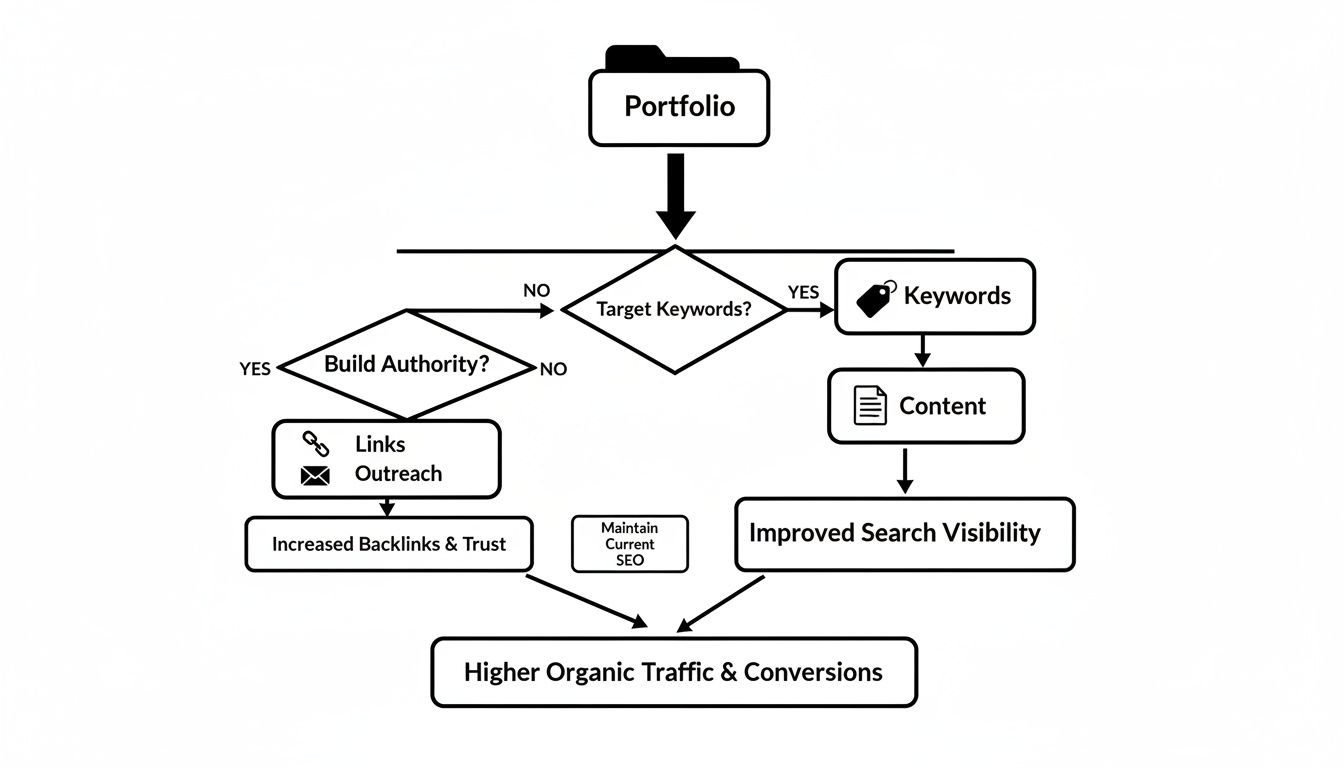
This shows how passive discovery and active pitching are two sides of the same coin, both critical for connecting with the right people.
Walking Clients Through Your Work
Getting them on a call is a huge win. Now’s your chance to bring those case studies to life. Whatever you do, don’t just pull up your website and narrate what they can already read. Use this time to reinforce the story you started in your email.
Guide them through your process with confidence. When you present a case study, always anchor the conversation back to their potential problems and goals.
Try using a framework like this:
- Frame the Problem: “The client in this project was facing a challenge that I think is similar to what you’re dealing with regarding…”
- Explain Your Strategy: “So, my first step was to really dig into their core audience. We discovered that…”
- Connect to the Result: “That insight led directly to the final design, which ultimately drove a 25% increase in conversions. We could potentially apply a similar strategic lens to your project to achieve…”
By confidently connecting the dots from a past success to their future goals, you transform the meeting from a simple portfolio review into a collaborative problem-solving session. This is how you close bigger projects and position yourself as an indispensable partner.
A Few Portfolio Questions I Hear All The Time
When you’re putting together a portfolio to attract a certain caliber of client, a lot of the same questions tend to pop up. Getting the details right can be the difference between getting noticed and getting passed over. Here are my straight-to-the-point answers to the most common ones I get from designers.
How Many Projects Should I Actually Show?
My philosophy has always been quality over quantity. Always. It’s far better to show three to five of your absolute best projects, presented with incredible detail, than it is to toss in fifteen mediocre ones. A scattered, unfocused portfolio just creates noise.
For a high-end audience, you need to think of each project as a strategic showcase. It’s not just about pretty pictures; it’s about proving you can deliver tangible business results. This is your highlight reel, so make sure every single project earns its spot.
Can I Build a Portfolio If I Don’t Have “Real” Client Work?
You absolutely can. Don’t ever let a lack of paid clients hold you back from creating a killer portfolio. The trick is to create self-initiated or conceptual projects that are laser-focused on the exact type of work you want to land.
For example, dreaming of working with luxury hospitality brands? Invent one. Create a complete brand identity for a fictional boutique hotel, from the logo and booking experience to the in-room stationery. Document your entire process—the research, the strategy, the execution, and the hypothetical impact. This shows you have the skills, the passion, and the proactive mindset that discerning clients love.
Your portfolio is a living document, not a static archive. It should evolve alongside your skills and career ambitions. Keeping it current signals that you are an active, growing professional in your field.
Is a PDF Portfolio Still Relevant?
Yes, and I’d argue it’s one of your most powerful outreach tools. Your website is your public-facing gallery, but a polished PDF is your private, tailored pitch. It’s perfect for when you’re approaching a specific client or applying to an exclusive network.
A PDF portfolio allows you to:
- Cherry-pick the most relevant work that speaks directly to that client’s industry and pain points.
- Write a personal introduction that shows you’ve done your homework and aren’t just sending a generic blast.
- Deliver a clean, self-contained file that’s easy for a busy creative director to review and share with their team.
Taking this extra step shows a level of thoughtfulness and professionalism that immediately sets you apart. It’s a small effort that makes a huge impact.
How Often Should I Be Updating This Thing?
Think of your portfolio as a direct reflection of your professional growth. I tell my mentees to get into a rhythm of reviewing and refreshing it every three to six months. It’s just good creative hygiene.
Each time you check in, add your newest, most impressive work. But here’s the key: be ruthless about culling older projects that no longer represent your best self or the career direction you’re heading in. A fresh, current portfolio tells the world you’re active, evolving, and consistently at the top of your game.
Ready to get your work in front of the right people? Join the Haute Design network, a curated community built for the nation’s leading design professionals. Showcase your work and gain the recognition you deserve.