


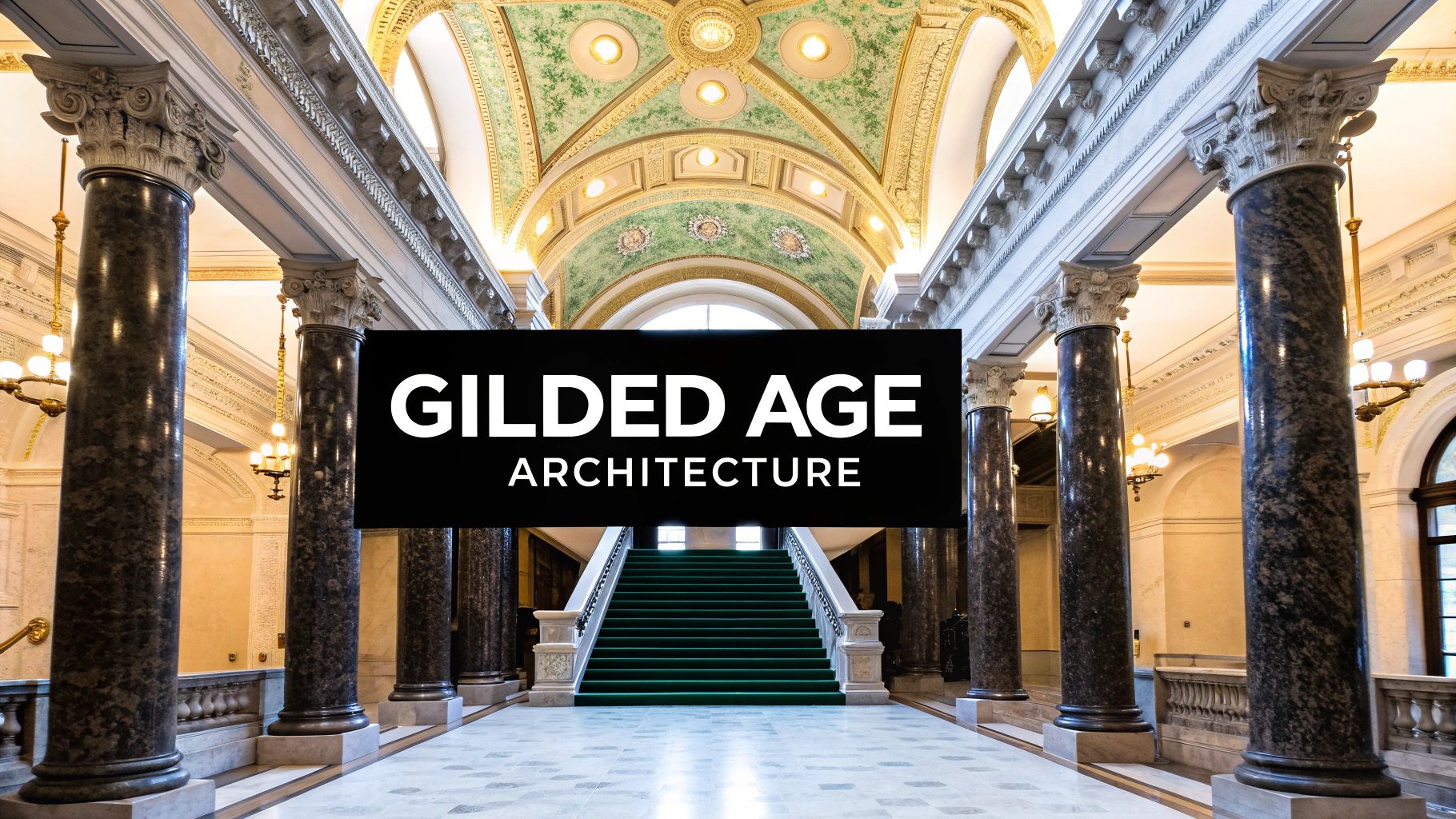
Gilded Age architecture, which flourished from the 1870s to the early 1900s, was America’s bold and extravagant answer to a new era of industrial wealth. It was a style defined by sheer scale, the finest materials money could buy, and a deep reverence for historical European design. This wasn’t just about building a house; it was about erecting a monument to one’s fortune and ambition, cementing a family’s place in the social hierarchy.
An Era of Unprecedented Ambition
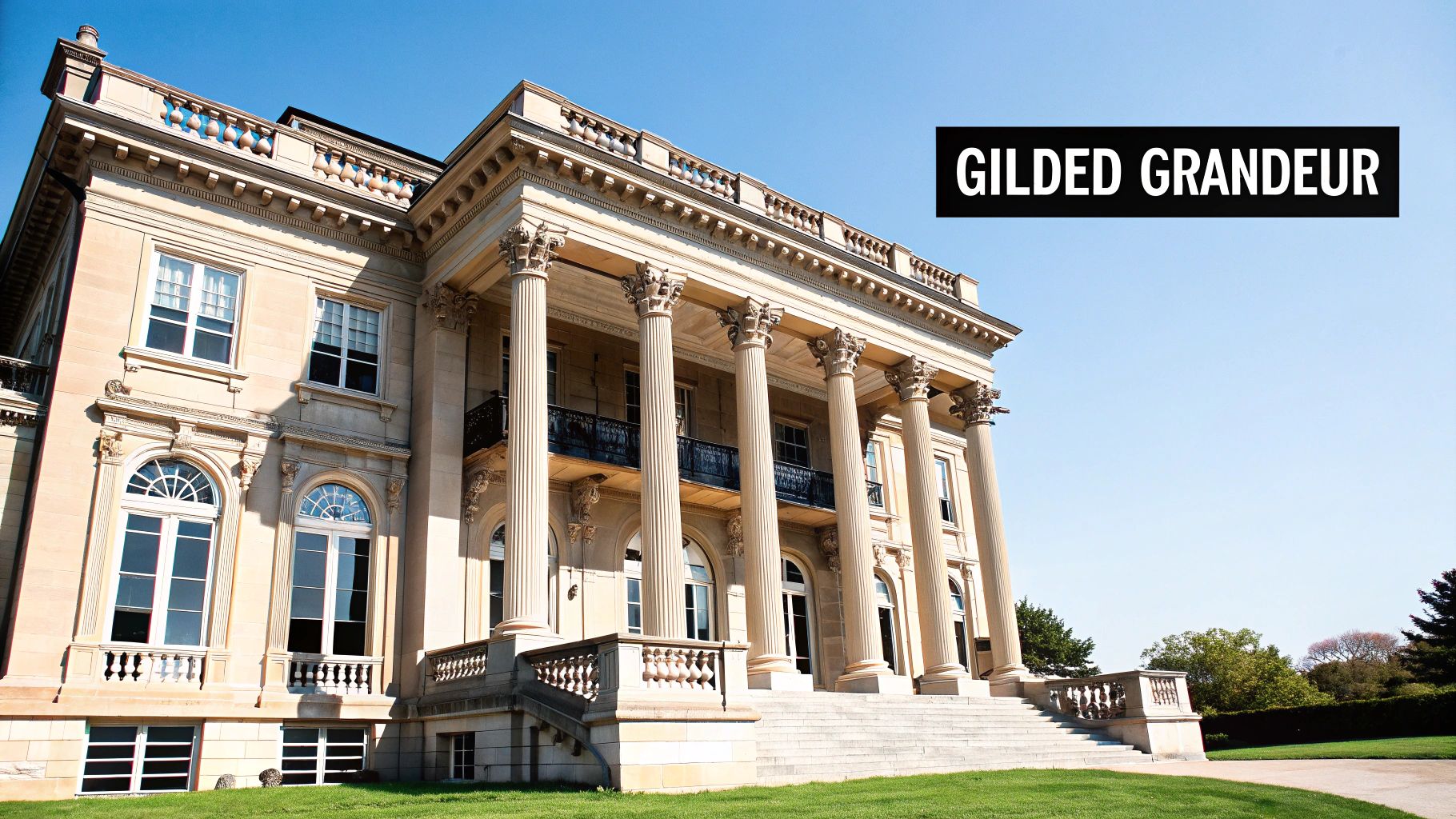
The period after the Civil War saw explosive economic growth in the United States. Fortunes were made seemingly overnight in railroads, steel, and finance, giving rise to an elite class of industrialists—names we still know today, like Vanderbilt, Carnegie, and Rockefeller. This “new money” aristocracy was eager to establish its legitimacy, and they looked to the cultural and architectural traditions of European nobility for inspiration.
Their homes became the ultimate stage for this social climb. They hired the best architects to design monumental estates that were meticulously crafted for lavish entertaining and, of course, a bit of social one-upmanship. The name for the era, famously coined by Mark Twain, says it all: the Gilded Age was a glittering, gold-leafed surface hiding the complex social and economic realities of the time.
Architecture became the most visible and permanent expression of success. A mansion on New York’s Fifth Avenue or a sprawling “summer cottage” in Newport, Rhode Island, was a tangible declaration of a family’s arrival into the highest echelons of society.
From Industrial Wealth to Architectural Masterpieces
This architectural movement was driven by a bold eclecticism and an unapologetic love for grandeur. Architects weren’t shy about borrowing from a rich library of historical styles, blending them to create something that felt both old-world and distinctly American in its ambition. The primary goal was always to project an image of culture, sophistication, and an established lineage.
You can spot a Gilded Age masterpiece by a few key characteristics:
- Monumental Scale: These buildings were designed to awe. Think soaring ceilings, vast ballrooms, and grand halls that made you feel small in their presence.
- European Inspiration: The look was often pulled directly from the palaces of European royalty. Styles like French Châteauesque, Beaux-Arts classicism, and the Italian Renaissance Revival were particular favorites.
- Lavish Materials: Nothing was off-limits. Facades were clad in limestone and marble, while interiors dripped with exotic woods, gilded plasterwork, imported tapestries, and intricate stained glass.
- Ornate Detailing: Every single surface was an opportunity for decoration. Grand staircases, fireplace mantels, and exterior cornices were covered in complex carvings, decorative ironwork, and elaborate ornamentation.
In the end, Gilded Age architecture was the physical manifestation of a society obsessed with status, legacy, and the dramatic performance of wealth. It’s a captivating story of how industrial fortunes were spun into a lasting cultural and architectural legacy, one that shaped our cities and defined luxury for generations to come.
The Defining Features of Gilded Age Design
To really get Gilded Age architecture, you have to understand the art of the spectacle. These buildings were never meant to be subtle. They were grand, public announcements of wealth, culture, and social standing—European palaces reimagined on American soil, where every single element was chosen to project an image of a new, yet established, aristocracy.
This mindset led to a fascinating and sometimes dizzying blend of historical styles, often within the same building. Architects of the day were raiding a rich European playbook, picking and choosing elements to create an aesthetic that felt both classically familiar and uniquely American in its sheer boldness. This eclectic borrowing is really at the core of the era’s design.
A Symphony of Historical Styles
The architectural language of the Gilded Age was anything but monolithic. Architects became masters of historical revival, and their clients, the newly minted titans of industry, had an insatiable appetite for looks that screamed history and prestige.
Three major influences really shaped the landscape:
- Beaux-Arts: Straight out of the famed École des Beaux-Arts in Paris, this style is all about formal symmetry, grand proportions, and classical details like columns, pediments, and sweeping balustrades. It was the absolute go-to for major public buildings and the grandest of urban mansions, projecting a powerful sense of order and cultural authority.
- Châteauesque: This style is a direct nod to the grand country manors of 16th-century French royalty. You can spot it immediately by its steep, complex rooflines, towering turrets, and ornate dormer windows. The whole effect creates a silhouette that’s both romantic and incredibly imposing.
- Romanesque Revival: Defined by its massive, heavy stone construction, powerful rounded arches, and a formidable, castle-like presence, this style was all about conveying permanence and strength. While it was a favorite for churches and public institutions, it also found its way into some truly impressive residential designs.
But here’s the key: these styles were rarely used in their pure forms. Architects would often mix and match, layering elements from different periods to create the visually complex, one-of-a-kind aesthetic that became the true hallmark of Gilded Age design.
Materials of Uncompromising Quality
The materials used in Gilded Age architecture were just as important as the designs themselves. Every choice was a statement—a declaration of permanence and limitless wealth. The preference was always for solid, imposing materials that felt substantial and, frankly, expensive.
Limestone, granite, and marble were the stones of choice for exteriors, often intricately carved with classical reliefs and motifs. Step inside, and the opulence continued with rare hardwoods for intricate paneling and floors, vast expanses of polished marble, and gilded plasterwork that shimmered under the glow of newly installed electric lights. Every surface was an opportunity for lavish display.
The philosophy was simple: if it looked and felt expensive, it belonged. This commitment to luxury materials extended to every detail, from bronze doors and iron grillwork to stained-glass windows by masters like Louis Comfort Tiffany.
Hallmarks of Opulent Detailing
Beyond the broad strokes of style and material, the real character of a Gilded Age building is found in its extraordinary attention to detail. Ornamentation was never an afterthought; it was woven into the very fabric of the design, meant to overwhelm the senses with pure craftsmanship and cost.
Grand carved staircases were a staple, often serving as the dramatic, beating heart of the home. You’d see intricate ironwork adorning gates, railings, and balconies. Ceilings were rarely left plain, instead featuring coffered designs, hand-painted murals, or layers of elaborate plaster moldings. These decorative flourishes reinforced the home’s status as a total work of art. To see how these ideas live on, exploring modern applications of elaborate crown moulding designs offers a fascinating look at carrying this legacy forward.
To put it all together, here’s a quick look at the key characteristics that define the era’s architecture.
Key Characteristics of Gilded Age Architecture
This table summarizes the defining stylistic elements, materials, and influences that characterize Gilded Age buildings.
| Characteristic | Description | Common Examples |
|---|---|---|
| Scale & Massing | Monumental and imposing structures designed to dominate their surroundings with a heavy, substantial presence. | The Breakers (Newport, RI), Biltmore Estate (Asheville, NC) |
| Exterior Detail | Intricate carvings, prominent columns, decorative cornices, and asymmetrical rooflines with turrets and gables. | Fifth Avenue mansions, Marshall Field mansion (Chicago) |
| Interior Finish | Lavish use of marble, exotic woods, gilded plaster, silk wall coverings, and grand, sculptural staircases. | Marble House interiors, The Frick Collection (New York, NY) |
| Fenestration | Large, often arched or bay windows, sometimes featuring elaborate stained or leaded glass designs. | Tiffany glass windows in period homes, grand Palladian windows |
Ultimately, these elements combined to create structures that were far more than just homes or buildings; they were physical manifestations of an era defined by ambition, innovation, and an unapologetic celebration of wealth.
How Wealth and Society Shaped These Homes
To get to the heart of Gilded Age architecture, you have to look past the stone and steel. These homes were a direct, almost visceral, reaction to the enormous economic and social upheavals of late 19th-century America. They weren’t just places to live; they were declarations of power, status, and the arrival of a new American aristocracy.
The entire architectural movement is fundamentally tied to the country’s explosive industrial growth after the Civil War. A new class of titans—industrialists and financiers—raked in astonishing fortunes from railroads, steel, oil, and finance. With fortunes often swelling into the tens of millions, they had the capital to build on a scale that rivaled European royalty.
In places like New York City, this ambition transformed the landscape. Fifth Avenue’s northward march became a parade of French châteaux and Italian Renaissance palazzos, each one a magnate’s attempt to cement his social standing in stone. You can find some fascinating historical context on this era from the Smithsonian Associates.
The Rise of the Robber Barons and Their Palaces
The term “robber baron” may sound dramatic today, but it captures the often brutal business tactics that built these empires. Men like Cornelius Vanderbilt (railroads), Andrew Carnegie (steel), and John D. Rockefeller (oil) amassed wealth on a level previously unimaginable. With no income tax to speak of, their financial power was immense, and they needed a very public way to show it.
Architecture became their primary tool. A mansion on Fifth Avenue or a sprawling Newport “cottage”—a famously ironic understatement—was more than a home. It was a scoreboard in the cutthroat game of social dominance. These houses were designed for one thing: lavish entertaining. They hosted grand balls for hundreds and intimate dinners where fortunes were made and lost.
The homes of the Gilded Age were strategic assets. They were built to impress, intimidate, and solidify a family’s legacy, acting as the primary stage for the intense social competition that defined high society.
This detailed visual breaks down the key elements these industrial titans used to make their architectural statements.
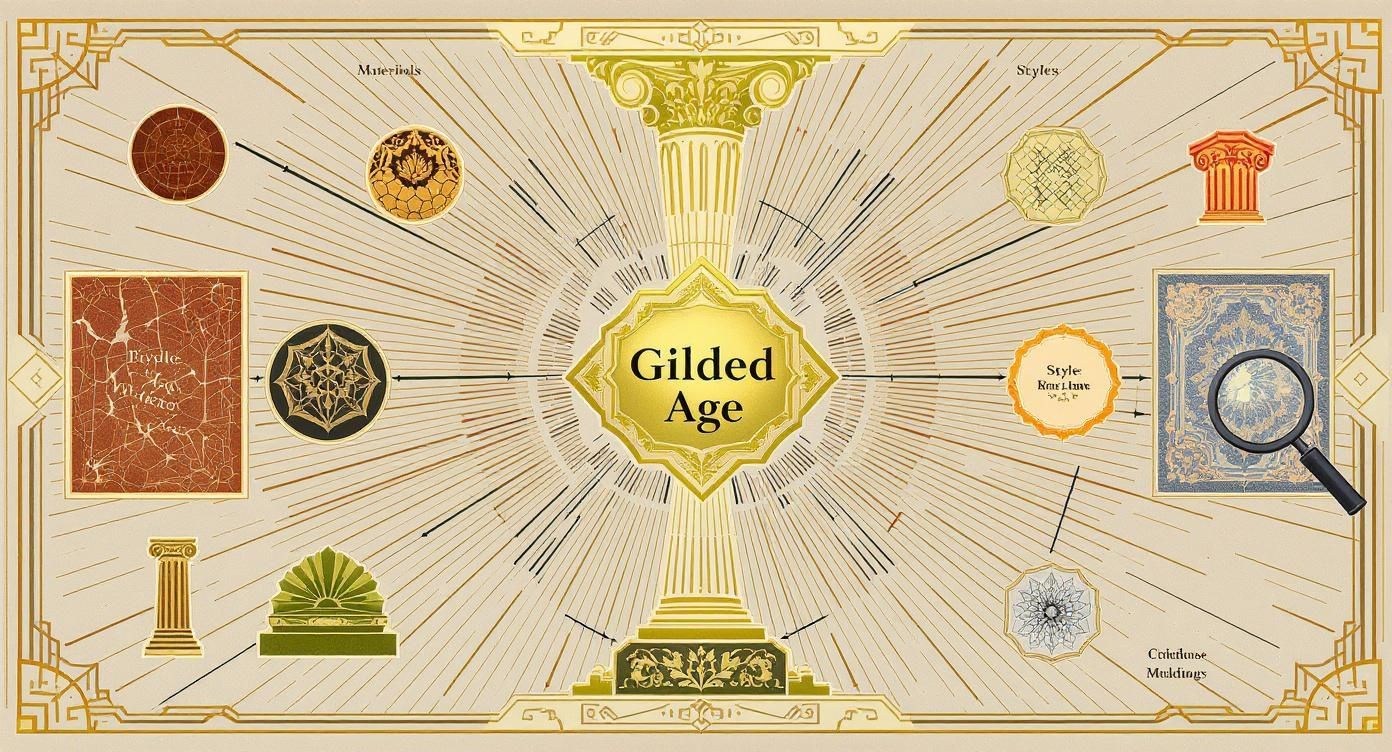
As you can see, the choice of robust, expensive materials, the devotion to classical European styles, and the obsession with intricate detailing were all part of a calculated strategy to project an image of power and permanence.
Architecture as Philanthropic Legacy
What’s interesting is that this same architectural language wasn’t just for private indulgence. As these titans of industry got older, many pivoted toward philanthropy, eager to shape America’s cultural landscape and perhaps soften their public image. They began funding museums, libraries, universities, and concert halls, all designed in the same grand, classical styles as their own homes.
This had a two-pronged effect:
- Cultural Foundation: It established major cultural institutions that are still cornerstones of American life, like the Metropolitan Museum of Art in New York.
- Reputation Management: It allowed these magnates to recast themselves from ruthless capitalists into benevolent patrons of the arts and sciences.
By commissioning these public buildings, they made sure their names would be linked not just with commerce, but with culture and enlightenment for generations. The grand facades of these institutions sent a clear message: great wealth came with great civic responsibility—or at least, the appearance of it. Ultimately, the homes, museums, and libraries of the Gilded Age tell the story of a nation grappling with unprecedented fortunes and the burning desire to build a legacy as enduring as the stone itself.
The Master Architects and Their Landmark Creations

Behind every great Gilded Age mansion stood an architect who was more than just a designer. They were visionaries, tastemakers, and trusted advisors to the wealthiest families in America, translating immense fortunes and social aspirations into stone, marble, and wood.
The relationship between architect and patron was intensely personal and collaborative. An industrialist knew they wanted to project power, culture, and a sense of permanence; the architect was the one with the historical knowledge and design genius to actually make it happen. This powerful dynamic gave us some of the most iconic buildings in American history.
Richard Morris Hunt: The Architect of the Elite
If one name defines the sheer opulence of the Gilded Age, it’s Richard Morris Hunt. He was the first American to graduate from the legendary École des Beaux-Arts in Paris, and he brought that rigorous classical training back to the States. This pedigree made him the undisputed choice for the era’s most powerful and demanding clients, especially the Vanderbilts.
Hunt was an absolute master of the Beaux-Arts and French Châteauesque styles, wielding them with a confidence that was nothing short of breathtaking. His work is known for its perfect proportions, scholarly historical details, and an unwavering commitment to grandeur. He didn’t just design houses; he created cultural institutions, including the iconic façade of the Metropolitan Museum of Art and the pedestal for the Statue of Liberty.
But his residential commissions are the stuff of legend. For the Vanderbilts, he designed a string of palaces that became instant landmarks. During the era from roughly 1875 to 1914, Hunt’s work perfectly captured the peak of American luxury. His designs for Marble House and The Breakers in Newport, Rhode Island, both finished in 1895, are still considered masterpieces. Marble House alone, with its 50 rooms modeled on French classicism, reportedly cost an $11 million equivalent today. You can explore more about these famous Gilded Age American architects to see the scope of their influence.
McKim, Mead & White: The American Renaissance Firm
While Hunt was the master of French-inspired grandeur, the firm of McKim, Mead & White was forging its own path. The trio of Charles Follen McKim, William Rutherford Mead, and the famously flamboyant Stanford White pioneered what we now call the American Renaissance. Their philosophy was built on a more restrained and scholarly classicism, drawing heavily from Italian and American Colonial sources.
Their goal wasn’t just to imitate European styles, but to create a new, dignified architectural identity for America. They believed classical principles could be adapted to design buildings that felt both monumental and modern for their time.
The firm’s genius was its incredible versatility and collaborative energy. They could seamlessly pivot from a grand public library to an elegant city townhouse or a sprawling country estate, all while maintaining a signature of refined classicism.
Some of their most celebrated projects show this range perfectly:
- The Boston Public Library: A triumph of Renaissance Revival design that set a new benchmark for what a civic building could be.
- The Villard Houses in New York: A brilliant complex of brownstones unified to look like a single Roman palazzo, proving their mastery of urban residential architecture.
- Rosecliff Mansion in Newport: An elegant, H-shaped “cottage” inspired by the Grand Trianon at Versailles, standing in graceful contrast to its heavier neighbors.
Together, these architects weren’t just service providers; they were stars. They didn’t just build homes—they shaped the aesthetic of an entire era, leaving a portfolio of landmarks that still define our understanding of Gilded Age architecture.
Exploring the Interiors of a Gilded Age Mansion
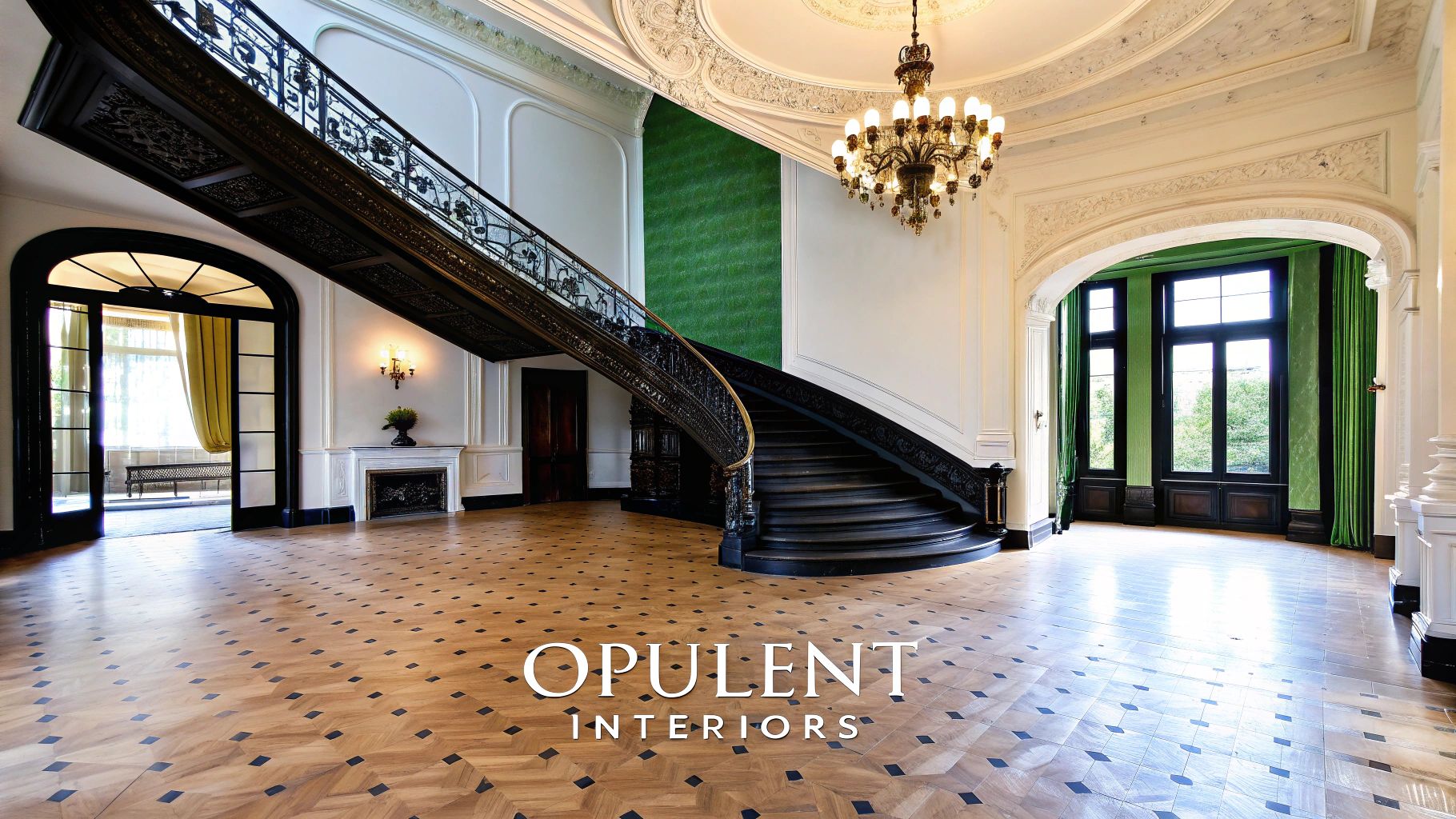
To step inside a Gilded Age mansion is to enter another world entirely. It’s a place where an aristocratic fantasy was brought to life with the muscle of modern technology. While the exteriors were built to project power and prestige, the interiors were where the real performance of wealth took place, each room a carefully set stage for lavish parties and a showcase of the owner’s worldly sophistication.
This was a period of staggering domestic innovation. The late 19th century introduced wonders like electricity, indoor plumbing, and even telephones into the home. For the ultra-wealthy, these weren’t just about making life easier; they were potent status symbols, seamlessly woven into the architectural fabric.
Technology Completely Reshaped the Floor Plan
Of all the new technologies, central heating was arguably the most transformative. Before it became common in the grandest homes, architects were tethered to the fireplace. Nearly every room needed one, a constraint that naturally led to smaller, enclosed spaces designed to trap every bit of precious warmth.
Central heating completely shattered that old model. This innovation freed architects from the tyranny of the hearth, allowing them to design sprawling, open-concept floor plans without worrying about a localized heat source. This newfound freedom gave birth to the eclectic, deeply personal homes that defined the era.
This fundamental shift is what made the iconic spaces of the Gilded Age possible:
- The Grand Hall: A dramatic, often multi-story entrance designed to awe visitors the moment they walked in.
- The Ballroom: A cavernous space built for one purpose: to host hundreds of guests for the most important social functions of the season.
- The Art Gallery: Long, stately corridors created specifically to display prized collections of European paintings and Old Master sculptures.
The interior wasn’t just a collection of rooms; it was a social blueprint. It was meticulously engineered to direct the flow of people, from the magnificent procession of guests at a gala to the quiet, almost invisible movements of the household staff.
A Socially Engineered Layout
The floor plan of a Gilded Age mansion was a masterclass in social engineering, with clearly defined zones to uphold a rigid social hierarchy. Public-facing rooms were breathtakingly opulent, designed for maximum impact. In contrast, the private family quarters offered a sanctuary from the relentless social scene.
Running parallel to this was an entirely separate world—a hidden network of back hallways, service staircases, and specialized workrooms for the army of staff needed to maintain such a property. This “backstage” allowed dozens of servants to operate unseen, preserving the carefully crafted illusion of effortless luxury for the family and their guests. You can see how these principles have evolved in our modern guide to luxury mansion interior design.
An Explosion of Lavish Materials
If the floor plan was the mansion’s skeleton, the interior finishes were its dazzling, jewel-encrusted skin. No surface was left unadorned. Every wall, floor, and ceiling was an opportunity for an extravagant display, featuring the finest materials sourced from every corner of the globe. The aim was to overwhelm the senses with layers of texture, color, and craftsmanship.
Certain elements became hallmarks of the style:
- Rich Wood Paneling: Walls were frequently sheathed in dark, ornately carved oak, walnut, or mahogany.
- Gilded Ceilings: Elaborate plaster moldings on the ceilings were often highlighted with genuine gold leaf.
- Parquet Floors: Intricate geometric patterns were painstakingly created from a variety of inlaid woods.
- Imported Textiles: Enormous tapestries and sumptuous silks from Europe and Asia added color, warmth, and a sense of aristocratic history.
These materials weren’t just decorative; they worked in concert to create immersive environments. These homes weren’t just places to live—they were stages for a gilded life, where every single detail was a testament to the owner’s soaring ambition and the incredible skill of the artisans who built them.
Bringing Gilded Age Elegance into Modern Design
If you’ve fallen for the grandeur of the Gilded Age, bringing that sensibility into a modern home is an exercise in thoughtful adaptation, not a museum-like replication. The goal isn’t to recreate a period room piece by piece. It’s about capturing that spirit of opulence in a way that feels fresh and livable today—a true conversation between past and present.
The key is selectivity. Instead of copying a ballroom from a Vanderbilt mansion, focus on introducing a few high-impact elements that evoke the era’s character. This strategic approach is what makes a space feel curated and genuinely luxurious, not cluttered or like a stage set.
Focus on Foundational Details
The most powerful way to infuse Gilded Age character is to start with the room’s bones—the architectural details that provide a historic backdrop. These elements add a layer of complexity and a sense of permanence that immediately elevates any interior.
Think of it as setting the stage.
- Detailed Millwork: This is non-negotiable. Ornate crown molding, deep baseboards, and intricate wainscoting add instant gravitas. For an even more authentic touch, consider paneled walls, which were a hallmark of the era’s finest homes.
- Rich Materials: The Gilded Age was defined by its unapologetic use of lavish materials. Introduce marble for fireplace surrounds or countertops, and choose dark, substantial hardwoods like walnut or mahogany for flooring.
- Statement Lighting: Nothing says Gilded Age quite like a breathtaking light fixture. A classic crystal chandelier or a substantial, sculptural bronze fixture can act as the stunning centerpiece of a room, a direct nod to the grand fixtures that first illuminated these historic interiors.
By concentrating on these core components, you build a strong, authentic foundation. This philosophy of borrowing from history to enrich modern design is a powerful one, and you can see similar principles at play when exploring the tenets of a modern Georgian style house.
Curating Gilded Age Accents in Key Spaces
With the architectural framework in place, you can begin to layer in the decorative elements. The trick is to choose pieces that echo the era’s opulence without suffocating the room’s modern sensibilities.
The secret is all in the balance. For every piece of ornate Gilded Age decor you introduce, give it breathing room with plenty of negative space and modern simplicity.
Here’s a practical look at how these ideas can come to life throughout your home:
The Entryway This is your chance to make a powerful first impression. An oversized mirror with an ornate, gilded frame makes an immediate statement. Pair it with a marble-topped console table, and you’ve established a tone of sophisticated luxury from the moment a guest steps inside.
The Living Room Look for furniture with classic, time-tested silhouettes. A deep-buttoned Chesterfield sofa or a pair of tufted armchairs upholstered in rich velvet instantly adds a touch of Gilded Age comfort and style. Anchor the entire seating area with a large, intricate area rug whose patterns recall historic tapestries.
The Kitchen A full-blown Gilded Age kitchen simply isn’t practical for modern life, but you can certainly incorporate its spirit. Think custom cabinetry with detailed molding and elegant brass hardware. A dramatic marble backsplash or an oversized, custom range hood can serve as a beautiful and functional tribute to the era.
Common Questions About Gilded Age Architecture
It’s natural to have questions when diving into a specific architectural period. Let’s tackle some of the most common ones about the Gilded Age to clear up the details and give you a better feel for this incredible era.
Gilded Age vs. Victorian: What’s the Real Difference?
It’s a great question, especially since the timelines overlap. The easiest way to think about it is through scale and intent. Victorian architecture is more of a broad category covering many popular styles of the late 19th century, like Queen Anne or Gothic Revival. You typically see these styles in middle-class homes, often built with wood and characterized by their intricate trim, vibrant colors, and asymmetrical shapes.
Gilded Age architecture, on the other hand, was the domain of the super-rich. It wasn’t just a house; it was a statement. Think massive, European-palace-inspired mansions in styles like Beaux-Arts or Châteauesque. These were built of stone and designed on an almost unimaginable scale to project pure power and staggering wealth. Victorian is charmingly complex; Gilded Age is monumentally grand.
Why Did the Gilded Age Building Boom End?
The era of building American palaces came to a rather abrupt end, thanks to a perfect storm of economic and cultural change. A huge blow came in 1913 with the introduction of the federal income tax. Suddenly, the immense cost of heating, staffing, and maintaining these colossal estates became an unsustainable burden for many families.
World War I also played a major role, shifting the nation’s focus and resources away from extravagant private building projects. At the same time, tastes were simply changing. The elaborate, historical styles of the Gilded Age started to feel dated as the clean lines and functional principles of Modernism began to take hold.
The cultural appetite for such open displays of wealth was fading. The world was changing, and architecture was changing with it, moving away from ornate palaces and toward a new, more streamlined aesthetic.
Where Can I See Gilded Age Mansions Today?
Thankfully, many of the era’s most spectacular homes have been beautifully preserved and are now open to the public as museums. If you want to experience their grandeur firsthand, you have some incredible options.
- Newport, Rhode Island: This is the epicenter. A trip here feels like stepping back in time, with breathtaking mansions like The Breakers, Marble House, and Rosecliff lining the coast.
- New York City: While many Fifth Avenue mansions are gone, you can still step inside the Gilded Age at The Frick Collection, the former home of industrialist Henry Clay Frick.
- Asheville, North Carolina: Nothing prepares you for the sheer scale of the Biltmore Estate. Built for George Washington Vanderbilt II, it’s still the largest private home in America and an absolute masterpiece.
You’ll also find the Gilded Age’s influence in countless city buildings from that period—look for grand public libraries, universities, and train stations that still stand as proud symbols of the era’s ambition.
Finding the right professional to bring your vision to life is the most critical step in any luxury design project. Haute Design connects you with an exclusive, curated network of the nation’s top interior designers and architects, ensuring your home is crafted by a true master of the trade. Explore our network of design experts.