


When it comes to marketing for a custom home builder, you can forget about casting a wide net with generic ads. It’s really about the meticulous work of building a brand that attracts a very specific, high-net-worth clientele. Success means showcasing your unmatched craftsmanship and selling a bespoke lifestyle long before you ever shake hands at a first meeting.
Your Foundation for Marketing Success

So why do so many standard marketing tactics fall flat for custom builders? Put simply, you’re not selling a product. You’re selling a vision, a multi-year partnership, and a dream that often costs millions. This reality demands a complete shift in thinking—away from mass-market noise and toward a strategy grounded in precision, trust, and exclusivity.
Think about your marketing the same way you think about constructing one of your homes. It’s a deliberate process where every single element is chosen for its quality and impact. If you just throw things together, you end up with a weak structure. But with a solid, well-designed plan, you create a legacy.
The Blueprint for Builder Marketing
This guide is all about reframing your marketing away from just ‘selling projects’ and toward curating an aspirational lifestyle. To get there, your strategy needs four core components, just like any premier build:
- A Solid Foundation: This is your brand identity. It’s so much more than a logo; it’s the story you tell, the values you stand for, and the unwavering promise of excellence you deliver on every project.
- A Detailed Blueprint: This is your digital strategy. It’s the carefully designed architecture of your website, SEO, and targeted ad campaigns that guide the right clients straight to your door.
- Premium Materials: This is your content. Every photograph, every video, and every word written about your projects must reflect the same high-caliber quality found in your work.
- Masterful Execution: This is where data comes in. Just as you inspect every joint and finish on a job site, you must analyze your marketing performance to constantly refine your approach and maximize your investment.
The real goal here is to build a reputation so powerful that the most discerning clients actively seek you out. Your marketing should do the heavy lifting, pre-qualifying leads and establishing your firm as the only logical choice for their legacy home.
Before a client even thinks about a floor plan, they have to choose a builder. That decision is deeply personal and built almost entirely on confidence. To connect with them, it helps to see the process from their perspective. Understanding how to choose a home builder for your custom home can give you incredible insight into aligning your message with what they truly need.
Ultimately, every piece of your marketing should answer their unspoken questions and build that unshakable trust.
Crafting a Brand That Resonates With Luxury Buyers
In the world of custom home building, your brand is the single most important asset you have. It’s so much more than a logo on a truck or a tagline on a business card. For the kind of clients you serve, your brand is a promise—an assurance of impeccable quality, visionary design, and a seamless, white-glove experience from the first sketch to the final walkthrough.
Think of your brand as your firm’s reputation, crystallized. It’s the story people tell about you when you’re not in the room. This story isn’t just about the beautiful homes you build; it’s about the trust you inspire, the complex problems you solve, and the legacy you help create for your clients. A weak brand forces you to compete on price. A strong one makes you the only choice, regardless of cost.
This distinction is critical in a market that’s proven to be remarkably stable. The custom home building sector has shown incredible resilience, with 34,000 custom home starts in the first quarter of 2025 alone, contributing to 181,000 starts over the previous year. This corner of the industry is less swayed by interest rates and more by client wealth, which means buyers are selecting partners based on confidence, not just cost. You can read more on the stability of the custom building market from Custom Builder Online.
Define Your Unique Value Proposition
To truly stand out, you have to get crystal clear on what makes your firm different. This is your Unique Value Proposition (UVP), and it should be the bedrock of your entire brand. Are you the builder known for groundbreaking architectural innovation? For old-world craftsmanship that’s almost a lost art? Or for an unparalleled client service model that feels more like a concierge?
Your UVP needs to be specific and, more importantly, provable. It’s the definitive answer to the question: “Why should a discerning client trust you with their legacy home over anyone else?”
Most powerful UVPs are built around one of these core pillars:
- Architectural Innovation: You’re known for partnering with visionary architects to create one-of-a-kind homes that push the boundaries of design and engineering.
- Impeccable Craftsmanship: Your team is made up of master artisans who use only the finest materials, with an obsessive attention to detail that’s obvious in every joint, finish, and fixture.
- White-Glove Service: You provide a concierge-level experience, managing every complexity of the build with flawless communication and complete transparency. You make the entire journey stress-free for the client.
Your brand isn’t about being all things to all people. It’s about being everything to a select few. The more focused your message, the more powerfully it will resonate with the right audience.
Articulate Your Brand Story
Once you’ve nailed down your UVP, the next step is to weave it into a compelling brand story. This narrative has to be told consistently across every single touchpoint, creating a cohesive and memorable experience for anyone who interacts with your company.
Think about how your story comes to life in these key areas:
- Your Website: Does your digital front door immediately convey luxury and expertise? High-resolution photography and cinematic videos aren’t optional anymore; they are the absolute minimum to even be in the conversation.
- Project Proposals: Your proposals should be more than a spreadsheet of costs. They need to be beautifully designed documents that reinforce your brand story, outline your unique process, and showcase the immense value you deliver.
- Client Communications: Every email, phone call, and site meeting should reflect your brand’s promise of professionalism, care, and excellence. Consistency here is everything.
When you get this right, a powerful brand becomes your most effective salesperson. It works around the clock to attract and pre-qualify your ideal clients, building desire and establishing trust long before you ever meet them in person. It transforms your business from a construction service into a coveted luxury good.
Designing Your High-Impact Digital Blueprint
With your brand foundation firmly in place, it’s time to build out your digital marketing plan. This isn’t about just being active online; it’s about architecting a deliberate system that consistently attracts and engages your ideal high-net-worth clients. Think of this as the architectural plan for your online presence, ensuring every piece works in concert to guide prospects from their first impression to a design consultation.
The absolute heart of this plan is your website. For luxury buyers, your site isn’t just a brochure—it’s your digital showroom. It needs to instantly communicate the caliber and sophistication of your work through a clean, intuitive design that puts high-resolution photography and cinematic video front and center. Crucially, your site must be optimized for local SEO so that affluent clients in your target markets find you, not your competitors, when they start searching for a premier builder.
Building Your Visual Story Across Platforms
A stunning website is the destination, but you have to create pathways to get people there. That’s where visually-driven social media platforms come in. They are perfect for telling a compelling story and building desire long before a client is ready to talk.
- Instagram: Treat this as your curated gallery. It’s the place for breathtaking shots of finished projects, behind-the-scenes glimpses of true craftsmanship, and short video tours that let potential clients imagine themselves in the spaces you create.
- Pinterest: Affluent homeowners often spend months, even years, on Pinterest gathering inspiration. By creating beautiful, well-organized boards around architectural styles, material palettes, or specific rooms (like “Modern Wine Cellar Ideas”), you position your brand as a key resource and taste-maker.
- Houzz: Maintaining a polished, professional profile on Houzz is non-negotiable. It serves as a portfolio, a review platform, and a social network rolled into one, connecting you directly with an audience that is actively planning a home project.
This infographic provides a great summary of the core brand pillars your digital presence should communicate at every single touchpoint.
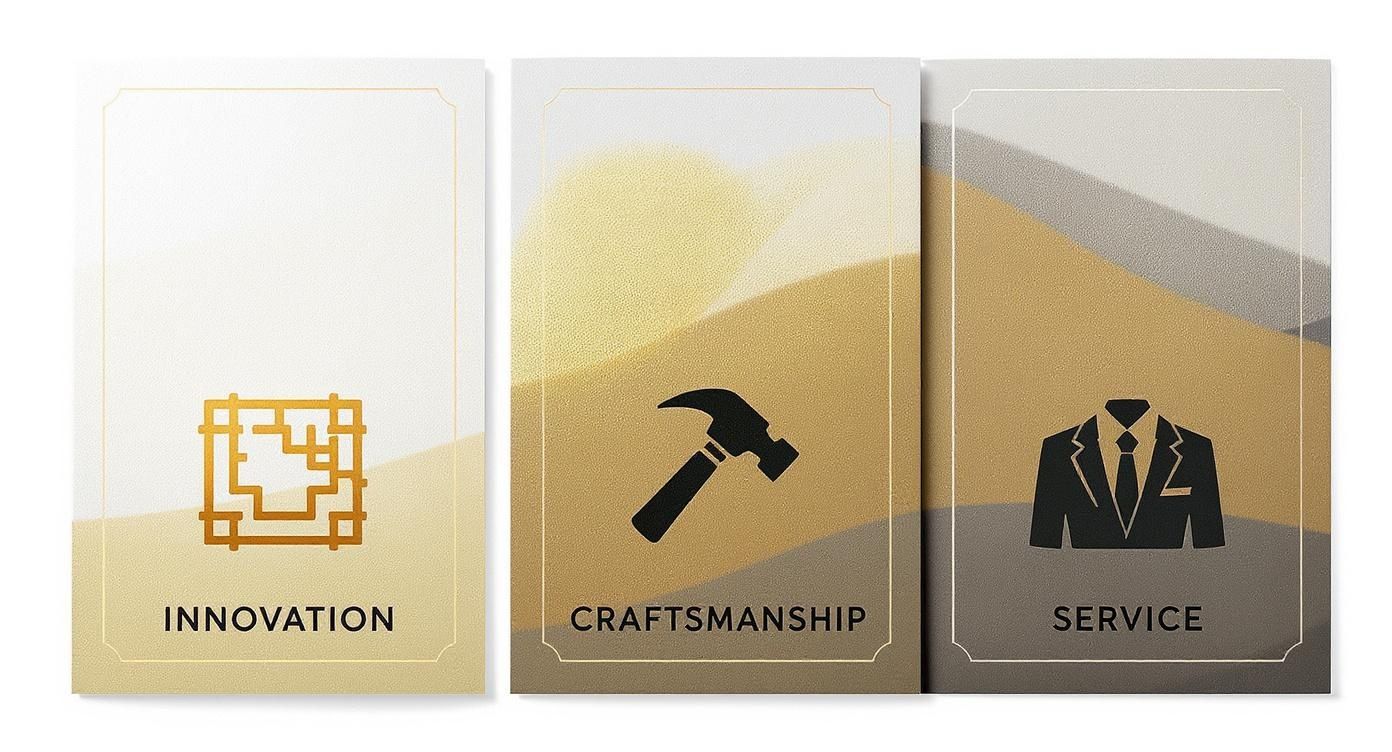
This visual is a constant reminder that every digital action you take must reflect your firm’s unwavering commitment to innovation, quality craftsmanship, and exceptional service.
To bring this all together, let’s look at how the primary digital channels fit into a cohesive strategy for a custom builder.
Key Digital Marketing Channels for Custom Builders
| Channel | Primary Goal | Key Performance Indicators (KPIs) | Strategic Role |
|---|---|---|---|
| Website & SEO | Convert interest into leads; establish authority | Organic Traffic, Keyword Rankings, Form Submissions, Time on Page | The digital hub and primary lead-generation engine. Captures high-intent prospects actively searching for a builder. |
| PPC Advertising | Generate qualified leads with precision and speed | Cost Per Lead (CPL), Click-Through Rate (CTR), Conversion Rate | Gets your message in front of a hand-picked audience based on income, location, and interests. Ideal for immediate impact. |
| Social Media | Build brand desire and showcase visual expertise | Engagement Rate, Follower Growth, Website Clicks | The “top-of-funnel” inspiration machine. Tells your brand’s story visually to nurture long-term interest. |
| Email Marketing | Nurture long-term relationships and build trust | Open Rate, Click-Through Rate, Unsubscribe Rate | The relationship builder. Keeps your firm top-of-mind by providing value to prospects not yet ready to build. |
Each channel plays a distinct but interconnected role. A successful strategy isn’t about choosing one over the other; it’s about making them work together seamlessly.
Reaching Qualified Buyers with Precision Advertising
While building an organic audience is vital, hyper-targeted pay-per-click (PPC) advertising gives you the power to place your message directly in front of the right people, right now. Forget casting a wide net. The goal here is to eliminate wasted ad spend by using sophisticated targeting to reach a very specific profile.
You can layer criteria to define your ideal audience with incredible accuracy. For instance, you can target users based on:
- Demographics: Focusing on indicators for high household income and net worth.
- Geography: Zeroing in on specific high-value zip codes or even exclusive communities.
- Interests: Reaching users who follow luxury real estate publications, high-end interior designers, or show interest in adjacent luxury pursuits like yachting.
This level of precision is a cornerstone of effective custom home builder marketing. Top agencies have found this approach dramatically improves results, with some reporting that strategic targeting can expand a builder’s qualified buyer pool by 20-35%. Better yet, directing this traffic to specialized landing pages can boost conversion rates by 15-25%, as detailed in these reports on home builder marketing strategies and client results at oppgen.com.
Nurturing High-Value Leads Over Time
Finally, your digital plan must account for the long game. The journey to building a custom home is a marathon, not a sprint, and it’s built on a foundation of trust. This is where sophisticated email marketing becomes your most valuable tool for relationship building.
Instead of just sending out a generic monthly newsletter, think in terms of automated nurture sequences that deliver real value. Share insightful guides on complex topics like land acquisition, navigating zoning laws, or the latest architectural trends. This approach subtly positions you as a trusted advisor, not just a contractor.
By consistently providing expertise, you keep your firm top-of-mind. When a prospect is finally ready to take that next big step, you won’t be just one of the options—you’ll be the only one they call.
Creating Content That Converts Prospects Into Clients
In the luxury home market, content has a much bigger job to do than just getting attention. Its real purpose is to build unshakable trust and prove you’re the expert, guiding a discerning prospect from their first flicker of interest all the way to a signed contract. A well-crafted content strategy acts like a virtual consultation—it anticipates questions, demonstrates your value, and makes a case for why your firm is the only choice, long before you ever meet in person.
This means you have to go way beyond simple photo galleries. Your content needs to tell a story. Think about each project less as a finished product and more as the narrative of a client’s dream brought to life. High-quality content is the “premium material” of your marketing; it has to reflect the same level of excellence you deliver on the job site.
From Portfolio to Compelling Project Case Studies
Your project portfolio is easily your most powerful sales tool, but a collection of static images just won’t cut it. The key is to transform each finished home into a compelling case study that walks people through the entire journey. This approach gives prospects a rare, behind-the-scenes look at your process, your craftsmanship, and how you solve real-world problems.
A great case study isn’t just a collection of pretty pictures. It needs to be structured like a good story, with a clear beginning, middle, and end.
- The Challenge: Kick things off by explaining the client’s initial vision and any unique hurdles the project presented. Maybe it was a tricky lot, a specific architectural demand, or an ambitious timeline.
- The Process: Walk the reader through how your team tackled the design and build. This is where you can highlight pivotal moments, innovative techniques, or the specific materials that give the home its soul.
- The Transformation: Wrap it all up with a stunning visual reveal of the completed home, making sure to connect the final result back to the client’s original dream.
What ties this all together? Professional visuals and, most importantly, a powerful client testimonial. Hearing directly from a thrilled homeowner provides a level of social proof that no marketing copy can ever hope to match.
A great project case study doesn’t just show what you built; it explains why it was built that way and celebrates the collaborative journey you took with the client. It sells your process, not just your product.
Building Authority with Expert Content
While case studies put your work on display, authority-building content proves you’re a master of your craft. Affluent clients are making one of the biggest investments of their lives; they need to see you as a trusted advisor, not just a contractor. This kind of content answers their most pressing questions and cements your firm’s reputation as a leading expert.
Creating this educational content is a cornerstone of custom home builder marketing. It’s how you nurture leads over the long haul by giving them real value.
Think about developing in-depth guides on the topics your ideal clients are already searching for online:
- Land Acquisition: A practical guide on what to look for when buying a lot, covering everything from zoning rules to potential topographical issues.
- Architectural Styles: An exploration of different design aesthetics that helps potential clients find the language to describe their own vision.
- Navigating the Build: A transparent look at the entire construction timeline. This shows you have a structured, proven process and can guide them with confidence. For example, a thorough article on the custom home building process guide can demystify the journey and build tremendous trust from the outset.
Content like this does double duty. It educates your audience while also boosting your website’s SEO, helping you show up for the exact search terms high-net-worth individuals use when they start planning a custom home.
The Immersive Power of Video Marketing
If a picture is worth a thousand words, then a well-produced video is worth a signed contract. Video takes your portfolio from a static, two-dimensional gallery and turns it into an immersive, emotional experience. It’s the closest you can get to letting potential clients feel the space without them actually being there, creating a much deeper connection to your brand.
You don’t need a Hollywood-sized budget, but the quality has to be on par with your brand. Just a few strategic videos can make a massive difference.
- Cinematic Home Tours: Start with breathtaking drone footage to show off the home’s setting and scale. Then, transition to smooth, stabilized walkthroughs of the interior that linger on the key architectural details and high-end finishes.
- Architect & Builder Interviews: A short video with your lead architect or project manager explaining the vision behind a home adds a powerful human element. It’s a chance for them to share their passion and expertise directly with the viewer.
- Client Testimonial Videos: Nothing beats a video of a happy client standing in their beautiful new home, sharing their experience. It’s authentic, it’s persuasive, and it’s incredibly effective at calming the nerves of new prospects.
By weaving together these three types of content—narrative case studies, expert guides, and immersive video—you build a powerful system that doesn’t just attract your ideal clients, but converts them.
Winning at the Local Level: SEO and Community Trust
At its core, custom home building is an intensely local game. Your clients aren’t just buying a property; they’re investing in a community, a school district, and a way of life. This means your marketing has to be just as grounded in the local fabric, both online and off.
A powerful local strategy is what ensures that when affluent buyers in your service area begin their search, your firm is the first and most trusted name they encounter. It all starts with mastering local Search Engine Optimization (SEO). Think of it as putting up a billboard, but one that’s only visible on the exact digital streets your ideal clients are traveling. When someone types “luxury home builder in [Your City]” into Google, you need to own that top spot.
Your Digital Front Door: The Google Business Profile
If you do one thing for your local marketing, make it this. Your Google Business Profile (GBP) is arguably your most critical local asset. It’s the first impression you make, showing up right in Google Search and on the map. Neglecting it is like having a messy, uninviting storefront on the busiest street in town.
Getting it right is straightforward but demands consistent effort:
- Showcase Breathtaking Imagery: This is your visual handshake. Fill your profile with a curated gallery of your absolute best work—high-resolution photos of stunning exteriors, meticulously crafted interiors, and those unique architectural details that define your brand.
- Get the Details Right: Consistency is king. Ensure your business name, address, and phone number (known as NAP) are identical everywhere online, from your website to industry directories.
- Collect Five-Star Reviews: Don’t be shy. Actively and systematically ask your happiest clients for reviews. A steady flow of glowing feedback is one of the most powerful trust signals you can possibly send.
Your Google Business Profile isn’t a static listing. It’s a living, breathing showcase of your quality and reputation. It’s where potential clients go to validate their interest and decide whether to pick up the phone.
Capturing High-Intent Buyers with Location Pages
To really dominate the local search results, you need to speak directly to clients looking in specific, high-value areas. This is where dedicated “location pages” on your website come in. These are pages built from the ground up to rank for hyper-specific searches like “custom home builder in [Exclusive Neighborhood Name].”
Each page should function as a micro-brochure for that specific community.
- Tell the Neighborhood’s Story: Talk about the area’s unique character, prevailing architectural styles, and the lifestyle it offers.
- Show Relevant Work: Feature photos of homes you’ve built in or near that neighborhood. This demonstrates direct, relevant experience.
- Add Local Voices: Include testimonials from clients who live in that community. It adds an incredibly powerful layer of social proof.
This targeted strategy helps you connect with the most motivated buyers—the ones who have already pinpointed where they want to build and are now just looking for the right partner.
Forging Powerful Local Alliances
Your digital presence becomes exponentially more powerful when you pair it with real-world community engagement. Building strategic partnerships with other high-end professionals in your area creates a referral engine that runs on its own, delivering exceptionally qualified leads right to your doorstep.
Start connecting with professionals who serve the same clientele but aren’t direct competitors:
- Top Luxury Real Estate Agents: They are on the front lines, often meeting affluent buyers the moment they decide to move or purchase land.
- Respected Local Architects: Strong collaborations on projects build mutual respect and naturally lead to future recommendations.
- In-Demand Interior Designers: They work with clients who already value quality craftsmanship and aesthetics, making their referrals a perfect fit.
By nurturing these relationships, you embed your firm into the local luxury ecosystem. You become the go-to builder, not just for clients who find you online, but for those asking other trusted advisors for a recommendation. Seeing where your name appears on the top platforms to find high-end home builders near me will reinforce just how crucial this integrated local presence is. It’s how you build deep community trust and turn your business into a respected local institution.
Measuring Your Marketing ROI for Sustainable Growth
Marketing without measurement is like building a house without a blueprint. You’re spending a lot of money and time, but you have no real way of knowing if the final product will be what you envisioned. To grow your business in a predictable, sustainable way, you have to stop guessing and start measuring. This means tracking the numbers that tie your marketing efforts directly to your bottom line.
Think of it this way: a data-driven approach turns your marketing budget from a simple expense into a strategic investment. It all starts with identifying your Key Performance Indicators (KPIs)—the vital signs that tell you how healthy your marketing really is. For a custom home builder, these aren’t vanity metrics like social media likes. We’re talking about tangible data that points to real business opportunities.
Key Metrics That Matter for Builders
To get a real sense of performance, you have to look beyond surface-level numbers like overall website traffic. The devil is in the details. Here are the essential KPIs every custom builder should be watching like a hawk:
- Traffic from Target Zip Codes: Are you reaching people in the affluent neighborhoods you actually want to build in? Tools like Google Analytics can pinpoint where your website visitors are coming from, geographically.
- Qualified Lead Form Submissions: How many of your contact form inquiries are from serious prospects versus tire-kickers? This is all about measuring the quality of your leads, not just the quantity.
- Cost Per Qualified Lead (CPQL): This is your ultimate efficiency metric. It answers a simple but critical question: how much are we spending to get one legitimate, build-ready client in the door?
- Tracked Phone Inquiries: Using unique, trackable phone numbers on your website, ads, and social media profiles lets you see exactly which marketing channels are making your phone ring.
When you know your numbers, you can confidently double down on what’s working and cut the fat from what isn’t. It’s about making smarter, more profitable decisions with every single dollar you put into building your brand.
These metrics are especially important because the luxury custom home market dances to a different beat than the rest of the housing industry. While rising interest rates might cool the broader market, your clients are more influenced by household wealth and stock market performance. In fact, over a recent four-quarter span, custom housing starts hit 184,000—a 2% increase from the previous period, showing a steady demand. You can read more about the growth of custom home building on Eye on Housing.
Mapping the Full Customer Journey
At the end of the day, your goal is to draw a straight line from a prospect’s first click on your website to the day they sign a contract. True custom home builder marketing is about mapping that entire journey.
When you can see how a client first discovered you—whether it was a Facebook ad, an article on your blog, or a Google search for “luxury builder near me”—you can pinpoint your most profitable marketing channels. This complete picture allows you to fine-tune your strategy, ensuring every move you make is calculated to attract your next legacy project and drive real, long-term growth.
Your Top Marketing Questions, Answered
When you’re mapping out a marketing plan, a lot of specific questions tend to bubble up. Let’s tackle some of the most common ones we hear from custom builders, giving you direct, no-fluff answers to help you sharpen your strategy.
These aren’t just theoretical ideas; they’re grounded in the core principles of what actually works for marketing a custom home building business: precision, a focus on quality, and a relentless eye on the return.
What’s a Realistic Marketing Budget for a Custom Builder?
For an established builder, a solid rule of thumb is to set aside 3-5% of your total revenue for marketing. This is typically enough to keep your brand visible and maintain a consistent flow of high-quality leads from the channels that are already working for you.
If you’re a newer builder trying to break into the market, or if you’re expanding into a new luxury territory, you’ll need to be more assertive. In that case, an investment closer to 5-8% is more realistic. This gives you the fuel needed for that initial push to build brand recognition and earn credibility from scratch.
The specific percentage is less important than the return it generates. Your real focus should always be on measurable ROI. Start with a budget you’re comfortable with, put your money into high-impact assets like your website and local SEO first, and then scale up based on what’s bringing in genuine, qualified prospects.
If I Can Only Focus on One Thing, What’s My Most Important Marketing Asset?
Your website. No contest. And to be even more specific, your project portfolio is the star of the show.
Think about it from your client’s perspective. They are preparing to make one of the most significant investments of their lives. Seeing is believing, and your website is their very first chance to vet the quality of your work. It’s your digital showroom, and the portfolio is the main event.
Your portfolio has to be flawless. This means high-resolution, professional photography and compelling stories for each project that truly capture your craftsmanship, your eye for detail, and your distinct design aesthetic. A dated, slow, or clunky website can get you crossed off the list before a potential client even learns your name.
Should I Bother with Social Media for My Building Business?
Absolutely, but you have to be smart and selective. The goal isn’t to be on every platform; it’s to be on the right platforms—the ones where stunning visuals can do the talking and connect with an aspirational audience.
Concentrate your energy on visually-focused platforms where world-class imagery reigns supreme:
- Instagram: Perfect for building a curated gallery of your finest work. You can showcase breathtaking details in photos and offer compelling walkthroughs with Reels.
- Pinterest: This is a powerhouse for inspiration. Affluent clients spend hours here creating dream boards for their future homes. You want your work to be what they find and save.
- Houzz: An essential hub for the home design and building industry. It’s part portfolio, part social network, and it’s filled with a community of prospects actively looking for builders.
The aim here isn’t to make a quick sale. It’s to inspire. It’s about building your brand’s unique identity and telling the story behind your craftsmanship. When you do that effectively, you attract followers who resonate with your style—people who will become your future clients or your most valuable source of referrals.
Ready to connect with a clientele that values unparalleled craftsmanship? Haute Design is the premier platform for distinguished builders to showcase their work to an exclusive, high-net-worth audience. Gain the visibility and credibility your brand deserves. Learn more and apply to join our curated network at https://hauteliving.com/designnetwork.