


Before you ever break ground on your dream home, the most critical tool in your arsenal is the custom home builder contract. This isn’t just a piece of paperwork. It’s the legally binding blueprint that dictates every single detail of the project, from the rebar in the foundation to the finish on the cabinet pulls. A solid, well-negotiated contract is your best line of defense against misunderstandings, budget blowouts, and the kind of disputes that can turn a dream project into a nightmare.

Building a custom home is an incredible journey, and you’re in good company. The demand for truly personalized living spaces is booming. We saw 4% growth in the custom home building sector in the second quarter of 2025 alone, with builders starting 184,000 unique homes over the previous year.
What’s driving this? Unlike spec homes, the custom market is often fueled by personal wealth and a specific vision, making it less susceptible to the whims of interest rate hikes. Understanding these trends helps you see the bigger picture of the market you’re stepping into.
A handshake deal or a vague, one-page agreement simply won’t cut it for a project of this magnitude. Think of the contract as the ultimate communication tool. It’s designed to translate your vision and the builder’s commitments into an enforceable, shared plan, ensuring everyone is on the exact same page from the start.
A meticulously crafted contract does more than just outline the basics; it protects both your massive financial investment and the builder’s professional reputation. Ambiguity is the enemy in construction, and a vague agreement leaves the door wide open for conflict.
A proper contract needs to nail down several key areas:
A great contract doesn’t just protect you when things go wrong; it prevents them from going wrong in the first place by forcing clarity and alignment from day one.
The journey from a vague idea to a finished home involves thousands of decisions. The contract is where those decisions get put into writing, turning concepts into concrete, legally binding commitments.
This is where you specify the brand of the windows, the grade of the flooring, and the model number of the kitchen appliances. Getting this granular might seem tedious, but it’s absolutely essential for ensuring you get the home you’re paying for.
Getting familiar with the structure of this agreement is your first step. For a broader look at the entire process, our comprehensive custom home building process guide offers valuable context. By arming yourself with this knowledge, you can walk into negotiations with confidence, ready to secure a contract that protects your interests and paves the way for a smooth build.
A custom home builder contract can look like a fortress of legalese. It’s intimidating. But the reality is, the strength of that document—and your ultimate protection—is buried in those details. This isn’t just about letting the lawyers handle it; as the homeowner, understanding these key clauses is one of the most important things you’ll do. This is where your vision for a home stops being a dream and starts becoming a set of concrete, legally-binding promises.
Let’s get practical. We’re going to walk through the sections that matter most and what they actually mean for your budget, your schedule, and the quality of the home you end up with.
Make no mistake: the Scope of Work is the single most important part of your entire contract. Think of it as the project’s DNA. It needs to be an exhaustive, almost painfully detailed description of every single task the builder is responsible for and every material they’ll use. Any vagueness here is a wide-open door for disputes and extra costs later.
For example, a builder might write, “Install hardwood floors in the living room.” That sounds okay, but it’s a trap. A well-defined scope will read something like: “Install 3/4-inch thick, 5-inch wide, pre-finished white oak hardwood flooring (Model #XYZ from ABC Flooring) in the living room, to include QuietWalk Plus underlayment, matching transition strips at all doorways, and quarter-round molding stained to match.” The difference is staggering.
This level of detail needs to be applied to absolutely everything.
Your job here is to eliminate assumptions. If it isn’t written down in excruciating detail, you have to assume it’s not included in the price. It’s that simple.
A fair Payment Schedule is a two-way street; it protects you, and it protects the builder. The key is to link every single payment to a tangible, verifiable construction milestone. Never, ever agree to a schedule based on calendar dates. And if a builder asks for a massive upfront deposit—anything over 10-15% is a huge red flag—it often signals they have cash flow problems you don’t want to inherit.
Before signing, we need to create a clear checklist of what to look for in the contract clauses.
Here is a summary of the most important, non-negotiable clauses you should review in your custom home builder contract, and what to watch out for in each one.
| Clause | What to Verify | Potential Red Flag |
|---|---|---|
| Scope of Work | Every material, fixture, and task is specified with model numbers, brands, and dimensions. | Vague descriptions like “builder-grade fixtures” or “hardwood floors” without specifics. |
| Payment Schedule | Payments are tied to completed, inspectable milestones (e.g., foundation poured, framing complete). | A large upfront deposit (over 15%) or payments based on arbitrary dates. |
| Allowances | Budget amounts are realistic for the quality you expect. Research costs for your desired items. | Unrealistically low allowance numbers used to make the total contract price seem lower. |
| Change Orders | The process for making changes is clearly defined, including how costs and time will be handled. | No formal process, or language that allows for verbal agreements without written sign-off. |
| Timeline | A clear start date and projected completion date are included, along with clauses for delays. | No distinction between excusable (weather) and inexcusable (poor scheduling) delays. |
| Dispute Resolution | The contract requires mediation before arbitration or litigation. | A clause that forces you directly into costly binding arbitration or a lawsuit. |
| Warranty | The warranty explicitly states what is covered (workmanship, materials) and for how long. | A warranty that is vague, very short, or provided by a third party with a poor reputation. |
This checklist isn’t just a suggestion; it’s your frontline defense against misunderstandings and unexpected expenses down the road.
A healthy payment schedule breaks down logically, ensuring you only pay for work that’s actually been done. It should look something like this:
This approach keeps you in the driver’s seat by maintaining leverage throughout the entire build.
Your contract will also lay out how materials get selected and paid for, which often means dealing with allowances. An allowance is just a budget placeholder for items you haven’t picked out yet, like light fixtures, tile, or countertops.
Here’s where you need to be careful. Some builders will intentionally put lowball allowance numbers into the contract to make the overall price look more appealing. A $5,000 lighting allowance might sound generous, but you’ll burn through that in a heartbeat when outfitting a whole luxury home. Do your own homework. Price out the fixtures and finishes you actually want and insist that the allowances reflect reality.
Every contract needs a Construction Timeline with a firm start date and a target completion date. But what’s even more critical is the clause that defines how delays are handled. It must clearly separate excusable delays (things no one can control, like a hurricane or a major supply chain collapse) from inexcusable ones (like the builder’s own poor planning).
Finally, look for the Dispute Resolution clause. This is the roadmap for what happens when you and the builder don’t see eye-to-eye. A well-written contract won’t send you straight to court. It will mandate a stepped approach, starting with direct negotiation. If that fails, the next step should be mediation, where a neutral third party helps you find common ground. Only after that should binding arbitration or a lawsuit be on the table. Starting with mediation can literally save you tens of thousands of dollars in legal battles.
Going through these clauses with a fine-toothed comb—ideally alongside a good construction attorney—is what turns a contract from a source of anxiety into your most powerful tool for getting the home you paid for.
Even with the most detailed blueprints in hand, a custom home budget can quickly get away from you. Nine times out of ten, the culprits are two little words that carry a lot of financial weight: allowances and change orders. Getting a firm handle on how these are defined and managed in your contract isn’t just a good idea—it’s the single best way to protect your wallet and avoid those gut-wrenching surprise invoices.
These two clauses are where most of the financial risk in a custom build lies. Think of allowances as placeholders for things you haven’t picked out yet, and change orders as the official paperwork for any time you color outside the lines of the original plan. Without a tight process for both, your contingency fund can vanish in the blink of an eye, creating a lot of unnecessary friction with your builder.
The infographic below really drives home how all the major pieces of your contract—the scope of work, payment schedule, and timeline—are interconnected.
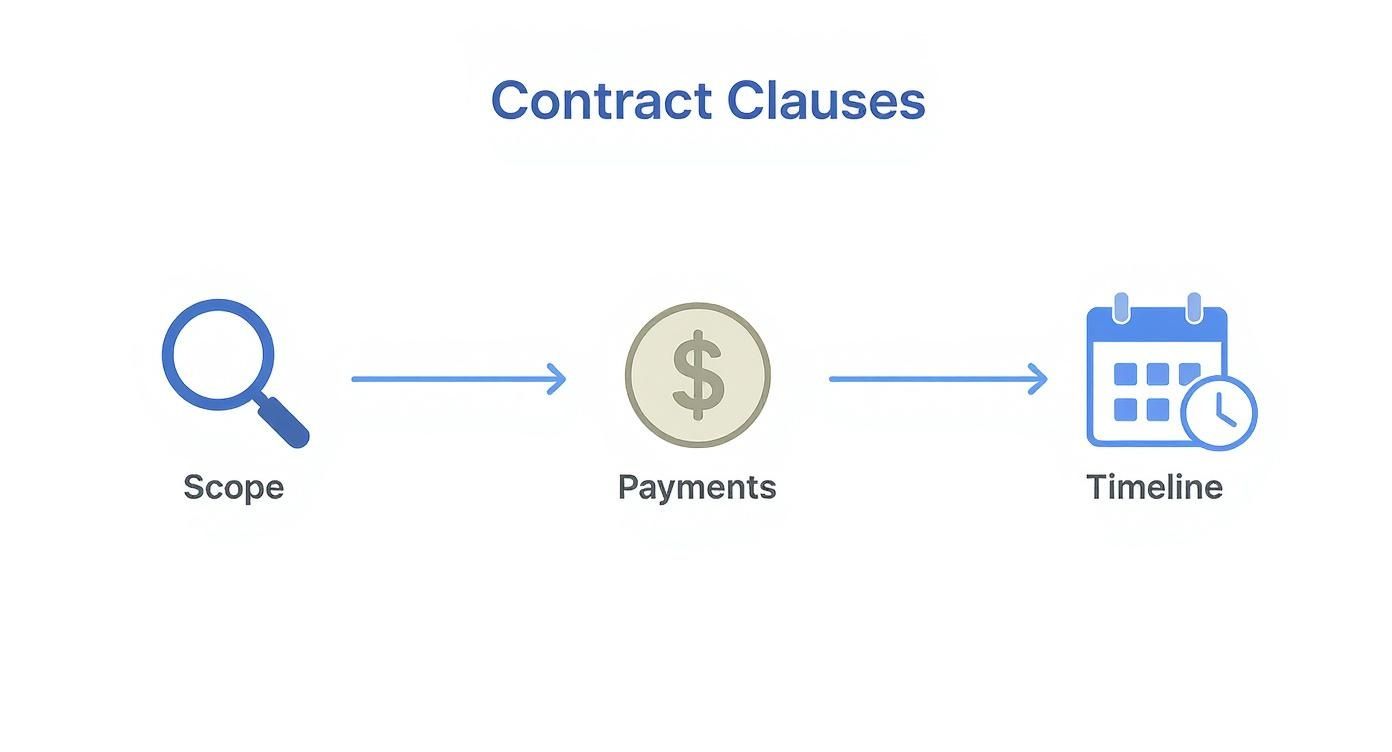
As you can see, a solid foundation built on a clear scope, milestone payments, and a realistic timeline directly impacts how you have to manage allowances and changes to keep the entire project from going off the rails.
An allowance is simply a line-item budget for a specific category where the final choice is still up in the air. We see them most often for things like:
While they offer great flexibility, allowances can also be a well-disguised trap. A less-than-scrupulous builder might deliberately plug in unrealistically low numbers to make their overall bid look more attractive. For instance, a $10,000 allowance for all the kitchen appliances in a high-end custom home is almost certainly a fantasy. The moment you select the professional-grade appliances you’ve been dreaming of, you’re already over budget, and that difference comes straight from your pocket.
Before you sign anything, do your own homework. Price out the kinds of fixtures and finishes you actually want. Then, insist that the allowance figures in the contract reflect that reality, not just wishful thinking. A great builder will work with you to set realistic numbers from day one.
Let’s be honest: no matter how perfect the plan is on paper, things will change. You might stand in the framed-out kitchen and realize you want to add a window over the sink, or decide to upgrade your countertops after seeing a stunning slab of quartzite. Any time you stray from the original scope of work, it needs to be documented with a formal change order. This is a non-negotiable step that protects both you and the builder.
A quick verbal agreement to “just go ahead and add that” is a recipe for a massive headache down the line. It leaves everything ambiguous—cost, responsibility, timing—and almost always ends in a dispute when the final bill comes due.
Your contract must lay out the change order process in black and white. A well-defined system creates total transparency and ensures you’re always in the driver’s seat. Here’s what it absolutely must include:
This might feel a bit formal, but this process is your best defense against scope creep and a runaway budget. It forces everyone to pause and consider the full financial impact of every decision before it’s too late. When your contract gets this right, allowances and change orders are no longer budget-breakers; they’re just manageable, predictable parts of the custom home journey.

A custom home builder contract, no matter how perfectly drafted, is only as strong as the person who signs it. Before you commit, you have to remember this is a long-term partnership. The due diligence you do now is arguably the most critical part of the entire build process. It’s how you ensure you’re not just hiring a contractor, but bringing on a partner who truly understands and can execute your vision.
The negotiation that follows isn’t about winning or losing. It’s about getting everything crystal clear and making sure the agreement is fair. This is where you align on every detail, from how payments are handled to what the warranty really covers, creating a balanced contract that protects everyone.
First things first: look past the glossy portfolio and dig into the builder’s real-world reputation. A stunning website doesn’t tell you anything about their process or the quality of their work when things get tough. You need to verify their credentials and, more importantly, talk to people who have been in your shoes.
This groundwork is non-negotiable. While the construction industry has its share of challenges—from talent shortages to volatile material costs—its fundamentals are solid. Total construction spending pushed past $2 trillion in 2024, and the residential market is expected to hit $8.3 trillion by 2030. This is a strong market, which is great, but it also means the best builders are in high demand, making your vetting process all the more crucial.
Here are the absolute must-do checks:
When you talk to past clients, ask the pointed questions: “How did the builder handle unexpected problems?” “Did the final cost line up with the initial estimate?” “Knowing what you know now, would you hire them again?” The answers will tell you everything you need to know.
A builder’s financial health is directly tied to your project’s health. If they’re struggling with cash flow, they might be tempted to cut corners, delay paying their subs (which can lead to a lien on your property), or even walk off the job.
A great way to gauge their stability is to talk to their suppliers. Local lumberyards or building material suppliers can often tell you if a builder pays their bills on time. Consistent, timely payments are a very strong sign of a well-managed, financially responsible business.
For a deeper dive into this critical selection phase, our guide on how to choose a home builder for your custom home lays out a more detailed framework for making this decision with confidence.
Once you’ve found a builder you can trust, it’s time to dial in the contract details. While many clauses are standard, almost everything is open for discussion. A good builder will welcome these conversations to make sure the agreement works for both of you.
Focus your energy on these key areas:
A successful negotiation creates a win-win. By doing your homework upfront and advocating for fair terms, you can turn a standard document into a personalized custom home builder contract that truly serves as the blueprint for a successful project.
You’ve worked through the complex clauses, done your due diligence on the builder, and hammered out terms that feel right. The finish line is just ahead, but these last few steps before you sign the custom home builder contract are arguably the most important. This is where you shift from discussion to documentation, making sure the legal foundation for your project is as solid as the concrete one they’re about to pour.
Before a single signature hits the page, there’s one step that is absolutely non-negotiable for every single person building a home. You must have the complete, final draft of the contract reviewed by a real estate or construction attorney.
This isn’t a place to save a few dollars. A few hundred spent on legal fees now can literally save you tens of thousands of dollars and months of stress down the road. An attorney who lives and breathes construction law will immediately spot vague language or imbalanced clauses that an untrained eye would easily miss. They are your best defense, ensuring the contract legally protects your interests, especially around critical areas like lien waivers, warranties, and how disagreements will be handled.
Think of your attorney as the ultimate quality control check. They’ll verify that every verbal promise and negotiated change has made its way into the final document correctly. They provide a detached, professional perspective, ensuring the contract isn’t just a roadmap but a legally enforceable shield for your investment.
This expert review is more critical than ever in a booming market. The residential construction industry is massive, growing from a $4.17 trillion market in 2017 with projections hitting $6.8 trillion by 2022. While this growth signals a healthy industry, it also means builders are juggling more projects, making airtight agreements absolutely essential to navigate the chaos.
Bringing in a construction attorney isn’t about showing distrust. It’s simply smart business for a financial commitment of this size. A reputable builder will expect it and respect you for it.
Once your attorney gives you the all-clear, it’s time to sign. It’s crucial that both you and an authorized person from the building company sign and date the document. You may also need to initial each page to confirm you’ve reviewed it all.
Make sure you walk away with a “fully executed” copy of the contract immediately after signing. This is the official version with all signatures, and it becomes the project’s guiding document. Digital signatures are standard practice and legally binding today, but always request a final, unalterable PDF for your personal records.
With the contract officially in place, the project moves from paper to reality. The next steps should unfold in a clear sequence, which your agreement should already spell out for you.
This final stage is what turns your dream into a tangible plan. Getting these last steps right ensures your custom home journey begins with clarity, legal protection, and a shared understanding. This same attention to detail is just as crucial when putting together a professional interior design contract.
When you’re building a custom home, the contract can feel like a maze of legal jargon. Even after you’ve grasped the key clauses, real-world questions always pop up. Let’s break down some of the most common ones I hear from clients as they get ready to sign on the dotted line.
This is all about how your money flows and where the financial risk lies. You’ll almost always see one of two models: fixed-price or cost-plus. They’re very different animals.
A fixed-price contract is exactly what it sounds like: one number for the whole job. Your builder agrees to complete everything in the plans for that specific amount. This route offers incredible peace of mind because your budget is locked in from day one, assuming you don’t make changes. It’s perfect when your architectural plans are 100% complete and you want no financial surprises.
Then there’s the cost-plus contract, which is an open-book approach. You agree to pay the actual cost of labor and materials, plus a fee for the builder’s overhead and profit. That fee can be a set dollar amount or a percentage of the total project cost. While this model gives you total transparency into where every dollar is going, it also means you carry the risk if costs run higher than the estimate. It’s often better for complex, one-of-a-kind projects where the scope might need to evolve.
Most reputable builders will hand you their standard contract, often based on a template from an organization like the National Association of Home Builders (NAHB). These are a great starting point—they’ve been vetted and cover the essential legal bases.
But here’s the crucial thing to remember: that contract was written to protect the builder, not you.
This isn’t a red flag or a sign the builder is out to get you; it’s just smart business on their part. Your job is to make sure the final document protects your interests, too. Never just sign what they give you. The best strategy is to treat their contract as a first draft.
Give it to your construction attorney to review. They’ll spot the one-sided clauses and suggest amendments or add an addendum to balance the scales. This is far more effective and less confrontational than trying to start from scratch.
Your goal isn’t to start a battle over the contract; it’s to refine it into a tool that fosters clear communication and mutual protection. A good builder will be open to reasonable modifications.
Things can go wrong, and disagreements happen. This is exactly why the Dispute Resolution clause is one of the most important sections in the entire document. A solid contract won’t just vaguely mention resolving differences; it will spell out a clear, step-by-step process for handling conflict.
The whole point is to de-escalate problems before they blow up into a lawsuit, which is a nightmare for everyone involved. The process usually looks something like this:
Following the process outlined in your contract is non-negotiable. It gives you a structured, legally sound path to resolving problems while hopefully keeping the project—and your relationship with the builder—intact.
This should be crystal clear in the contract, with no room for interpretation. In 99% of custom home projects, the builder is responsible for securing all necessary building permits.
This is a core part of their professional service, not just a bit of paperwork. An experienced builder knows the local codes inside and out, understands the submission process, and has relationships with the officials at the building department. Their management fee should absolutely cover the time and skill this requires.
Before you sign anything, find the clause (usually in the Scope of Work) that explicitly states the builder will handle all permitting. It should also clarify that no construction will begin until every required permit has been officially issued and posted on-site. This is a critical protection against the legal and financial disaster of unpermitted work.
Finding the right professionals is the first step to a successful custom build. At Haute Design, we connect discerning clients with the nation’s most acclaimed architects, builders, and interior designers. Discover the experts who can bring your vision to life at https://hauteliving.com/designnetwork.