


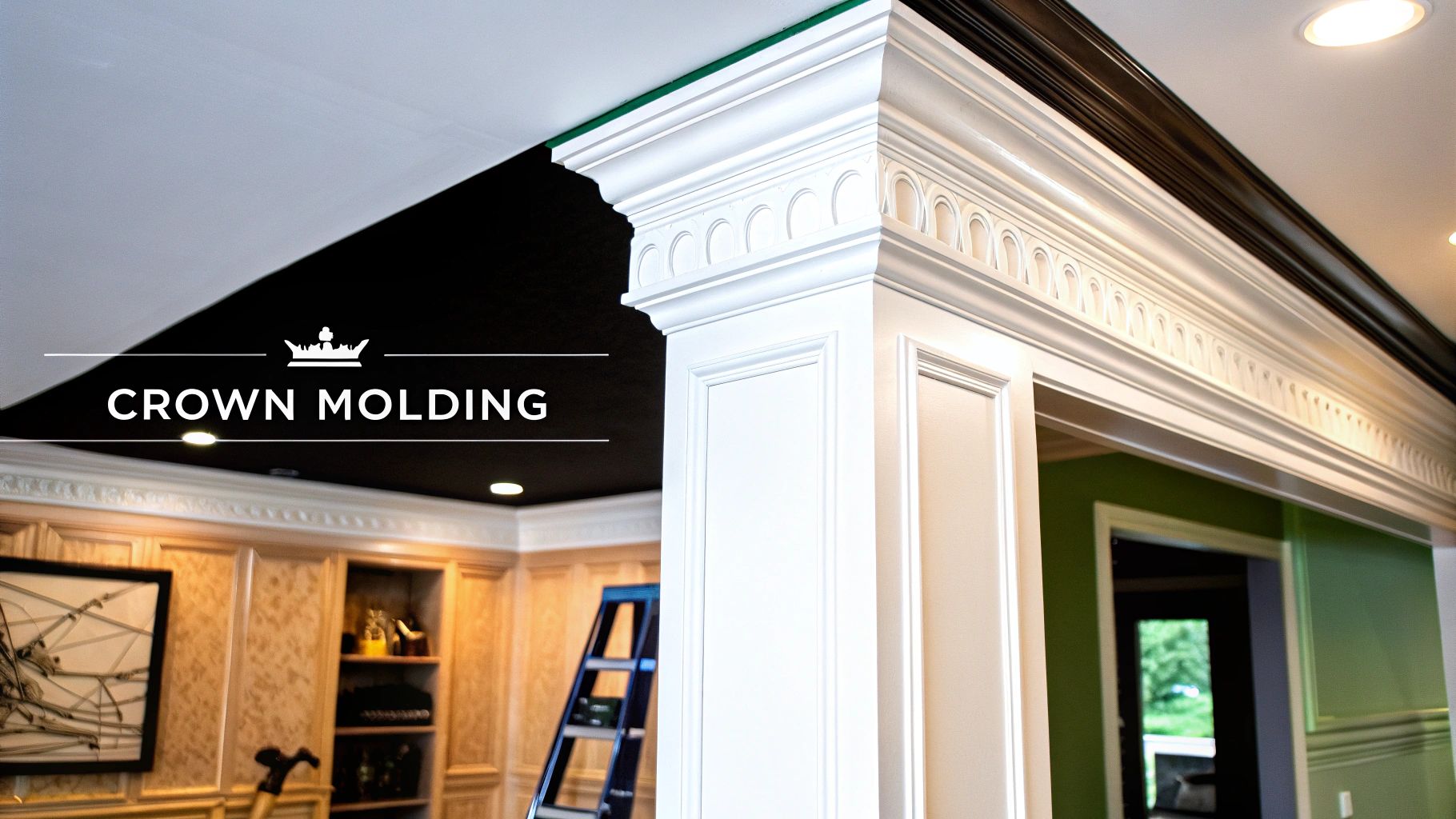
Crown molding is so much more than just a piece of trim; it’s the architectural signature that gives a room its personality. Think of it as the final, perfecting touch that ties everything together. It beautifully bridges the space where walls meet the ceiling, creating a seamless and polished look that can completely elevate an interior.
The Transformative Power of Crown Molding
Crown molding is one of those design secrets that adds both incredible beauty and real, tangible value to your home. It introduces a layer of detail and sophistication that can make any room feel like it was custom-designed.
By drawing the eye upward, a great molding installation can create the illusion of higher ceilings, making the entire space feel more expansive and grand.
Historically, you’d find elaborate crown molding in the grandest homes, a clear signal of wealth and status. While it still carries that air of luxury, today’s designs are incredibly versatile, fitting in everywhere from classic estates to sleek, modern condos. It’s that finishing touch that communicates a real commitment to quality design.
But its impact goes beyond just looking good. Crown molding serves a few key roles:
- Adds Visual Depth: It introduces beautiful shadow lines and dimension to what would otherwise be a plain, flat corner, breaking up the monotony.
- Defines Your Style: The right profile can lock in your home’s character, whether you’re going for intricate Victorian charm or the crisp, clean lines of a minimalist space.
- Boosts Home Value: It’s no secret in the real estate world. Appraisers and agents consistently point to details like high-quality trim as a feature that enhances a home’s appeal and market value.
A well-chosen crown molding doesn’t just decorate a room—it completes it. It’s the subtle detail that transforms a simple box into a sophisticated space with a distinct personality.
Ultimately, finding the perfect molding comes down to balancing proportion, style, and material. The options are nearly endless, from understated profiles for a contemporary loft to dramatic, multi-layered designs for a traditional home.
If you’re looking for inspiration, seeing how the pros do it is a great place to start. Exploring a gallery of luxury home design ideas can spark incredible creativity for your own project. This guide will walk you through all the choices, helping you find the perfect match for your vision.
Understanding Crown Molding Profiles and Styles
Choosing a crown molding design is a bit like learning a new visual language. Every curve, line, and angle tells a distinct architectural story, transforming a room from a simple box into a space with history and personality. Getting to know these different profiles is the first step in finding a design that truly speaks to your home’s character.
The profile is the specific shape of the molding when you look at it from the side—think of it as the molding’s unique fingerprint. Each one casts different shadow lines and creates different visual effects, which is why a seemingly small choice can have such a huge impact on the overall feel of a room.
The Most Popular Crown Molding Profiles
While the variations are nearly endless, most crown molding designs are built from a few foundational shapes. Once you can spot these core profiles, you’ll have a much better handle on what you’re drawn to.
- Cove: This is one of the simplest profiles out there, featuring a single, elegant concave curve. Its clean and unadorned look makes it a versatile choice for minimalist and transitional spaces where you want subtlety.
- Ogee: A classic S-shaped curve that brings together both a concave (cove) and a convex (round) arc. The ogee is probably the most traditional and widely used profile, offering a balanced look that works well in many architectural styles.
- Dentil: You’ll recognize this one by its series of small, tooth-like blocks that add a strong, rhythmic detail. It’s often found in Colonial, Federal, and Neoclassical homes, lending a formal and stately appearance.
This infographic breaks down how molding serves as a fundamental element in defining a room’s character.

As you can see, molding isn’t just a decorative afterthought; it’s a strategic tool for creating a polished look, adding value, and pulling an entire interior together.
Connecting Profiles to Architectural Styles
The real art is matching the profile to your home’s existing aesthetic. A poorly chosen molding can feel jarring and out of place, but the right one elevates the architectural integrity of the entire space. The relationship between trim work and the overall design is a core principle, and you can learn more about what interior architecture is and how it shapes spaces to deepen your understanding.
For example, highly ornate and complex profiles with details like egg-and-dart or bead-and-reel are hallmarks of Victorian or Georgian design. These styles celebrate intricacy and grandeur.
In contrast, modern and contemporary designs favor simplicity. Here, you’ll see sharp, clean lines—often simple cove profiles or even just flat, straight-edged stock—that emphasize form over ornamentation.
A transitional style, which bridges the gap between traditional and modern, might use a classic ogee but with softer, less dramatic curves for a more updated feel. The key is to select a crown molding design that feels like a natural extension of the room’s existing lines and character. This thoughtful selection is what elevates a space from merely decorated to truly designed.
Choosing the Right Material for Your Project
Picking a beautiful profile is only half the battle when it comes to crown molding; the material you choose is just as critical. Think of it like casting an actor for a role—each material brings its own character, strengths, and weaknesses to the final performance. Your decision will shape everything from the final look and feel to the complexity of the installation, its long-term durability, and, of course, the budget.
The right material has to do more than just look good. It needs to align with your design goals and handle the practical demands of the space. A grand, formal dining room might demand the timeless elegance of solid wood, while a steamy bathroom needs something that won’t warp or buckle under constant humidity.
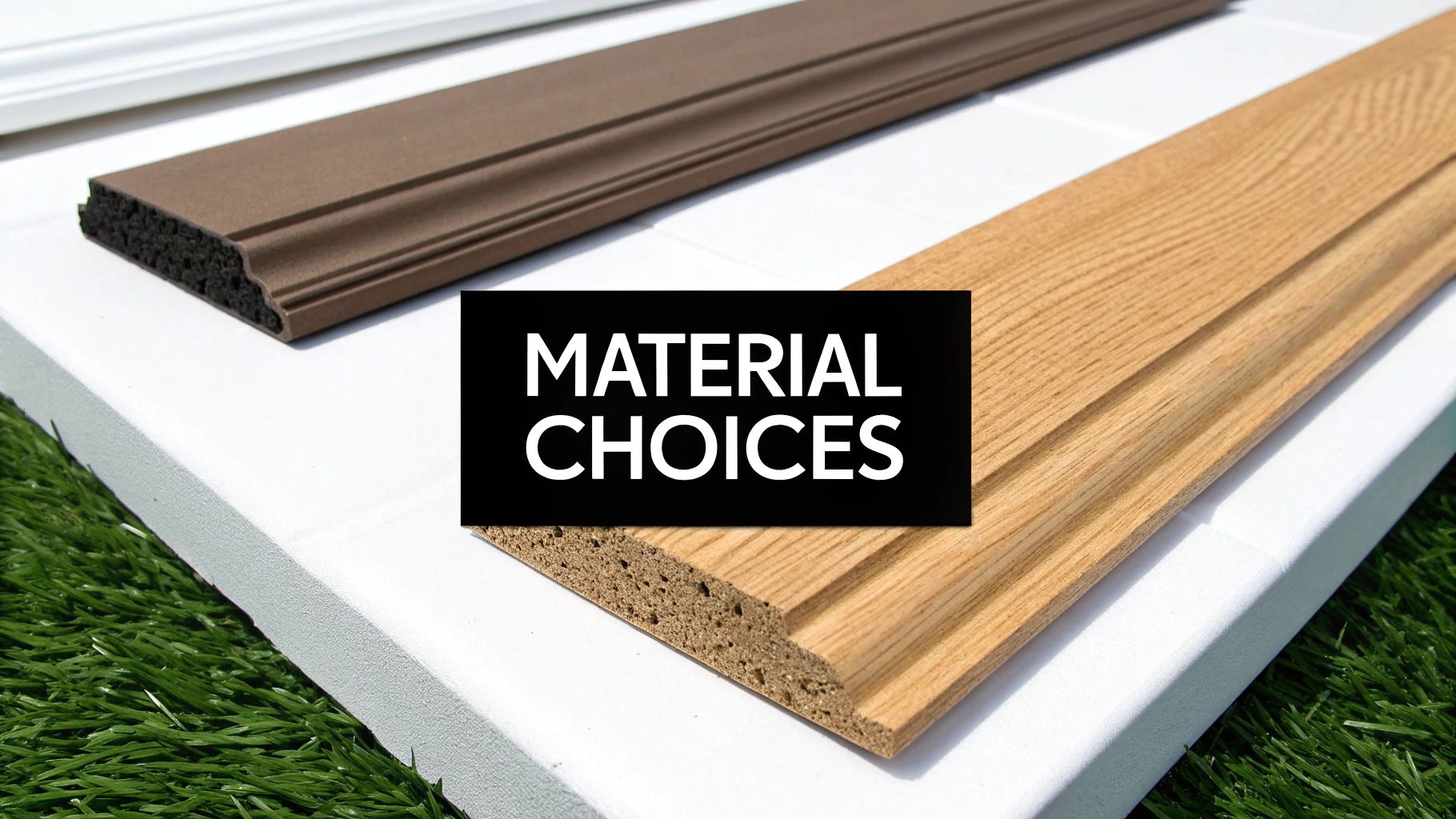
Let’s break down the most common options so you can make a choice with confidence.
Solid Wood: The Timeless Classic
For centuries, solid wood has been the undisputed champion of architectural trim, and for good reason. It offers a richness, warmth, and authenticity that other materials can only try to imitate. Hardwoods like oak, cherry, and walnut can be stained to let their beautiful natural grain shine through, adding incredible depth to a room. On the other hand, softer woods like pine and poplar are perfect for painting, giving you that crisp, clean finish.
Of course, this premium quality comes with a few considerations. Wood is a natural material, so it reacts to changes in temperature and humidity, which can cause it to expand, contract, or even warp over time. It’s also the heaviest and often most expensive option, requiring a skilled installer to get those mitered corners and seamless joints just right.
MDF: A Versatile and Budget-Friendly Option
Medium-Density Fiberboard, or MDF, is an engineered product made by compressing wood fibers with resin. It has quickly become a go-to choice for crown molding, mainly because of its affordability and incredibly smooth, uniform surface. Since it has no grain, MDF provides a flawless canvas for paint, resulting in a sharp, professional look every time.
Its popularity isn’t just anecdotal. The global market for MDF crown moulding was valued at USD 137.05 million in 2024 and is expected to keep growing, which highlights just how widely it’s being used in homes today. You can read more about the growth of the MDF molding market to see the full picture.
The biggest advantage of MDF is its stability. Unlike solid wood, it won’t expand or contract with environmental changes, making it a reliable and low-maintenance choice for most interior spaces.
The primary drawback? MDF and water are not friends. If the outer layer of paint gets chipped or damaged, moisture can seep in and cause the material to swell and crumble. This makes it a poor choice for bathrooms, laundry rooms, or anywhere with high humidity.
Polyurethane: The Durable and Lightweight Contender
For any room with moisture, polyurethane is your best bet. This high-density foam material is completely waterproof, insect-proof, and rot-proof, making it a fantastic solution for tough environments like bathrooms or even outdoor applications. It’s also incredibly lightweight, which makes it much easier to handle and install—often turning a pro-level job into something a skilled DIYer can tackle.
Polyurethane molding is impressively detailed, capable of replicating the sharp, intricate profiles of classic wood or plaster molding. While it typically costs more than MDF, its sheer durability and resistance to damage often make it a smarter investment for the long haul.
Choosing between these materials isn’t always easy. To simplify the decision, let’s look at them side-by-side.
Crown Molding Material Comparison
| Material | Average Cost (Per Foot) | Best For | Pros | Cons |
|---|---|---|---|---|
| Solid Wood | $3 – $12+ | Stained finishes, historic homes, high-end formal spaces. | Unmatched authenticity and beauty; can be stained or painted; adds significant value. | Expensive; heavy; susceptible to warping and cracking; requires professional installation. |
| MDF | $1 – $4 | Painted finishes in dry, stable environments like living rooms and bedrooms. | Affordable; smooth surface perfect for paint; dimensionally stable; easy to cut. | Vulnerable to water damage; can sag over long spans; not as durable as wood. |
| Polyurethane | $2 – $6 | Bathrooms, kitchens, exteriors, or any area with moisture; intricate profiles. | Waterproof and rot-proof; lightweight and easy to install; holds detail well. | Can dent easily; more expensive than MDF; requires special adhesives. |
Ultimately, the best crown molding material for your project depends on a careful balance of aesthetics, budget, and the specific demands of the room itself. By understanding these key differences, you’re well-equipped to select an option that will not only look stunning but also stand the test of time.
Matching Crown Molding to Your Interior Style
Choosing a crown molding profile without first considering your home’s existing style is like buying a picture frame before you’ve even seen the art. The right molding should feel like a natural extension of your decor, not an afterthought. It’s about creating a cohesive look where the trim speaks the same design language as your furniture, colors, and overall architecture.
Think of your molding as a key supporting actor—it’s there to enhance the room’s character, not steal the show. The goal is a seamless synergy, where the trim beautifully complements the dominant aesthetic, whether that’s the rustic charm of a farmhouse or the clean lines of a modern space.
Aligning Profiles with Popular Decor Styles
Every interior has its own unique vocabulary, and crown molding is a big part of that conversation. Pairing the right profile with your decor is absolutely critical for an authentic, polished finish. If you’re still working to pin down your home’s aesthetic, exploring a detailed essential interior design style guide can offer a ton of clarity.
Here’s a quick breakdown of how to pair molding with some common styles:
- Modern Farmhouse: This style is all about comfort and simplicity. Look for clean, unfussy profiles—a simple cove or a flat, Shaker-style trim works perfectly. You want a finishing touch that doesn’t add a lot of ornate complexity.
- Mid-Century Modern: Defined by organic shapes and function over form, this style often skips crown molding altogether. If you do decide to add it, go for something incredibly minimal, like a sleek, single-curve profile that practically disappears.
- Neoclassical or Traditional: These styles are built on a foundation of grandeur. This is where you can embrace multi-piece, built-up moldings with classic details like dentil, ogee curves, or egg-and-dart patterns to create a formal, stately look.
The secret to a truly successful crown molding design is its ability to complement, not dominate. It should feel intentional and fully integrated, as if it was always part of the home’s original architectural vision.
The Critical Role of Scale and Proportion
Beyond the specific profile, the scale of your crown molding is arguably the most important decision you’ll make. Get it wrong, and the entire room can feel off. An oversized molding in a room with low ceilings will feel heavy and oppressive, while a tiny, delicate trim will get completely lost in a grand space with soaring heights.
Proportion is everything.
A good rule of thumb I always follow is to match the molding size to the ceiling height.
For standard 8-foot ceilings, a profile that’s between 2.5 and 6 inches tall usually looks just right. Once you get to 9- to 10-foot ceilings, you can confidently step up to a molding between 5 and 9 inches. For those truly grand rooms with ceilings over 10 feet, you’ll need larger profiles of 9 inches or more to make an impact that feels balanced.
Remember, this isn’t just about the physical height of the trim; it’s also about its visual weight. A simple, flat profile will appear much smaller than a deeply carved, intricate one of the exact same height. Those complex shapes and deep shadow lines give it more presence. By carefully balancing the profile style with the room’s vertical space, you ensure the molding elevates the architecture, creating a perfectly sophisticated interior.
Advanced Crown Molding Design Techniques
Once you’ve got the basics down—picking the right profiles and materials—it’s time to get creative. This is where you can elevate standard trim into a stunning architectural feature that truly defines a space. Advanced crown molding isn’t just about capping the wall-to-ceiling joint; it’s about building layers, adding functionality, and crafting details that feel completely custom.
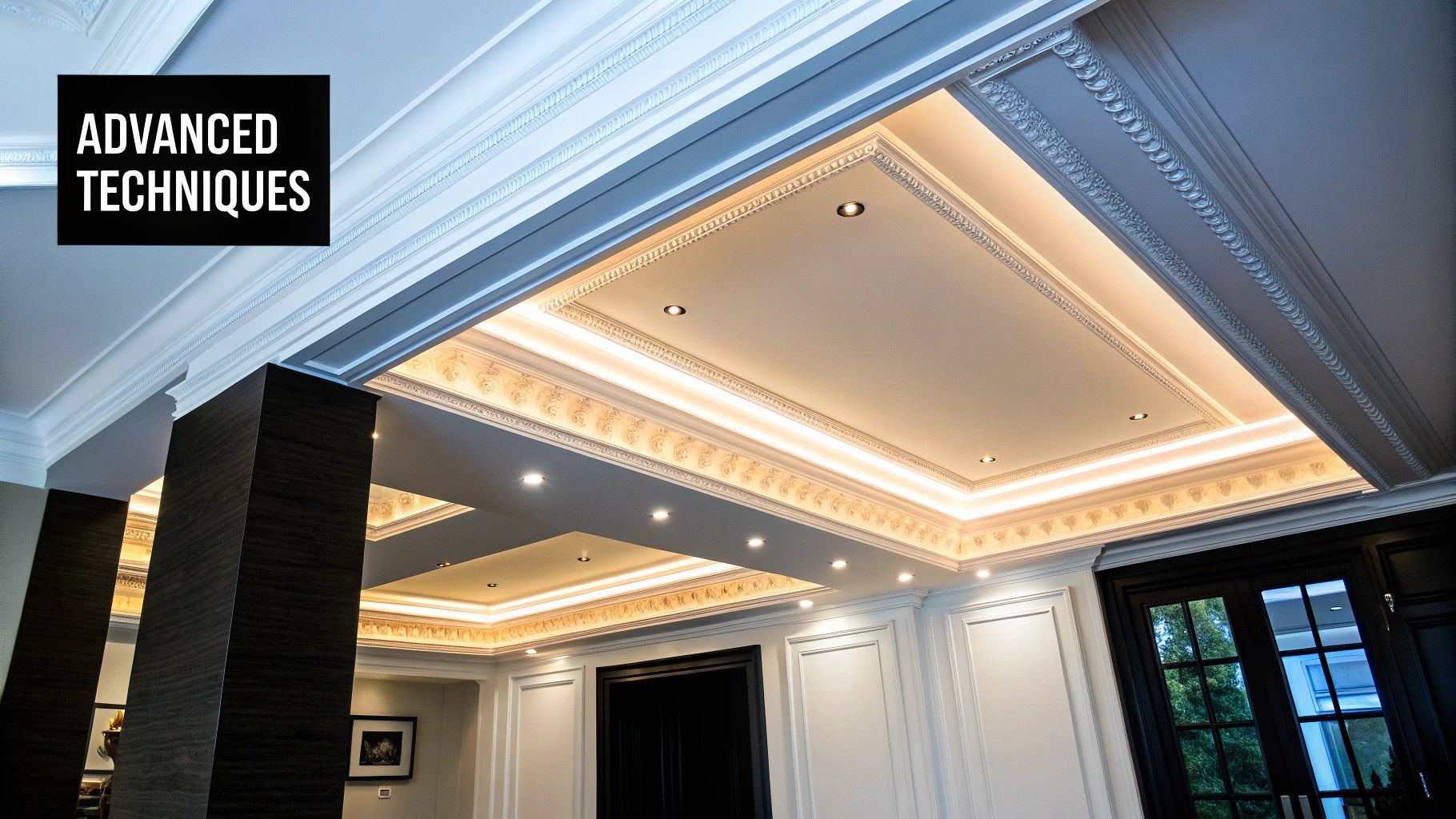
This is where you shift from decorator to designer. You start thinking in three dimensions, using molding to construct dramatic coffered ceilings, frame a doorway to create a grander entrance, or even hide modern tech like LED strips for a soft, ambient glow.
Creating Coffered Ceilings
Nothing says luxury quite like a coffered ceiling. It’s a classic feature, with its signature grid of recessed panels, that adds incredible depth and a sense of grandeur to a room—especially one with high ceilings.
What used to be a prohibitively complex and expensive project has become much more achievable thanks to modern materials. You can build out a grid on the ceiling using a mix of standard crown profiles and flat stock trim. The crown molding is then nested inside each square of the grid, which creates that iconic sunken look. It’s a technique that instantly gives a room historical character and visual heft.
For a build this intricate, your material choice really matters. Polyurethane crown moulding is a fantastic option and has become a go-to for both homes and commercial spaces; its global market was valued at USD 1.1 billion back in 2021. Because it’s so lightweight, it’s much easier to work with overhead on a ceiling, and its moisture resistance means it will last. You can find more details about the polyurethane crown moulding market on archivemarketresearch.com.
Integrated and Functional Molding Designs
Going beyond the purely decorative, advanced molding design is also about blending form with function. It’s about making your molding work for you.
A brilliant modern technique is to use molding to create a hidden channel for indirect LED strip lighting. By mounting a piece of trim a few inches below the ceiling, you can cast a soft, ambient glow upward. The light washes across the ceiling, creating a beautiful effect with no visible fixtures.
This approach is popular for a few key reasons:
- Adds Ambiance: It creates a warm, sophisticated atmosphere that’s perfect for dining rooms, bedrooms, or home theaters.
- Highlights Architecture: The upward-facing light draws the eye up, accentuating ceiling height and the crisp lines of the molding itself.
- Modernizes a Classic Element: You’re merging timeless architectural detail with contemporary lighting for a look that feels completely bespoke.
Another practical application is building up multiple pieces of molding to cleverly conceal unsightly wiring or even small pipes. In the same vein, you can use wider, flat profiles to create a sturdy picture rail, which lets you hang artwork without putting a single nail in your walls. These smart techniques turn a simple decorative element into a problem-solver, making your space both beautiful and brilliantly functional.
A Few Common Questions About Crown Molding
Even the most well-thought-out design plans can bring up a few practical questions. When it comes to crown molding, getting a handle on the details early on can make all the difference between a project that flows smoothly and one that hits a snag. Let’s tackle some of the questions we hear most often.
What’s the Best Size for Crown Molding?
This is easily the most critical question, and the answer comes down to one simple word: proportion. The right size for your molding is directly linked to the height of your ceilings. Think of it like a picture frame—it has to be scaled correctly to complement the art, not overpower it.
Here’s a reliable rule of thumb to follow:
- For standard 8-foot ceilings, stick with a molding that’s between 2.5 to 6 inches high. This range feels intentional and balanced, not cramped.
- With 9-foot ceilings, you have a bit more room to play. A profile between 4 to 7 inches tall works beautifully here.
- If you have soaring ceilings of 10 feet or more, you need a molding that can hold its own. Go for a grander profile of 7 inches or more to make the kind of statement the room deserves.
What About Installation and Style?
Another big question is whether this is a project you can tackle yourself. Yes, it’s definitely possible, especially if you’re working with lightweight materials like MDF or polyurethane. But be warned: it requires a steady hand, a good eye for detail, and the right tools—most importantly, a miter saw for those tricky corner angles. For heavy plaster, intricate wood profiles, or rooms with unusual angles, bringing in a professional is usually the smartest move for a seamless, polished finish.
Homeowners also ask if crown molding needs to match the baseboards and window casings. The goal isn’t to be identical but to be cohesive. All the trim in a room should feel like it belongs to the same family. They should share a similar design language, whether it’s the crisp lines of a modern profile or the ornate curves of a traditional one. The easiest trick in the book? Paint all the trim the same color to instantly tie everything together.
And what’s trending right now? The current mood in crown molding is leaning toward a more refined, subtle look. Simpler, cleaner profiles are very popular, but so is the opposite approach: painting the molding a bold, contrasting color to turn it into an architectural feature that really pops.
Ready to connect with top-tier design professionals who can bring your vision to life? Join the Haute Design network to discover and collaborate with the best interior designers and architects in the industry. Explore premier portfolios and find your perfect match.