


When you weave smart home technology into a home’s very fabric, you’re doing more than just connecting devices. You’re creating a responsive, automated environment where lighting, climate, security, and entertainment all work together in perfect harmony. It’s about controlling everything from a single, intuitive interface to fundamentally change how a space feels and functions.
Weaving Technology into Luxury Design
In the world of luxury residential design, technology is no longer an afterthought bolted on at the end. It’s a foundational element of the architectural vision itself. The real goal of smart home technology integration is to build environments that aren’t just visually stunning but are also incredibly responsive to the homeowner’s lifestyle. This requires a shift in thinking—moving beyond standalone gadgets to design a cohesive ecosystem where every part works in concert.
This is a massive opportunity for designers, architects, and builders. When you master the art of integration, you deliver a far superior client experience. You create spaces that anticipate needs and offer a level of comfort and convenience that was once science fiction. The focus is always on crafting a user experience that feels completely natural, where the technology just melts into the background.
Why Integration Is the New Standard
The demand for fully integrated homes is exploding. The U.S. smart home market hit a valuation of USD 23.72 billion in 2024 and is on track to reach USD 29.42 billion in 2025. With a projected compound annual growth rate of 23.4% through 2030, this isn’t a passing trend.
This growth is fueled by discerning clients who expect their homes to be as intelligent as they are beautiful. They’re often looking for sophisticated, energy-efficient solutions and know that a well-executed project can boost a property’s value by as much as 10%.
This guide is your roadmap for orchestrating this complex, yet rewarding, process. We’ll walk through the essential phases, from the first client conversation and strategic blueprinting all the way to the art of a perfect handover.
The ultimate measure of success is when the technology becomes invisible, and the experience feels effortless. It’s about enhancing life within the space, not complicating it with controls and wires.
Key Focus Areas for Designers
To really lead these projects, you need a firm grasp on the core pillars of a successful integration. This guide is all about translating a client’s daily routines into a seamless, automated environment that just works.
Here’s what we’ll get into:
- Translating Lifestyle into Logic: We’ll move beyond a simple list of features to truly understand how a client lives, breathes, and moves within their space.
- Strategic System Planning: This involves choosing the right foundational platforms and designing a technology blueprint that’s both powerful and reliable.
- Aesthetic and UX Harmony: We’ll cover how to ensure the technology enhances, rather than clashes with, the meticulously planned interior design.
- Flawless Execution and Handover: The final step is managing the commissioning process to deliver a system that delights the client from the very first day.
By mastering these elements, you can elevate your role from a designer of spaces to a curator of experiences. You’ll be delivering homes that are truly intelligent by design. For some creative inspiration, check out our guide on smart home automation ideas.
Crafting The Strategic Technology Blueprint
The foundation of a truly intelligent home isn’t the hardware you choose; it’s a deep, personal understanding of the client’s life. A successful smart home technology integration starts long before a single wire is pulled. It begins with a conversation—one that goes far beyond a simple checklist of features.
This initial discovery phase is all about translating a lifestyle into technical logic. Instead of asking, “What features do you want?” the questions should be designed to uncover the rhythm of their daily life and the experiences they value most. This is how you design a system that feels truly intuitive, not just tacked on.
The Art of Client Discovery
To get to the heart of what a client really wants, you need them to share stories, not just specs. The goal here is to uncover the emotional and practical needs that great technology can solve. So, for a moment, forget the jargon and focus on the human experience you’re aiming to create.
Try asking questions that help paint a picture:
- “Walk me through your perfect weekend morning.” This simple prompt might reveal a desire for automated shades that rise with the sun, a favorite playlist that starts softly in the bedroom, and bathroom floors that are already perfectly warm.
- “What does entertaining friends and family look like for you?” This conversation could uncover the need for a “Party” scene that instantly adjusts the lighting, cues a specific music playlist across multiple rooms, and sets the landscape lighting to create the perfect ambiance.
- “Describe your routine when you come home after a long day.” From this, you might design an “Arrive Home” automation that disarms the security system, opens the garage, illuminates a safe path to the kitchen, and adjusts the thermostat to their favorite temperature.
These narrative-driven answers give you the raw material for a system that doesn’t just perform tasks but actually enhances daily rituals. They help define the core pillars of the smart home experience, which almost always revolve around entertainment, ambiance, comfort, and peace of mind.
This process—moving from this crucial discovery phase to the final client handover—is what separates a mediocre project from an exceptional one.
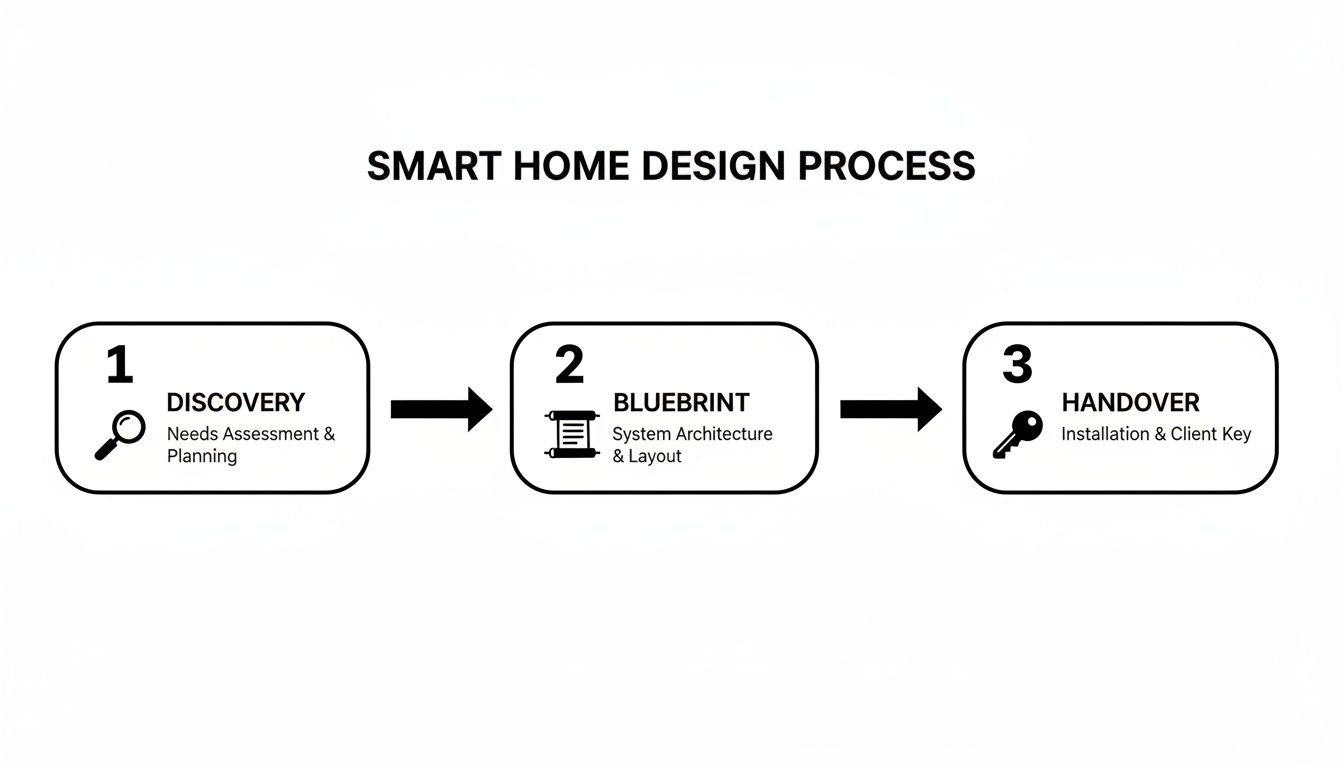
As you can see, a robust blueprint built on deep client discovery is the essential link to a successful final product.
Designing The System Architecture
Once you have a clear picture of the client’s vision, it’s time to design the system’s foundational blueprint. This document outlines the core control platform—the “brain” of the home—and every subsystem it will manage. This is a critical decision that will impact the project’s scalability, reliability, and day-to-day user experience for years to come.
Choosing this central nervous system means weighing different system architectures. Will you go with a centralized, professionally installed system or a more decentralized, consumer-grade approach? For luxury residences, a centralized system is almost always the right call.
A well-designed system blueprint is the single most important document in a smart home project. It aligns the client’s vision, the designer’s aesthetic, and the integrator’s technical execution into one cohesive plan.
Professional platforms like Savant, Control4, or Crestron are engineered to orchestrate a huge number of devices from different manufacturers. They create a truly cohesive ecosystem where lighting, climate, security, and media work in perfect harmony, not as a messy collection of separate apps.
This approach ensures a single, elegant user interface and provides the rock-solid backbone needed for complex automation. The alternative—a decentralized system cobbled together from various consumer brands—often leads to a fragmented and frustrating experience, completely undermining the goal of seamless living.
Comparing Smart Home System Architectures
To make an informed decision, it’s helpful to see how these two philosophies stack up. The choice between a centralized and decentralized architecture is one of the most fundamental decisions in the design process.
| Attribute | Centralized (e.g., Control4, Savant) | Decentralized (e.g., Apple HomeKit, Google Home with various brands) |
|---|---|---|
| Reliability & Performance | High. A dedicated processor handles all commands, ensuring robust, fast, and consistent performance. | Variable. Performance depends on individual device quality, Wi-Fi stability, and cloud service reliability. |
| Integration | Deep and seamless. Designed to make disparate systems (HVAC, security, lighting) work as one unified ecosystem. | Limited. “Works With” integrations are often superficial and lack the deep interoperability of professional systems. |
| User Experience (UX) | Consistent. A single, professionally designed app controls every aspect of the home. | Fragmented. Often requires multiple apps for full functionality, leading to a clunky and confusing experience. |
| Scalability | High. Built to manage hundreds of devices and complex automation logic without performance degradation. | Lower. Adding too many devices, especially Wi-Fi ones, can congest the network and lead to instability. |
| Customization | Extremely high. Can be programmed to create bespoke automation scenes tailored to the client’s exact lifestyle. | Basic. Automation is typically limited to simple “if-then” rules and routines within platform constraints. |
| Support & Maintenance | Professional. Supported and maintained by certified integration specialists who can troubleshoot the entire system. | DIY/Manufacturer. Relies on homeowner troubleshooting or support from individual product manufacturers. |
Ultimately, a centralized system provides the robust, reliable, and unified experience that clients in the luxury market expect.
The final blueprint should meticulously detail every subsystem, from motorized window treatments and multi-room audio to network infrastructure and security cameras. This becomes the master plan for the entire project team, ensuring the architect, builder, and technology integrator are all working from the same script to deliver an experience that is both powerful and effortlessly simple.
Assembling Your Integration Team and Planning Infrastructure
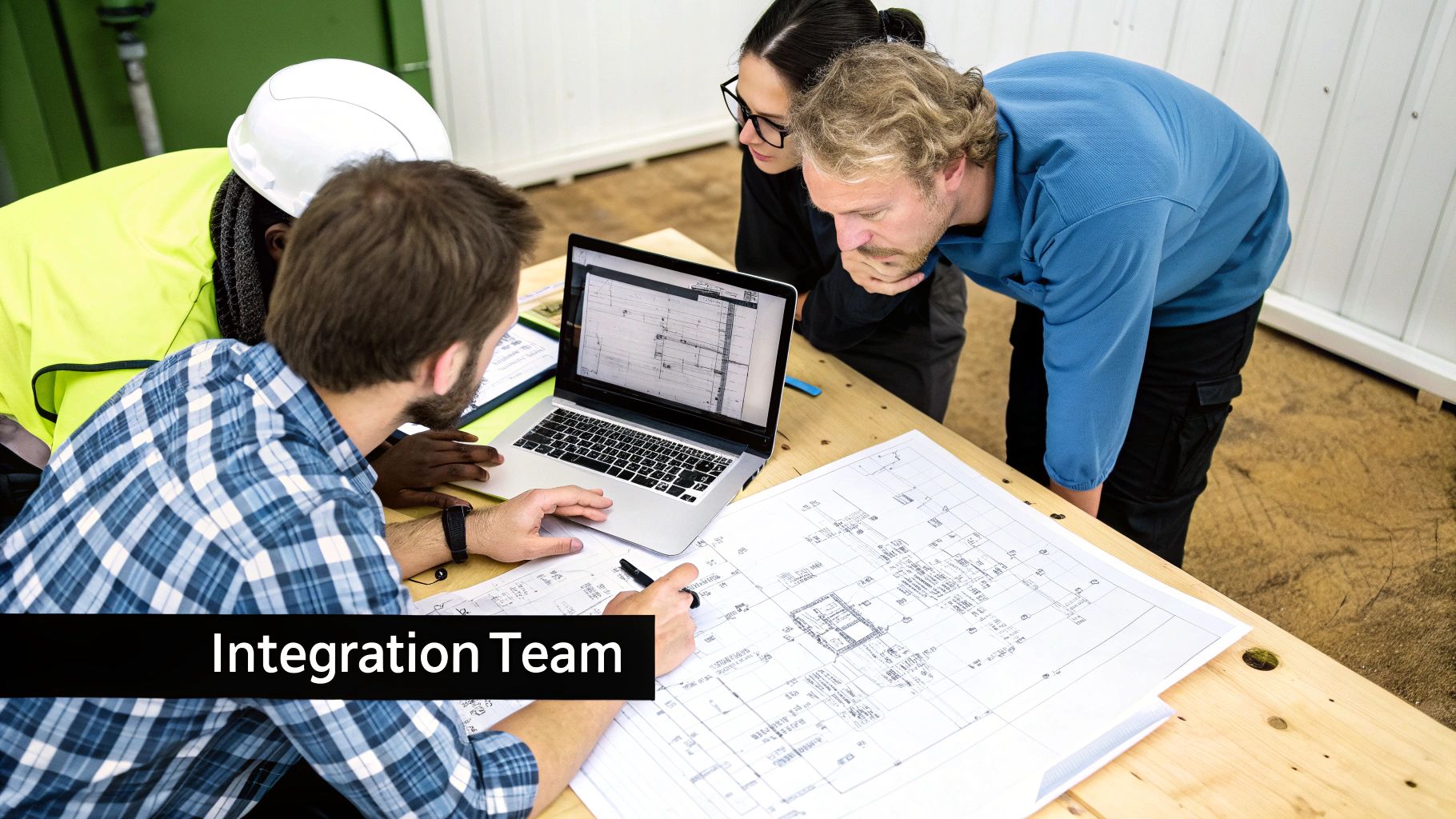
A truly exceptional smart home technology integration isn’t just about the tech; it’s born from brilliant collaboration. The entire project’s success hinges on getting the architect, builder, and technology integrator in the same room, all aligned with the design vision from day one. This early synergy is what prevents expensive rework and ensures the technology melts into the home’s aesthetic instead of clashing with it.
The technology integrator is the linchpin here. They need a seat at the table during the initial design phase, long before the first wall is framed. Their expertise is critical for planning the home’s digital infrastructure—the wiring, power, and network—with the same care given to the foundation and finishes. To get everyone on the same page, a solid pre-construction meeting checklist can be an invaluable tool.
Vetting The Right Technology Partner
Finding the right technology partner goes far beyond technical specs. You need an integrator who speaks the language of design and architecture. They should respect the nuance of high-end finishes, understand the architectural intent, and have a portfolio that proves they can make technology disappear.
When you’re interviewing potential partners, get straight to the point with these questions:
- Can you show me projects with a similar scope and aesthetic? You’re looking for case studies where the tech elevates the design, not overpowers it.
- How do you typically work with architects and interior designers? The best partners are consultants who offer solutions that serve the vision, not just sell their preferred products.
- What does your documentation and communication process look like? For a project this complex, clear blueprints and consistent updates are absolutely non-negotiable.
This vetting is more critical than ever. The global smart home market is projected to rocket from USD 121.59 billion in 2025 to a staggering USD 633.29 billion by 2032. With residential projects making up 64.8% of that market and security leading the charge at 28.1%, the demand for integrators who can skillfully install systems like biometric locks and AI surveillance in luxury homes is off the charts.
The Hardwired vs. Wireless Debate
One of the first, and most critical, infrastructure decisions you’ll make is what gets hardwired and what can rely on wireless. This isn’t just a technical footnote; it’s a decision that will directly impact the home’s performance and reliability for decades.
A rookie mistake is to lean too heavily on Wi-Fi for everything. While it’s great for flexibility, wireless simply can’t compete with the raw speed, security, and rock-solid reliability of a physical cable for your home’s most essential systems.
A robust, professionally designed wired network is the central nervous system of a modern luxury home. It is the single most important investment you can make to ensure a flawless smart home experience for years to come.
For any high-performance system, a hybrid approach is the only real answer. You have to prioritize hardwired connections for anything that absolutely cannot fail.
Planning Your Infrastructure Foundation
Your technology integrator will handle the nitty-gritty, but the design team must champion the need for an unshakeable foundation. This is about building for today while leaving room for the technology of tomorrow.
Here’s a strategic breakdown for planning the infrastructure:
- Hardwire the Essentials: Don’t compromise here. Insist on dedicated Ethernet runs for all stationary, high-bandwidth devices. This means smart TVs, media streamers, security cameras, and all the core networking gear like routers, switches, and access points. This guarantees buffer-free performance and keeps your Wi-Fi network clear for the devices that actually need it.
- Leverage Wireless for Flexibility: Use robust wireless protocols like Wi-Fi, Zigbee, or Z-Wave for devices that are mobile or where running a wire is impractical. Think smartphones, tablets, laptops, and certain smart sensors or locks.
- Future-Proof with Conduit: This is one of my biggest pieces of advice. During construction, run empty conduit—often called “smurf tube”—to key locations like media walls, potential future camera spots, or home offices. It makes adding or upgrading cabling down the road a simple, inexpensive task instead of a drywall-destroying nightmare.
- Strategize Network Access Points: Work with the integrator to map out the placement of Wireless Access Points (WAPs) meticulously. Proper placement is the key to blanketing the entire property—including patios and gardens—with seamless, high-speed Wi-Fi and eliminating the frustrating dead spots that plague so many homes.
By thoughtfully assembling your team and obsessing over the details of the underlying infrastructure, you build a resilient, high-performance backbone for the entire smart home. This foundational work is the unseen hero that makes the magic of an effortless, truly integrated home possible.
Integrating Technology So It Disappears
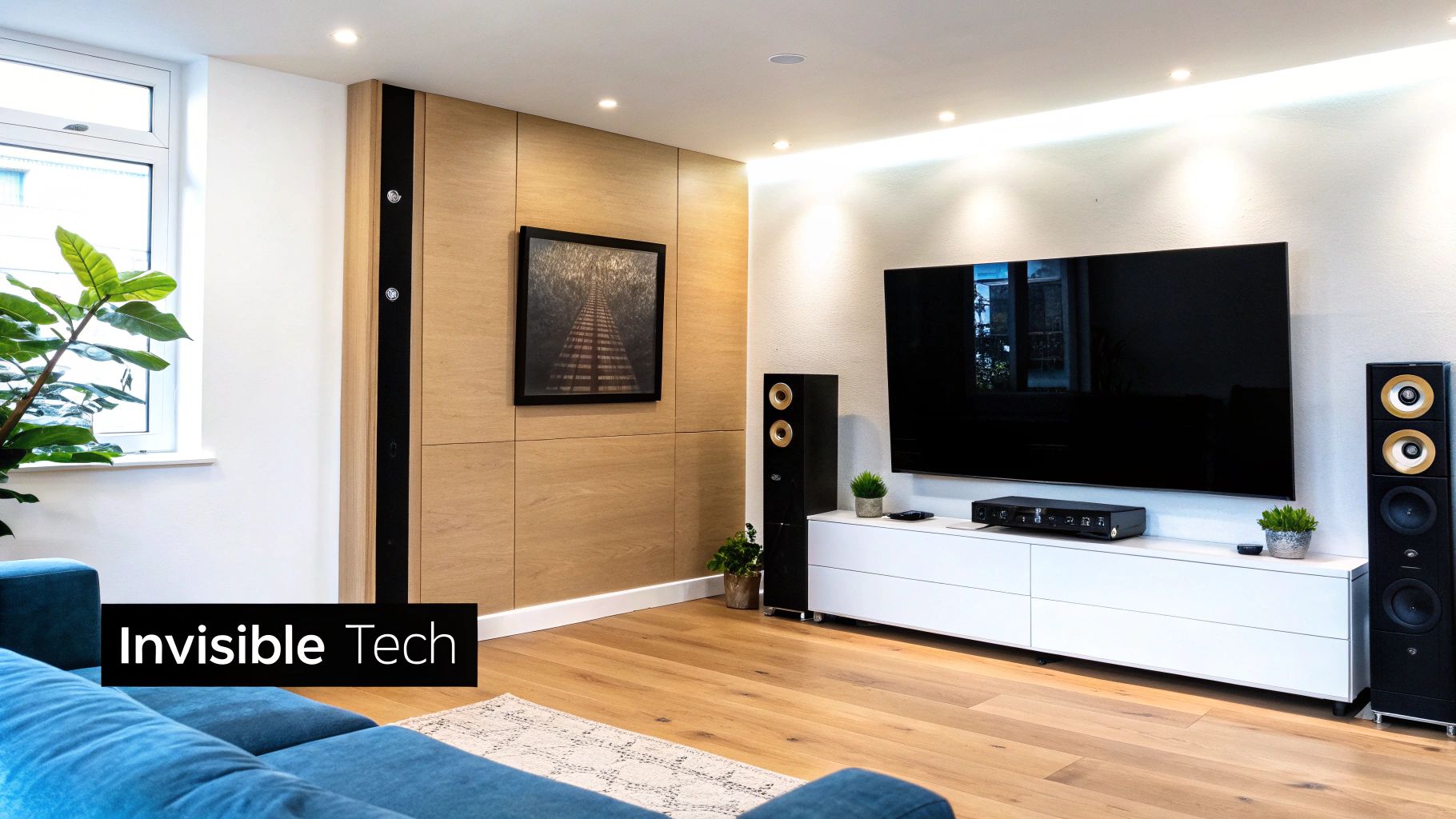
True luxury in smart home integration isn’t about showcasing the technology; it’s about making it vanish. The real art lies in weaving powerful, responsive systems into the very fabric of a home so that the design and architecture remain the stars of the show.
This goes far beyond just hiding a few wires or mounting a TV cleanly. It’s a deep, collaborative process where we work hand-in-glove with architects and interior designers from day one. The mission is to protect the clean lines and exquisite finishes that define a high-end space, ensuring that technology serves the aesthetic, not the other way around.
Concealing Hardware with Creative Solutions
Making speakers, screens, and controls disappear is where an experienced integrator’s creativity truly shines. The secret is to think architecturally, embedding devices into the home’s finishes so they become part of the structure itself. This isn’t an afterthought; it has to be planned during the earliest design phases.
Here are a few techniques we use to achieve this:
- Invisible Audio: We can install speakers that sit completely behind the drywall. Once plastered and painted, they are 100% invisible yet deliver stunning, high-fidelity sound that seems to emanate from nowhere. For spaces with wood paneling or custom cabinetry, we use special transducers that turn the entire surface into a high-performance speaker.
- Hidden Displays: A television can completely ruin the look of a formal living room or master suite. We solve this with motorized art lifts that conceal the screen behind a favorite piece of art, or sliding panels that match the wall finish perfectly. Mirror TVs are another fantastic solution—they function as elegant, flawless mirrors until you turn them on.
- Seamless Controls: A bank of plastic light switches can be an eyesore. Instead, we use custom-engraved keypads designed to be an exact match for the wall material, whether it’s marble, wood, or a specific paint color. This small detail makes a massive difference in maintaining a minimalist design.
This meticulous attention to detail is precisely what the luxury market demands. The global smart home market, projected to hit USD 162.27 billion by 2025, sees new construction as a leading application—largely because it allows for this deep, architectural integration. It’s no surprise that homes with this level of thoughtful technology can see their resale value increase by 7-12%. You can dig deeper into these market trends in this detailed report from Precedence Research.
The best technology doesn’t just work flawlessly; it respects the design intent of the space. When you can deliver a powerful experience without a single visible wire or piece of hardware, you’ve achieved true integration.
Crafting The Intuitive User Experience
Once the hardware is hidden, the focus shifts to making the control experience just as seamless. A clunky app with a hundred buttons is just as jarring as a coffee table cluttered with remotes. The solution lies in creating custom “scenes”—single-button commands that trigger a cascade of automated actions.
These scenes aren’t just technical macros; they are designed around the client’s real-world routines, transforming mundane tasks into moments of effortless comfort and convenience. The interface should feel like an extension of the client’s lifestyle, not a complex piece of software.
Real-World Scene Programming Examples
Think of a simple, elegant keypad by the bed with just four custom-engraved buttons. Each one initiates a perfectly orchestrated sequence.
- Good Morning: One touch slowly raises the blackout shades to let in the morning light, tunes the TV to the news at a gentle volume, and warms the master bath floors to a perfect 78 degrees.
- Away: As they leave, a press of this button puts the entire home into a secure, energy-saving mode. Every light and media device turns off, thermostats adjust, and the security system arms itself.
- Entertain: In an instant, the living room lights dim to a warm, inviting glow, a curated “Dinner Party” playlist begins streaming through the invisible speakers, and the exterior landscape lighting turns on to welcome guests.
- Good Night: This all-off command is a client favorite. It shuts down every light in the house, lowers all shades, checks that the garage doors are closed, and arms the perimeter security for the night.
This is what turns a smart house into an intelligent home. By marrying invisible hardware with an effortless user experience, we deliver a final product where the technology serves silently in the background, allowing the beauty of the design to always take center stage.
Mastering The Client Handover and Commissioning
The moment a project truly comes alive is in the final stretch. This is where a meticulously planned smart home technology integration goes from being a collection of hardware to a seamless, living experience for the homeowner. A project isn’t really finished when the last wire is tucked away; it’s finished when the client feels completely at home, in control, and genuinely thrilled with their new environment.
It all starts with commissioning. Think of this as the exhaustive, behind-the-scenes quality check where every single function gets put through its paces. Before a client even lays a finger on a keypad, our job is to ensure that every light, every shade, and every security sensor works perfectly—not just on its own, but in concert with everything else.
The Rigorous Commissioning Phase
Commissioning is a disciplined, systematic hunt for perfection. We methodically comb through the entire system, sniffing out and squashing any bugs, glitches, or programming quirks. This is how you guarantee that when the client taps the “Good Night” scene, every designated light fades out, every shade glides down, and the security system arms without a single hiccup.
The process is built around a detailed checklist, often called a punch list to ensure project completion. Every single feature—from the simplest command to the most complex automation—is tested, verified, and signed off on before we even think about scheduling the handover.
During commissioning, we’re laser-focused on key areas:
- Scene Verification: Does the “Entertain” scene actually set the mood? We check if the lights dim to the right level, the right playlist starts, and the climate adjusts exactly as promised.
- Automation Logic: We test the real-world logic. Do the hallway motion sensors know the difference between midday and 2 a.m., activating at the appropriate brightness?
- Network Stability: A smart home is only as good as its network. We perform sweeps to ensure rock-solid, high-speed Wi-Fi covers every inch of the property, from the master bedroom to the patio.
- Remote Access: Can the homeowner securely check their cameras, unlock the door for a guest, or adjust the thermostat from halfway around the world? We test it until it’s flawless.
Only when the system has passed this trial by fire are we ready for the most critical step: the client handover.
The Art of the Client Handover
The handover is far more than just a technical tutorial. It’s the grand reveal. It’s a curated experience designed to showcase the magic of the home and build the client’s confidence from day one. A rushed or overly technical walkthrough can leave a homeowner feeling overwhelmed by the very technology that was meant to simplify their life.
The key is to frame everything around their lifestyle. We tie every feature back to the needs and desires they shared with us in the very first meeting. So instead of saying, “This button turns on the kitchen lights,” we say, “Remember how you wanted the kitchen to feel bright and energized for breakfast? This ‘Morning’ scene does just that.”
A successful handover isn’t about teaching someone how to use a complex system. It’s about demonstrating how simple and intuitive their new life at home can be, thanks to thoughtful design.
Executing a flawless handover comes down to personalization and a commitment to their long-term happiness.
- Personalized Documentation: Forget the generic manuals. We create a simple, beautifully designed guide for their specific home. It includes visuals of their actual keypads and app screens, with short, plain-language explanations of what each scene does.
- Hands-On Training: We walk the client and their family through the system in a practical way. We start with the scenes they’ll use most—like “Welcome Home” or “Movie Night”—to build immediate comfort and create those initial “wow” moments.
- Schedule Follow-Ups: Real-world living is the ultimate test, and it always reveals opportunities for fine-tuning. We always schedule a follow-up visit for a week or two after they’ve settled in. It’s our chance to tweak lighting levels, adjust automation schedules, and reprogram a keypad based on how they actually live in the space.
This thoughtful, client-first approach is what turns a complex installation into a simple, daily joy, ensuring the technology feels like a natural and indispensable part of their home.
Ensuring Long-Term Success and System Evolution
A luxury smart home isn’t a one-and-done installation. It’s a living, breathing ecosystem that needs to grow with the client. The last, and arguably most important, phase of any high-end smart home technology integration is planning for its future. This ongoing commitment is what truly separates a professional project from a simple transaction, making sure the system feels just as seamless and impressive in five years as it does on day one.
It all starts with a rock-solid service plan from the technology integrator. Technology moves fast—software updates, security patches, and firmware revisions are constantly rolling out. A formal support agreement isn’t just a nice-to-have; it’s essential for managing this complexity and giving everyone peace of mind.
Establishing A Proactive Service Plan
A great service plan is more about prevention than reaction. It’s about keeping the system in peak condition so the client never even notices a problem. Think of it as a wellness check-up for the home’s technology, catching minor hiccups before they can ever disrupt the homeowner’s life.
A truly robust plan should always include:
- Remote System Monitoring: The integrator needs the ability to securely check the health of the network and critical devices from afar. This often means they can diagnose and fix an issue without ever setting foot in the house.
- Scheduled Software Updates: The plan must clearly define how and when firmware and software updates get pushed. This is critical for patching security holes and ensuring new devices play nicely with the existing system.
- Priority Support: When something does go wrong, the client deserves to be at the front of the line. A good plan guarantees priority scheduling and access to dedicated support channels for a fast, effective fix.
The real goal of a service plan isn’t just fixing what breaks. It’s about making sure the technology consistently and invisibly makes the client’s life better. This proactive mindset cements your position as a trusted advisor for the long haul.
Guiding Clients Toward Future Upgrades
Your job doesn’t stop at the handover. As the designer, you’re in the perfect spot to show clients how new technologies can make their home even better. What seems like science fiction today might be a standard feature tomorrow.
Keeping the conversation going about potential upgrades helps you stay ahead of their needs. Maybe a new generation of tunable white lighting emerges that’s even better at supporting natural sleep cycles, or a breakthrough in invisible audio offers a more immersive soundscape for their media room.
The key is to frame these discussions around lifestyle benefits, not just tech specs. When you do that, clients see the real value in evolving their system. The project shifts from a one-time build to an ongoing partnership. You’re no longer just the person who designed their space; you’re the expert who helps their home adapt and grow with their family.
Common Questions About Smart Home Integration
When you’re working with clients on a luxury residence, the conversation around smart home technology inevitably brings up a few key questions. Let’s tackle the ones I hear most often so you can guide those discussions with confidence.
Probably the first thing on every client’s mind is cost. So, how much does a truly integrated smart home actually cost? The honest, if unsatisfying, answer is: it depends. For a basic package, you might be looking at around $10,000. But for the kind of sophisticated, whole-home systems we’re talking about in luxury projects, the budget realistically starts at $50,000 and can easily exceed $250,000. The final number really comes down to the size of the home, how many systems we’re tying together—lighting, climate, security, entertainment—and the depth of custom programming needed to make it all feel effortless.
Can We Add a Smart Home System Later?
This question comes up a lot, especially if the initial budget is tight. Yes, you can retrofit a smart home system into a finished home, but it’s a game of compromises. Wireless technology has come a long way, but nothing beats an installation that was planned from the ground up, right alongside the architectural drawings.
When you bring in an integrator during the design phase, you get:
- Rock-solid reliability from proper pre-wiring for all the essential systems.
- Flawless architectural details, like perfectly placed in-ceiling speakers, flush-mounted keypads, and invisible sensors.
- A cleaner, more predictable installation which ultimately means lower labor costs and fewer surprises.
Trying to add this technology later often forces you into wireless-only solutions and some creative, but not always ideal, ways of hiding wires and hardware. It’s doable, but you trade a bit of that seamless, built-in magic for it.
You can always add smart technology after a home is built. But for the most reliable, intuitive, and aesthetically clean result, it absolutely must be designed into the initial blueprints with the same foresight as the plumbing and electrical plans.
How Do You Handle Outdated Technology?
It’s a great question. No client wants to invest six figures into a system that feels obsolete in five years. This is precisely why working with a seasoned integrator is so critical—we design for the long haul.
A well-architected system is built to evolve. First, we anchor the entire home on a powerful, centralized control platform from a company like Savant or Control4. Think of this as the home’s “brain,” which can be updated with new software to accommodate future gadgets and features for years.
Second, we hardwire the core infrastructure. The physical cabling in the walls is the system’s backbone, and it’s incredibly durable. A specific TV or music streamer might get swapped out in a few years, but the network and wiring that support it will be solid for decades. This makes future upgrades far simpler and much less expensive.
Ready to connect with premier clients and elevate your design portfolio? Join Haute Design, the exclusive network for the nation’s top architects, designers, and builders. Showcase your work and grow your brand on hauteliving.com/designnetwork.