


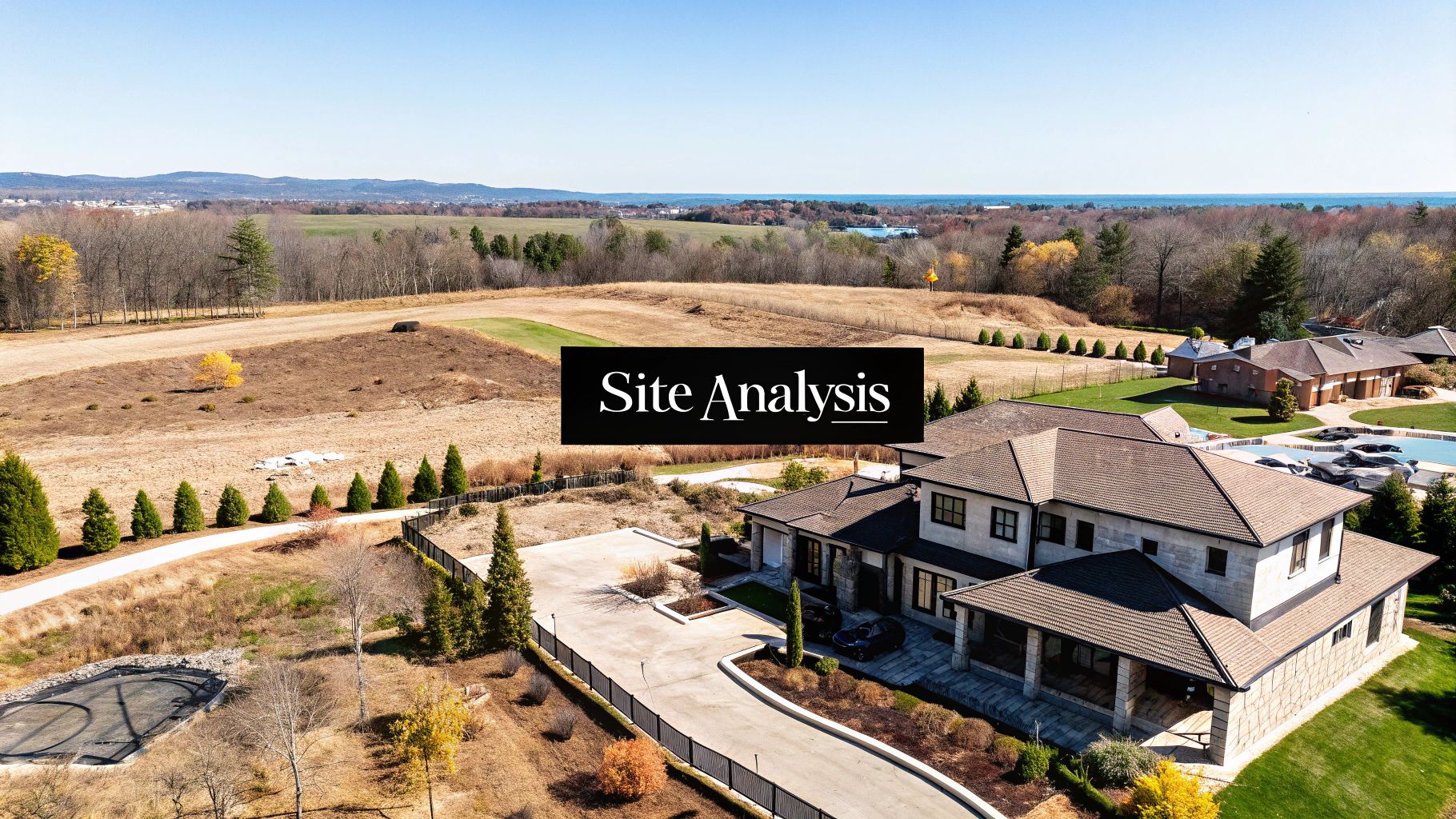
A site analysis is where luxury architecture begins. It’s the moment we uncover a property’s unique story, long before the first line is ever drawn. Think of it as a deep, comprehensive investigation into the land’s physical, environmental, and regulatory DNA, revealing its hidden strengths and potential challenges.
This process is absolutely essential to creating an extraordinary, bespoke home that feels truly connected to its environment.
Discovering the Land’s Unique Story
I like to think of site analysis not as a technical task, but as a conversation between the architect and the land itself. Before any design concepts take shape, this critical study deciphers the property’s language. We move beyond simple measurements to understand the soul of the site—how the light moves across it, where the gentle breezes flow, and what secrets the soil holds.
This initial exploration demystifies the building process and lays the groundwork for a residence that is both beautiful and intelligent. For discerning homeowners, this is the most important phase. It ensures the final home isn’t just placed on the land but grows from it, responding to every natural nuance.
The findings from this process directly influence everything that follows, from the initial sketches explored in what is schematic design to the final construction details.
The Purpose of a Thorough Analysis
The main goal here is to gather every piece of information that could impact the design and construction of a new home. This isn’t just about avoiding problems; it’s about uncovering hidden potential.
- Finding Opportunities: We pinpoint the perfect spots for rooms, windows, and outdoor spaces to maximize incredible views, natural light, and privacy.
- Navigating Constraints: We identify potential hurdles like poor soil conditions, steep slopes, or strict zoning laws early on, allowing us to craft clever, elegant design solutions.
- Making Informed Decisions: This provides the design team with the hard data needed to make choices that perfectly align the homeowner’s vision with the property’s inherent character.
A thoughtful site analysis transforms potential pitfalls into bespoke masterpieces. It’s the difference between a house that occupies a space and a home that truly belongs there, creating long-term value and an unmatched living experience for high-net-worth clients.
This deep dive is critical for creating extraordinary environments, as it dissects everything from topography and soil to climate and views. The global construction market, which relies heavily on this kind of data, is projected to reach US$16.11 trillion by 2030, underscoring the financial importance of getting this first step right. As digital site tools become more common, they help stabilize costs and improve outcomes, even as the industry faces skills shortages.
What Goes Into a Site Analysis? The Building Blocks of a Master Plan
To really get what a site analysis is all about, you have to look at its individual pieces. Think of it less like taking measurements and more like getting to know the land’s unique personality and history. By breaking down the investigation into distinct yet connected areas, an architect assembles a complete picture, ensuring every single design decision is deliberate, smart, and a perfect fit for the property.
This deep dive is a non-negotiable first step in the complete architectural design process steps, giving us the hard data that fuels all the creative work to come. Each component is a crucial piece of the puzzle, coming together to form a master plan that’s as practical as it is visionary.
This diagram shows how we organize a site analysis into three core layers—physical, environmental, and regulatory—to build that complete profile.
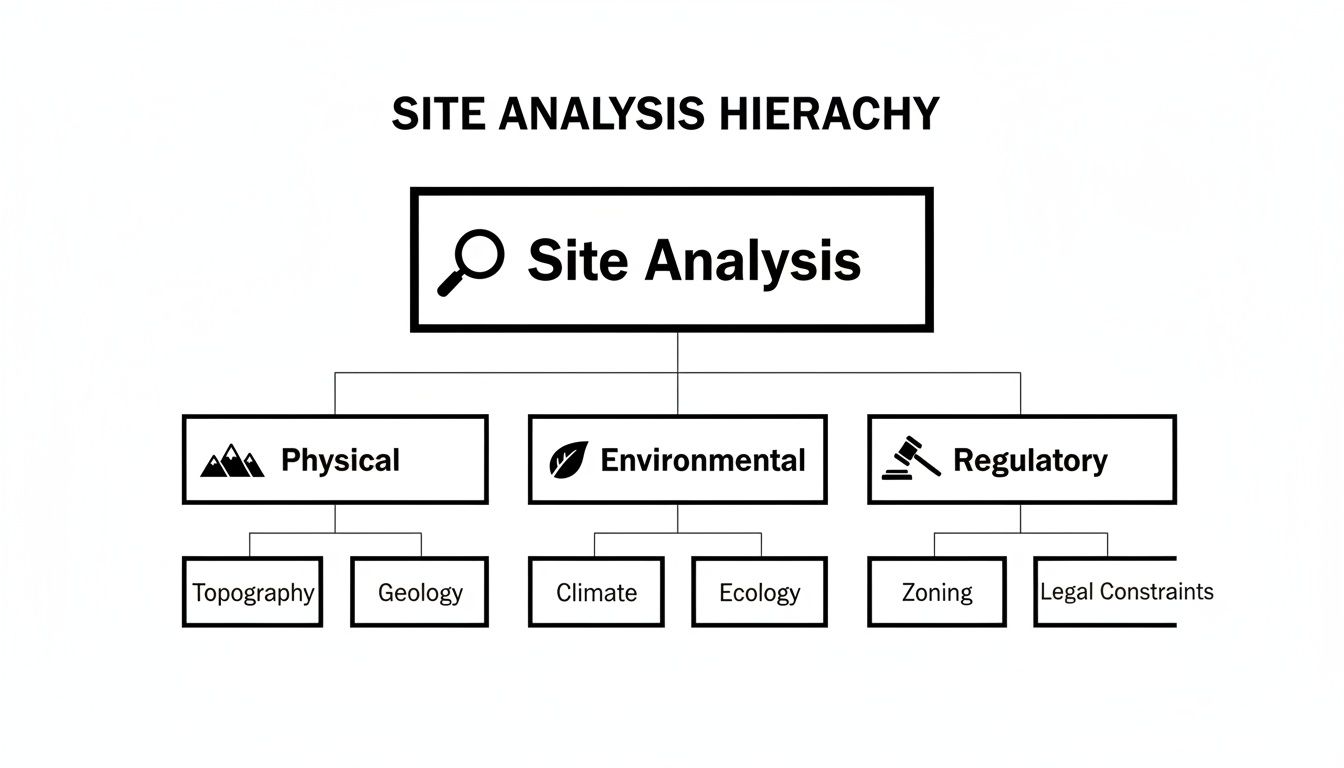
Let’s unpack what each of these layers involves.
Site Context and History
A piece of land never exists in a vacuum. It’s woven into a larger social and historical fabric, and understanding that context is where we always begin. This means looking at the architectural style of the surrounding neighborhood, the scale of the nearby homes, and the general character of the community. The goal is to design a home that feels like it belongs, even if it stands out.
For example, designing a modern home in a historic district requires a deft hand. You might reference local materials or echo traditional rooflines while still creating something distinctly contemporary. We also dig into the land’s own story. Was it once farmland, an old orchard, or part of a grand estate? These historical footnotes can spark unique design ideas, adding a layer of narrative and soul to the new home.
Climate and Environmental Factors
The environment is a powerful partner in design, telling us how a home should live and breathe. A deep dive into the local climate is fundamental to creating spaces that are comfortable, efficient, and bathed in beautiful natural light. This goes way beyond just checking the average temperature.
We meticulously study several key environmental forces:
- Sun Path Analysis: We chart the sun’s journey across the property—not just through the day, but through the seasons. This tells us exactly where to place windows, skylights, and overhangs to welcome the winter sun while shielding the home from harsh summer heat, which has a huge impact on energy use.
- Wind Patterns: Knowing which way the wind blows is crucial. It helps us position a terrace in a calm, sheltered spot, design for natural cross-ventilation that cools the home without air conditioning, and even place trees to serve as a natural windbreak.
- Precipitation and Drainage: Understanding how rain falls and water moves across the site is critical for avoiding future headaches like pooling or erosion. This data guides everything from the grading of the land to the design of sophisticated drainage systems or rain gardens.
When you work with the climate instead of fighting it, you create homes that are not only more sustainable but simply feel better to be in. It’s about forging a seamless connection between inside and out.
Topography and Geology
The land’s physical form—its slopes, its curves, and what’s under the surface—is the very stage for the architecture. Topography is the term for these natural contours and elevation changes. A flat lot offers a clean canvas, while a steep hillside presents a thrilling challenge. A great architect knows how to use this terrain to their advantage.
A slope, for instance, might inspire a dramatic multi-level home with cascading terraces, each capturing a different, stunning view. A gentle roll in the landscape could be the perfect spot for an infinity pool that seems to melt into the horizon.
Just as critical is the geology, which is the study of the soil itself. A geotechnical engineer is often brought in to test the soil’s composition and stability, which is essential for designing a safe, lasting foundation. This analysis tells us if the ground is sandy, heavy with clay, or rocky—information that directly impacts construction methods and costs. Skipping this step is asking for trouble down the line.
Legal and Regulatory Constraints
Finally, every property comes with a rulebook. These regulations govern what can be built, where it can be built, and how it can be built. A thorough site analysis means mastering these rules of the game from day one.
This regulatory deep dive covers a few key areas:
- Zoning Ordinances: These are the local laws that dictate land use, maximum building height, setbacks (how far a home must be from the property lines), and how much of the lot can be covered by a structure.
- Building Codes: These are the non-negotiable safety and construction standards for everything from structural integrity and fire safety to plumbing and electrical systems.
- Easements and Covenants: An easement might give a utility company the right to access a part of your property. Covenants are often neighborhood-specific rules that can restrict anything from fence heights to exterior paint colors.
Getting a firm grasp on these constraints at the very beginning is essential. It prevents the kind of costly redesigns and frustrating delays that can derail a project. It clearly defines the “buildable envelope,” setting the boundaries within which creativity can flourish.
Turning Constraints into Design Opportunities
A thorough site analysis isn’t about producing a dry, technical report. Think of it more like drawing a treasure map—it shows you where the gold is buried and where the traps lie. The real magic in luxury design happens when you take what looks like a trap and turn it into the property’s most stunning feature. Every challenge is just an invitation for an ingenious solution.
This is what separates the great architects and designers from the merely good. They have a knack for looking past an immediate problem to find the potential humming just beneath the surface. It’s a fundamental shift in perspective that makes every constraint a powerful driver for the design.https://www.youtube.com/embed/zreNtuyCPng
From Slopes to Sanctuaries
Take a steep, difficult slope, for instance. For most, this spells a construction nightmare and a major design headache. But a visionary sees something else entirely: the perfect canvas for a multi-level home with cascading terraces and breathtaking views that no flat lot could ever dream of offering. The topography isn’t an obstacle; it’s the very thing that will make the home extraordinary.
The same goes for a dense grove of mature, protected trees. You don’t clear them away. You design around them. They become the perfect frame for a serene, private courtyard or inspire a home that weaves elegantly between the trunks, creating a living experience that feels completely immersed in nature. Those trees offer shade, privacy, and a priceless sense of history.
The most memorable features of a luxury home are often born from the cleverest solutions to the site’s biggest challenges. Constraints force creativity and lead to designs that are deeply personal and specific to the land itself.
Uncovering Hidden Value
This mindset—turning problems into possibilities—has a direct and powerful impact on a property’s final appeal and market value. By leaning into the unique character of a site, designers craft residences that are truly one-of-a-kind.
- Difficult Soil Conditions: Finding poor soil doesn’t have to be a setback. It could lead to an innovative foundation design, like a pier-and-beam system that lets the home float lightly on the land, giving it an ethereal quality.
- Narrow Urban Lots: A tight footprint in a bustling city might inspire a brilliant vertical design topped with a stunning rooftop garden, capturing skyline views and creating a private oasis high above the streets.
- Harsh Sunlight Exposure: Instead of fighting the intense sun, a smart analysis can inform the use of deep overhangs, brise-soleils, or strategically placed courtyards that create a beautiful interplay of light and shadow, keeping interiors comfortable and dynamic.
For the professionals on the Haute Design network, mastering these site-specific challenges builds incredible credibility and trust with clients. A well-executed analysis can slash project risks, sometimes by as much as 40% in complex areas like seismic zones. When you consider that global construction for buildings was valued at USD 2,033.7 billion in 2024, mitigating risk isn’t just good practice—it’s essential. Even with forecasts predicting a slight dip in residential activity for 2025 before a rebound, the success of high-end projects will depend on these robust evaluations that turn challenges into triumphs. You can learn more about the global construction outlook and its reliance on sound planning.
In the end, a site analysis isn’t a process of limitation. It’s a process of liberation. It frees the design from generic, cookie-cutter solutions and anchors it in the authentic reality of the land. By truly listening to what the property has to say—its slopes, its sunlight, its history—a great designer can craft a home that doesn’t just sit on the site, but belongs to it.
Leveraging Advanced Technology for Precision Planning
The fundamentals of understanding a piece of land are timeless, but the tools we use have undergone a dramatic evolution. Today’s site analysis is a blend of an architect’s seasoned eye and some seriously powerful technology. This isn’t just about being modern; it’s about achieving a level of precision that was simply unimaginable a generation ago.

For homeowners, this shift from estimation to hard data means a smoother, faster planning process. More importantly, it nearly eliminates the risk of costly surprises cropping up mid-construction, ensuring the final design rests on a foundation of impeccable, complete information.
Drones and Aerial Mapping
One of the biggest game-changers in our toolkit has been the drone. These unmanned aerial vehicles (UAVs) can fly over large or tricky properties in a matter of hours, not days, capturing stunningly high-resolution images from every possible angle.
This bird’s-eye view gives us hyper-realistic maps that show us everything—from subtle shifts in the landscape to existing water flow patterns and the precise location of every mature tree. It’s like having a perfect, living blueprint of the property before we even begin sketching.
LiDAR and 3D Modeling
When we need surgical precision, we turn to LiDAR (Light Detection and Ranging). This technology sends out pulses of laser light to measure distances, building a “point cloud” made of millions of data points. The result is an exact 3D model of the terrain.
This digital twin of your property is accurate down to the millimeter. For an architect, it’s pure gold. It helps us:
- Design the Foundation: We can engineer the home’s foundation to perfectly match the natural topography.
- Perfect the Views: We can simulate the exact view from any window or balcony before a single wall is built.
- Calculate Earthwork: It tells us precisely how much soil needs to be moved, which saves significant time and money.
By digitally recreating the property, LiDAR removes all the guesswork. It allows the design team to “walk” the site virtually, testing ideas and refining the home’s placement long before breaking ground.
Geographic Information Systems
If drones and LiDAR are the data collectors, then Geographic Information Systems (GIS) are the master organizers. Think of GIS as an intelligent, layered digital map. It’s a powerful platform where we can stack all the different types of information we’ve gathered to see how they interact.
We can overlay data sets like:
- Utility lines (water, gas, electric)
- Zoning restrictions and property setbacks
- Sensitive environmental areas, like wetlands
- Soil survey maps
- Sun and shadow patterns throughout the year
This layered approach instantly flags potential conflicts or opportunities. For instance, a GIS map can show us precisely where a proposed driveway would cross a buried utility line or how a home’s shadow might affect a neighbor’s solar panels.
The fusion of these tools with artificial intelligence is opening up even more exciting possibilities. You can read more about how AI is reshaping luxury interior architecture in our feature on the topic. By bringing all these pieces together, we can make smarter decisions, ensuring no detail is overlooked.
Traditional Methods vs Modern Site Analysis Technology
The tools we use have a direct impact on the quality of the final design. Here’s a quick look at how old-school survey techniques stack up against the high-tech tools leading architects rely on today.
| Technique | Traditional Method | Modern Technology | Key Benefit for Homeowners |
|---|---|---|---|
| Topography Mapping | Manual surveying with transit levels and measuring tapes. Time-consuming and prone to human error. | LiDAR scans from drones or ground stations create a 3D digital model with millimeter accuracy. | Flawless Foundation Design: The home is built on a perfect understanding of the land’s contours. |
| Site Visualization | 2D drawings, hand-drawn sketches, and physical scale models. | Drone Photography/Videography and 3D Modeling provide immersive, photorealistic views. | Visualize Before Building: You can “see” your home and its views from any angle before construction begins. |
| Data Integration | Separate, manually drawn maps for utilities, zoning, and vegetation. Difficult to cross-reference. | GIS (Geographic Info. Systems) layer all data sets onto a single, interactive digital map. | Smarter, Faster Decisions: Complex site constraints are identified early, preventing delays and redesigns. |
| Speed & Efficiency | Could take weeks of on-site work for a large or complex property. | A comprehensive survey can often be completed in a single day. | Reduced Project Timelines: The design phase starts sooner with more reliable information. |
This technological leap isn’t just about efficiency; it’s about a deeper, more intimate understanding of the property, which is the cornerstone of truly exceptional design.
How Site Data Translates into Inspired Design
The real magic happens when raw data—sun angles, wind speeds, soil types—starts to shape the aesthetic and functional soul of a luxury home. This is the moment where technical findings blossom into inspired design. The unique story of the property, discovered during the analysis, becomes the narrative for the architecture itself.
An exceptional home doesn’t just sit on the land; it grows from it. Every piece of data informs a decision, ensuring the final residence is perfectly attuned to its environment.

A Coastal Retreat Shaped by the Wind
Picture a home on a stunning coastal bluff. A novice approach might just point the living room windows toward the ocean. But a proper site analysis reveals the prevailing offshore winds are relentless for nine months of the year, rendering any exposed deck or patio unusable most of the time.
This is where data becomes design. The wind analysis directly informs the architectural response. Instead of one big, exposed terrace, the architect designs a series of sheltered outdoor rooms.
- A central courtyard, shielded on three sides by the home itself, becomes a calm, sun-drenched pocket protected from the gales.
- The main ocean-facing deck is outfitted with retractable glass walls, offering an open-air experience on calm days and a protected, conservatory-like space when the wind picks up.
- Landscaping is layered in, with hardy native grasses and shrubs acting as natural windbreaks to create little microclimates of calm around the property.
The result is a home that lets you enjoy the coast year-round, not just on the rare perfect day. The design feels intelligent and responsive, turning an environmental constraint into a defining feature of comfort and luxury.
A Hillside Villa Following the Land
Now, let’s consider a lot on a steep, challenging slope. Some might see this as a huge obstacle, imagining massive excavation and retaining walls. A seasoned architect, however, sees an opportunity to create something truly dramatic. The topographical data from the site analysis becomes the blueprint for the home’s very form.
Instead of fighting the terrain, the design works with it. The home cascades down the hillside in a series of terraced levels. This approach, born directly from the survey data, has incredible payoffs.
A design that follows the land’s natural contours just feels right—more organic and integrated. It minimizes site disruption and often creates a more dynamic and engaging architectural experience.
This terraced design gives nearly every major room its own private outdoor space and an unobstructed panoramic view. The home feels like a natural extension of the hill, with living spaces intimately connected to the landscape at every level. It’s a perfect example of how what is a site analysis can transform a challenge into a signature strength.
This kind of strategic thinking has a real impact on a property’s bottom line. For Haute Design architects, carefully analyzing elements like viewsheds and microclimates can boost property values by 10-20%. This is especially critical in a global market where cost inflation is settling but labor shortages remain. As the construction industry anticipates USD 1,386.4 billion in growth, data-driven site intelligence is essential for ensuring project success and maximizing ROI. You can read more about the global construction outlook and its reliance on sound planning.
An Urban Sanctuary Crafted from Sightlines
Finally, let’s move to a dense urban lot. Here, the site analysis is less about natural topography and more about the man-made environment: neighboring buildings, street noise, and sightlines. The mission is to carve out a private, serene retreat from the city’s buzz.
The analysis turns up a few key factors:
- A tall office building to the west creates a privacy issue in the afternoons.
- Street-level noise is loudest at the front of the property.
- The most peaceful view isn’t outward, but inward, toward the center of the lot.
This data immediately suggests an inward-facing design built around a central courtyard. The home’s facade presents a solid, quiet face to the street, with minimal windows to buffer sound. The main living areas wrap around the private courtyard, with floor-to-ceiling glass walls that dissolve the line between indoors and out.
This design choice, a direct result of the site analysis, creates a true oasis. The city noise fades away, replaced by the rustle of leaves and the soft light filtering through the courtyard. It proves that even on the tightest urban lot, a deep understanding of the site can unlock the potential for tranquility and beauty.
Your Questions Answered: The Site Analysis Process
Even after you understand the why and the what, a few practical questions always come up about how a site analysis really fits into your project. It’s a critical part of the journey, so let’s clear up some of the most common things clients ask. Getting these details straight helps demystify the process and sets clear expectations for everyone involved right from the start.
How Long Does a Site Analysis Take?
There’s no one-size-fits-all answer here—the timeline really depends on the property itself. For a pretty straightforward suburban lot without many surprises, we might wrap things up in a week or two. That usually gives us enough time to pull the survey data, walk the site a few times, and dig into the local regulations.
But for a large estate, a remote property, or a challenging piece of land—say, a steep coastal bluff or a site with protected wetlands—the analysis could easily take a month or more. That extra time is often needed to bring in specialists, like a geotechnical engineer to test the soil or an arborist to assess significant trees.
Rushing this foundational step is a false economy. A thorough site analysis is an investment of time upfront that prevents costly mistakes, frustrating delays, and design compromises down the road.
Your design team will always give you a realistic timeline based on what your specific property demands.
What Is the Difference Between a Site Analysis and a Land Survey?
This is a fantastic question, and one we hear all the time. They are closely related but serve two very different purposes.
Think of it this way: the land survey is the map of hard facts, while the site analysis is the strategic guidebook for the journey.
- A Land Survey is a technical, legally binding document from a licensed surveyor. It precisely marks your property’s legal boundaries, dimensions, easements, and key physical features, like elevation points. It answers the question, “What is physically and legally here?”
- A Site Analysis is an interpretive process led by your architect or designer. They take the survey data—along with climate studies, neighborhood context, and zoning rules—to answer the far more important question, “What does all this mean for our design?”
So, a survey might state, “There is a 15-foot drop in elevation across the western boundary.” The site analysis interprets that fact: “This slope gives us a golden opportunity for a walk-out lower level with incredible sunset views, but it also means we need a smart grading plan to manage stormwater.”
The survey provides the raw data; the analysis unlocks its potential.
Is a Site Analysis Needed for a Major Remodel?
Yes, without a doubt. A site analysis is just as critical for a major addition or renovation as it is for building from scratch. Even if you aren’t breaking new ground, the existing conditions of your property will have a huge impact on the project’s success.
For any substantial remodel, the analysis guides crucial decisions. It helps figure out the right foundation for an addition by checking the soil next to your existing home. It informs where new rooms should go by studying how the sun moves across the property throughout the day. It also makes sure the new rooflines and patios have proper drainage designed in from the beginning.
Even if you’re focused on the interior, the site still matters. When designing a new primary suite, for example, you want to capture the best possible view or the softest morning light. Those are insights that come directly from a thoughtful analysis of the property.
How Much Should I Budget for a Site Analysis?
It’s best to think of the site analysis as a smart investment, not just another line item on a budget. The cost is usually folded into your architect’s overall design fees and can range from a few thousand dollars to much more for complex sites needing reports from outside experts.
While it might seem like a significant upfront cost, a proper analysis is one of the most powerful risk-management tools you have. It can ultimately save you tens, or even hundreds, of thousands of dollars by heading off construction problems, optimizing the design for energy performance, and maximizing your property’s final value. It’s the bedrock of every successful luxury home.
At Haute Design, we connect discerning clients with elite architects and designers who master the art of site analysis to create truly exceptional homes. Discover professionals who turn data into breathtaking design by exploring our network. Find your perfect design partner here.