


Generating high-value leads starts with knowing exactly who you’re trying to reach. Forget casting a wide net. The most successful luxury design firms build a laser-focused, actionable blueprint of their ideal client. This ensures every ounce of marketing effort is spent talking to the right people.
This isn’t about creating generic avatars; it’s about drilling down into the specific lifestyles, values, and even the digital hangouts of your dream client.
Defining Your Ideal High-Net-Worth Client
Vague targets like “Affluent Homeowner, age 45-65” are a recipe for diluted messaging and wasted ad spend. In this market, you need an almost intimate understanding of your ideal client’s world to land the projects you truly want.
This deep dive informs every single touchpoint—from the copy on your website to the magazines you pitch for a feature. It’s the difference between shouting into a crowded room and having a quiet, compelling conversation with the one person who matters.
Moving Beyond Demographics to Psychographics
Knowing a client’s net worth is just the entry ticket. It tells you nothing about their motivations. That’s where psychographics come in, uncovering the core values, lifestyle aspirations, and the real drivers behind their decisions.
To start building a more robust profile, ask yourself these kinds of questions:
- What are their core values? Are they focused on legacy, privacy, and family, or are they more interested in innovation, status, and making a statement? A client building a multi-generational estate thinks very differently than a tech founder building a modern masterpiece.
- What are their lifestyle triggers? What’s the catalyst for them seeking a designer? It could be the acquisition of a new penthouse, a major life event like a company exit, or simply the desire for a home that finally reflects their success.
- Where do they get their inspiration? Are they flipping through print copies of Architectural Digest and The Wall Street Journal, or are they scrolling through X (formerly Twitter) following specific venture capitalists and luxury influencers?
- What are their brand affinities? Understanding the brands they admire gives you powerful clues about their aesthetic. Is it the timeless craftsmanship of Patek Philippe or the bold engineering of Richard Mille? Savile Row tailoring or avant-garde fashion?
Answering these helps you craft a message that resonates with their ambitions and anxieties, creating a powerful connection before you ever speak.
Differentiating High-Net-Worth Archetypes
Not all wealthy clients are cut from the same cloth. A critical mistake is treating them as a monolith. The way you approach a self-made tech entrepreneur should be completely different from how you engage with someone from a family with legacy wealth.
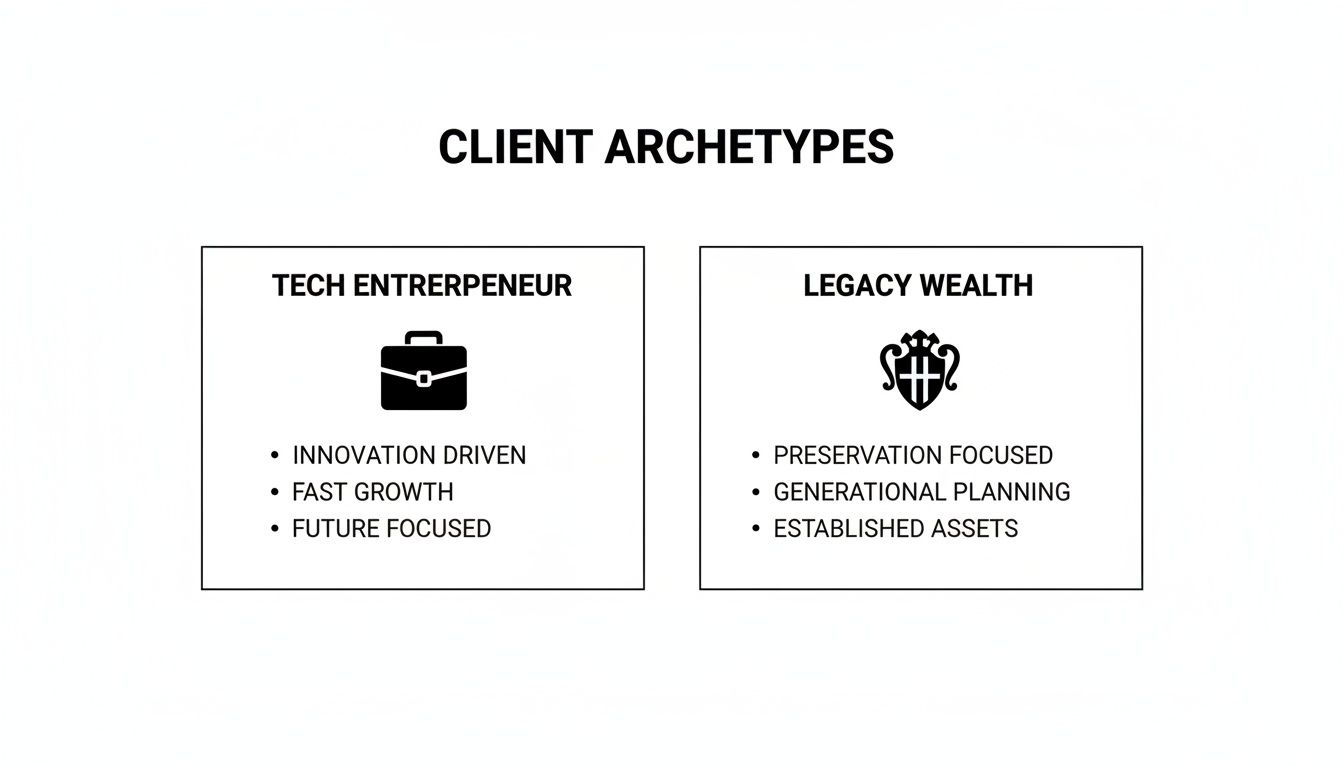
This distinction is crucial. While both archetypes have the resources for a significant project, their decision-making criteria, communication preferences, and design sensibilities are often worlds apart.
To illustrate this, let’s break down these two common profiles.
High-Net-Worth Client Archetype Comparison
| Attribute | Tech Entrepreneur (New Money) | Legacy Wealth Holder (Old Money) |
|---|---|---|
| Primary Motivation | Innovation, efficiency, status, return on investment (ROI). | Legacy, privacy, tradition, timeless quality. |
| Design Aesthetic | Modern, minimalist, smart-home integration, statement pieces. | Classic, timeless, bespoke craftsmanship, understated elegance. |
| Decision-Making | Data-driven, quick, decisive. Values clear proposals and tech-enabled processes. | Relationship-based, consultative, slower. Values trust and discretion. |
| Communication Style | Prefers email, digital presentations, and concise updates. | Prefers face-to-face meetings, personal phone calls, and detailed narratives. |
| Biggest Fear | Making a trendy mistake; their home looking dated in 5 years. | Sacrificing quality or authenticity; their home feeling impersonal. |
| Where to Find Them | Tech publications, LinkedIn, exclusive networking events, X. | Philanthropic galas, country clubs, art auctions, board memberships. |
Understanding these nuances allows you to tailor not just your marketing but your entire client experience, from the initial consultation to the final reveal.
The U.S. interior design market is a massive $37.66 billion industry, and it’s not slowing down. With projections to hit $52.20 billion by 2032 and renovations accounting for 47.37% of all revenue, the competition for top-tier clients is only getting more intense. You can see more in-depth industry statistics on ivyforms.com. This is why specialized platforms like Haute Design are so effective—they connect designers directly with these vetted, affluent individuals.
Key Takeaway: A one-size-fits-all approach will fail in the luxury space. You need to tailor your portfolio, your language, and even your initial questions to the specific client archetype you want to attract. This shows a sophisticated understanding of their world, which is the cornerstone of building trust.
Building An Irresistible Digital Presence
Think of your website not as a digital brochure, but as your flagship showroom. For the high-net-worth clients you want to attract, this is where the very first—and often most critical—impression is formed. In the luxury space, your online presence has to do more than just display beautiful photos. It needs to instantly build trust, clearly communicate your firm’s unique value, and guide discerning visitors toward becoming qualified leads.
Every single element matters. Your homepage headline, the flow of your project descriptions, even the speed at which your pages load—it all contributes to an experience that should feel as bespoke and thoughtfully curated as the spaces you design. Without this solid foundation, even the most sophisticated lead generation strategies will fall short.
Weaving Trust Signals Into Your Website
In the luxury market, trust is everything. Affluent clients aren’t just buying a design service; they’re making a substantial investment and entrusting you with their most personal environments. Your website has to immediately signal that you are a credible, established, and celebrated authority in your field.
Simply saying you’re an expert isn’t enough. You have to prove it with clear, visual cues that resonate with this clientele.
- Showcase Your Accolades: Badges from esteemed platforms like Haute Design act as an instant stamp of approval. Place these prominently in your website’s footer or on your “About” page where they can’t be missed.
- Build a Dedicated Press Page: An “As Seen In” section with logos from top-tier publications like Architectural Digest, Elle Decor, or Luxe Interiors + Design provides powerful third-party validation. It shows you’re recognized by the best.
- Develop In-Depth Case Studies: Go beyond a simple photo gallery. A real case study tells a compelling story: it outlines the client’s initial challenge, details your creative solution, and showcases the stunning transformation, all wrapped up with a glowing testimonial.
Together, these elements build a powerful narrative of credibility that speaks directly to a clientele accustomed to seeing proof of excellence.
Optimizing Your Digital Portfolio for Conversion
A high-end portfolio must do more than just look pretty. It needs to answer the unspoken questions every potential client has. They’re not just thinking, “Is this beautiful?” They’re asking, “Can this firm handle a project of my scale? Do they have a deep understanding of craftsmanship? Is this a wise investment?”
Your project galleries need to be strategically structured to address these deeper concerns.
Your portfolio’s job isn’t just to be seen, but to be understood. Each project should be a miniature case study that showcases your problem-solving abilities, your process, and the tangible value you deliver beyond just a beautiful room.
Instead of an endless grid of images, structure each project page to tell a story. Include a brief project scope, highlight the unique materials or artisan collaborations involved, and touch on the specific challenges you overcame. This simple shift reframes your work from a passive gallery to an active demonstration of masterful project execution. To dive deeper, you can explore more on crafting the best portfolio website for designers in our guide on Haute Living.
Advanced SEO For The Luxury Market
Generic SEO tactics just don’t work when your ideal client isn’t using generic search terms. To generate leads for a luxury firm, you need a much more targeted, location-specific strategy. The goal is to capture the attention of prospects who have high intent and are searching for elite services in affluent neighborhoods.
This is where long-tail keywords become your most valuable asset. These are longer, more specific phrases that indicate a user is much closer to making a decision.
Examples of High-Value Long-Tail Keywords:
| Broad Keyword | Targeted Long-Tail Keyword |
|---|---|
| Interior Designer Miami | Penthouse interior designer Fisher Island |
| Luxury Home Builder | Custom home architect in The Hamptons |
| Modern Kitchen Design | Bespoke Italian kitchen design Beverly Hills |
When you create service pages and blog content optimized for these hyper-specific terms, you attract a far more qualified lead. Someone searching for a “Beverly Hills modern home architect” isn’t just browsing for ideas—they have a specific project and location in mind. Capturing that traffic is how you fill your pipeline with the right kind of projects.
Creating Content That Attracts Affluent Clients
Let’s be honest: generic blog posts about the “hottest color trends” or “decorating on a budget” aren’t going to land you a seven-figure project. To connect with a high-net-worth clientele, your content must mirror the sophistication and exclusivity of your design work. It needs to speak their language—one that values craftsmanship, unique stories, and bespoke experiences over tired, mainstream advice.
This isn’t just about showing off your portfolio. It’s about shifting your position from a service provider to a true curator of fine living. Your content should be an extension of your brand, offering an insider’s look into the world you create for clients.
Develop Pillar Content That Tells a Story
Pillar content is the foundation of your entire content strategy. These are the substantial, beautifully crafted pieces that showcase your authority and provide real insight. Instead of churning out short-lived articles, you’ll be creating evergreen assets that you can promote and repurpose for months, even years.
Think of each one as a feature in a high-end design journal, not just another blog post.
- Exclusive Home Tours: Don’t just show a gallery of finished photos. Craft a compelling narrative around a signature project. Walk your audience through the entire design journey, from the first sketch to the final reveal. Talk about the collaboration with the architect, the hunt for that perfect slab of marble, or the story behind the custom-built furniture.
- Artisan & Maker Spotlights: Shine a light on the incredible craftspeople you partner with—the cabinet maker with a decades-old family business, the local metalworker, the textile artist. This does more than just share the credit; it powerfully signals your commitment to quality and your connection to an exclusive network of talent.
- Deep Dives into Materials: Dedicate an entire piece to a single, exceptional material. Explore the history and application of something like Calacatta Borghini marble or the meticulous process of applying hand-troweled plaster. This level of detail demonstrates a masterful understanding that discerning clients will immediately recognize and respect.
This kind of storytelling naturally fuels your interior design lead generation by attracting an audience that’s already educated, engaged, and aligned with your firm’s uncompromising standards.
Execute a Targeted Public Relations Strategy
A single mention in the right publication can be worth more than a year’s worth of blogging. When a prestigious magazine features your work, it provides powerful, third-party validation that resonates deeply with affluent clients. Your PR efforts should be surgical, focusing only on the publications your ideal clients actually read.
Start by building a highly curated media list. Pinpoint the specific editors and writers at magazines like Luxe Interiors + Design or Veranda who cover the type of high-end residential projects you specialize in.
Securing a feature in a top-tier publication isn’t just about visibility; it’s about borrowing credibility. It tells a potential client that your work has been vetted and celebrated by the highest authorities in design.
When it’s time to pitch, skip the generic press release. Write a personalized email that tells the unique story behind your project. What makes it newsworthy? Maybe it’s a groundbreaking use of sustainable technology or a remarkable transformation of a historic home. Always offer exclusive, professional photography—it’s often the hook that gets an editor’s attention.
Create Your Content Flywheel
The real magic happens when you create a “content flywheel,” where one finished project fuels a dozen different marketing assets. This approach maximizes your return on every bit of effort and ensures you have a consistent stream of top-tier content.
Here’s how a single project can be spun into gold:
- Land the Press Feature: Your first goal is getting that project featured in one of your target luxury publications. This piece becomes the anchor for everything else.
- Produce a Cinematic Video Tour: While the photography is happening, create a professional video walk-through of the home. This becomes a premium asset for your website, social media channels, and email list.
- Build an In-Depth Website Case Study: After the magazine feature is published, create your own detailed case study. Here, you can include more “before” photos, floor plans, and a direct client testimonial.
- Amplify Across Social Media: Systematically break the project down into weeks’ worth of social media content. Share close-up shots of intricate details, behind-the-scenes anecdotes, and quotes from the artisan interviews.
This methodical system turns every project you complete into a powerful engine for interior design lead generation, constantly reinforcing your expertise and keeping your firm at the forefront of your ideal clients’ minds.
7. Run Targeted Paid Ads and Forge Strategic Alliances
Organic marketing is your foundation, building trust and authority over time. But to really open the floodgates and attract high-net-worth clients now, you need to be more direct. This means putting your brand squarely in front of them through two powerful, proactive channels: precision-targeted paid advertising and high-value strategic partnerships.
Think of it this way: organic efforts pull clients in slowly, while paid ads and partnerships push your firm directly into their line of sight. When you combine them, you create a dynamic system that consistently brings your ideal clients to your doorstep.
Precision Targeting with Paid Advertising
In the luxury market, advertising isn’t a numbers game—it’s a sniper’s game. Forget casting a wide net. Your goal is to pinpoint the exact individuals whose online footprint screams “ideal client.” Visual platforms like Instagram and Pinterest are your best friends here, not just for their aesthetics, but for their incredible targeting capabilities.
You can slice and dice audiences to reach people whose behavior and interests align perfectly with the luxury lifestyle.
- Go Beyond Demographics: Target users who follow or show interest in brands like Rolls-Royce or Bentley, read high-end publications like Architectural Digest, or engage with content about private aviation, yachting, and exclusive travel.
- Zero in with Geo-Fencing: Don’t just target a city; target the most affluent postal codes within it. You can even draw a virtual fence around exclusive country clubs, luxury real estate brokerages, or high-end retail districts, serving ads to people who frequent those locations.
- Clone Your Best Clients: This is where it gets powerful. Take the email list from your 10 best past clients and upload it to create a “Lookalike Audience.” The platform’s algorithm analyzes their shared traits and then finds thousands of new users who match that profile, giving you a pre-qualified audience to target.
Your ad creative needs to match this level of sophistication. Use only your most breathtaking professional photography and short, cinematic video tours. The copy should be elegant and understated, hinting at the bespoke experience you provide.
A Note From Experience: The best ads in the luxury space never feel like ads. They’re more like an exclusive invitation or a beautiful piece of content. You’re not selling; you’re inspiring curiosity and prompting a quiet, considered click.
Before you invest heavily, it’s smart to understand the landscape. Different channels offer different levels of targeting precision and potential ROI.
Lead Generation Channel ROI Snapshot
Here’s a quick overview of what you can expect from various channels when targeting an affluent clientele.
| Channel | Targeting Capability | Typical Cost | Lead Quality |
|---|---|---|---|
| Google Ads (Search) | High-intent, but broad. Good for capturing active searchers. | High (cost-per-click) | Varies (Mixed Bag) |
| Instagram/Facebook Ads | Excellent. Deep behavioral, interest, and Lookalike targeting. | Moderate (cost-per-impression) | High (with right targeting) |
| Pinterest Ads | Excellent. Visual discovery and long-term planning behavior. | Moderate | High (inspiration-driven) |
| Luxury Publications | High. Targets an established affluent readership. | Very High (flat fees) | Very High (brand alignment) |
| Strategic Partnerships | Precision. Taps into an existing, trusted network. | Low (time/relationship) | Excellent (warm referral) |
As you can see, while digital ads are powerful, nothing quite beats the quality of a warm referral from a trusted source.
Building a Powerful Referral Network
What’s the fastest way to land a new multi-million dollar project? A personal introduction from another professional your ideal client already knows and trusts.
Building these strategic alliances is one of the single most effective things you can do for interior design lead generation. I like to call these connections “Profit Partners”—non-competing professionals who serve the same clientele and whose success is intertwined with yours.
Identifying Your Core Strategic Alliances
Think about who an affluent individual calls first when they make a major life or property decision. That’s where you want to be.
- Luxury Real Estate Agents: These are your top-tier allies. They’re on the front lines, working with clients who have just purchased a multi-million dollar property and need design services yesterday. They also work with sellers who need high-end staging to get top dollar.
- Architects & Custom Home Builders: Getting in on the ground floor—literally—is a game-changer. When an architect or builder brings you into a project from the very beginning, you can ensure the design vision is seamless, from the foundation to the final furnishings.
- Wealth Managers & Private Bankers: These professionals have incredibly deep, trust-based relationships. When one of their clients has a major liquidity event, like selling a business, they are often the first to know and can make a perfectly timed introduction for a new residence or vacation home project.
Getting your foot in the door requires a “give to get” mentality. Don’t just show up and ask for referrals; offer them value first.
Here’s an outreach script I’ve seen work wonders with top real estate agents:
“Hi [Agent’s Name],
My name is [Your Name], the principal designer at [Your Firm]. I’ve been following your work and am so impressed with your listings in the [Neighborhood] area.
My firm specializes in [Your Niche, e.g., large-scale renovations of historic properties], and I’m currently curating a list of the absolute best agents in the city to recommend to my own clients. I’d love to treat you to coffee next week to learn more about your process and see how we might be able to support each other.
Best, [Your Name]”
This approach immediately frames the relationship as a mutually beneficial partnership, not a one-sided request. Once you’ve built that rapport, you can formalize things with a simple referral agreement. And for more ideas on who to connect with, you can explore the various professionals listed on platforms where you can find luxury interior design firms.
By pairing the precision of digital ads with the power of genuine human connection, you’ll build a lead generation engine that doesn’t just find clients—it attracts the right clients.
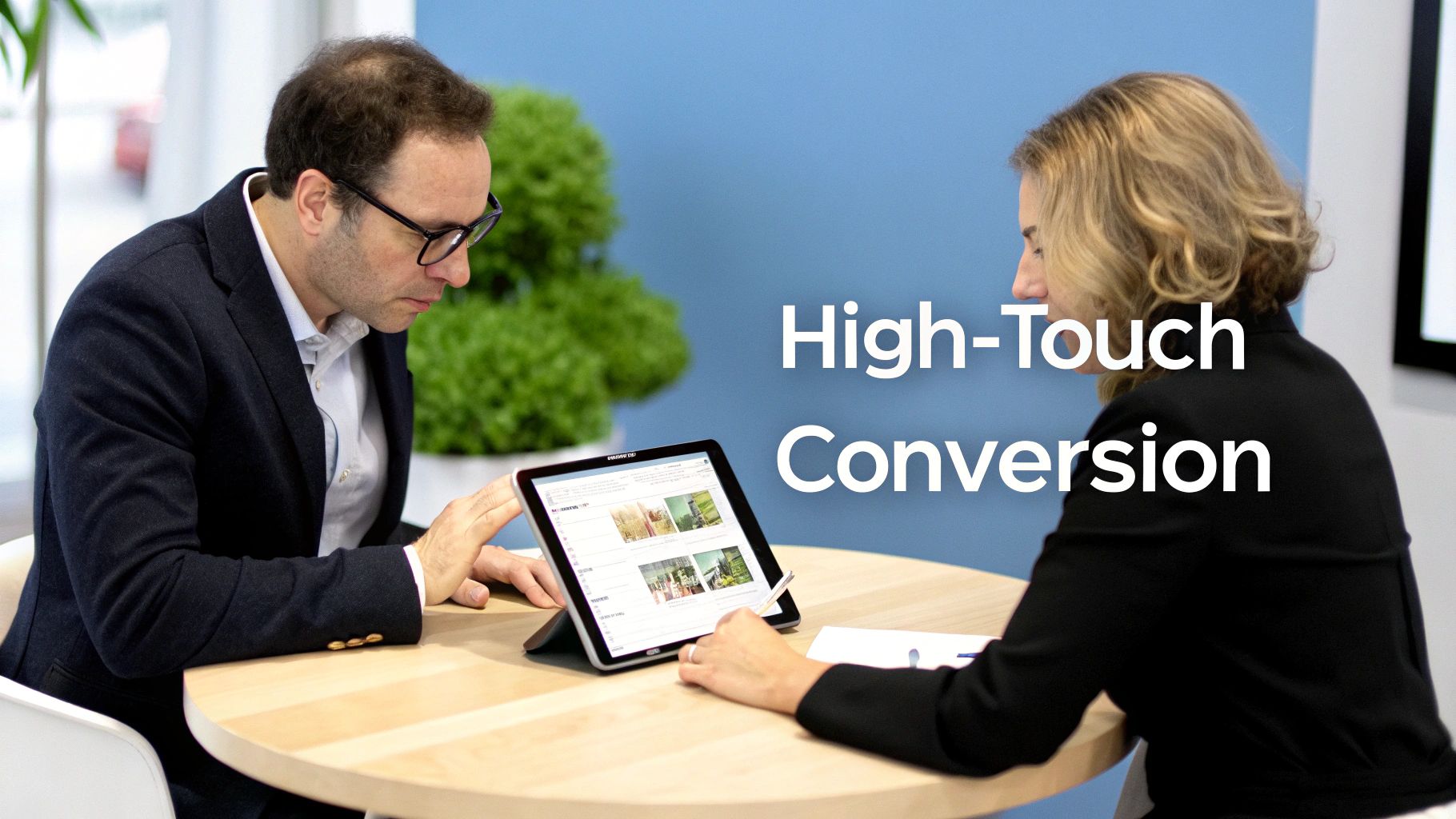
Mastering The High-Touch Conversion Process
Getting a lead in the door is just the beginning. The real artistry is in turning that initial spark of interest into a signed, high-value project. For luxury interior design firms, the follow-up isn’t a sales tactic—it’s the very first taste a client gets of your firm’s service, precision, and commitment. A clumsy, slow, or generic response can instantly undo all the hard work you’ve put into building your premium brand.
This isn’t about pushing a sale. It’s about a consultative, high-touch experience that meets the high expectations of a high-net-worth clientele. Every single interaction has to be seamless, personal, and reassuring, guiding a potential client from simple curiosity to absolute confidence in your vision.
The Critical Importance of Speed
In the world of luxury, speed is a clear signal of attentiveness and professionalism. The moment a qualified prospect reaches out, their interest is at its absolute peak. Any delay gives them time to second-guess their decision, browse your competitors, or just let the initial excitement fade. More often than not, the first firm to make meaningful contact sets the standard and wins the project.
This is a game-changer. Consider that a staggering 50-78% of affluent buyers end up choosing the very first vendor who replies to them.
Responding within just five minutes can boost your lead qualification rates by 21 times compared to waiting 30 minutes. The difference is so dramatic that firms getting back to leads in under a minute have seen conversion rates jump by as much as 391%. You can dig into more data on how response time shapes lead generation on bokkagroup.com.
Takeaway: Your goal should be a five-minute response time for every qualified web inquiry. This demands a solid system—whether it’s instant phone notifications or a dedicated team member—but the return on that investment is massive.
Crafting The First Point of Contact
That first email or phone call sets the entire tone for the relationship. It needs to feel warm, professional, and focused completely on the client, not on you. Your goal isn’t to sell them anything yet; it’s simply to understand their needs and get that initial consultation on the calendar.
Here’s a simple, effective way to approach it.
Example Initial Contact Email Script:
Subject: Thank You for Your Inquiry | [Your Firm Name]
Dear [Prospect’s Name],
Thank you for reaching out to us about your [Project Type, e.g., residence in The Hamptons]. We appreciate you considering [Your Firm Name] for what sounds like an exciting project.
Based on what you’ve shared, I would be delighted to schedule a brief 15-minute introductory call to learn more about your vision and answer any initial questions you might have.
You can book a time that works for you directly on my calendar here: [Link to Your Calendar Scheduler]
If you’d prefer, just let me know what time works best on your end.
Warmly,
[Your Name] Principal Designer, [Your Firm Name] [Link to Your Portfolio]
This script works because it’s respectful of their time, gives a clear next step, and immediately shows you have an organized, professional process.
Handling Common Objections with Confidence
High-net-worth clients are discerning. They will naturally have questions about budget, timelines, and how you work. The way you handle these conversations says everything about your firm’s expertise and value. The key is to shift the conversation away from cost and toward investment, value, and the bespoke experience only you can provide.
Let’s walk through a common scenario.
Scenario: A prospect brings up concerns about the potential budget.
- Weak Response: “Our fees can be high, but we use quality materials.” This is all about cost and doesn’t inspire confidence.
- Strong Response: “That’s an excellent question. Our entire process is designed to maximize the value of your investment, ensuring every detail reflects not only your vision but also masterful craftsmanship and timeless quality. During our consultation, we can walk you through exactly how our budget management process provides full transparency and delivers an exceptional outcome.” This reframes the discussion around value, process, and results.
When you confidently address their concerns and pivot the focus to the value you deliver, you reinforce your position as a trusted advisor, not just another vendor. For more on creating compelling client documents, check out our guide on the perfect interior design proposal template. Mastering this high-touch process is how you ensure the premium leads you generate are converted into incredible projects.
Common Questions & Straight Answers
Putting a sophisticated lead generation plan into action always raises a few practical questions. Let’s tackle some of the most common ones we hear from luxury design firms to give you some quick clarity and help sharpen your approach.
How Much Should I Budget for Luxury Lead Generation?
There’s no single magic number here. A solid rule of thumb, though, is to set aside 5-10% of your target revenue for all your marketing and lead generation activities.
But honestly, it’s more useful to think in terms of Cost Per Acquisition (CPA) rather than a fixed budget.
Let’s say your average project commands a $100,000 fee. If you can acquire that client for $5,000, that’s a fantastic return. The trick is to be absolutely meticulous about tracking your spending across every channel, from Google Ads to a PR retainer. This is the only way to know for sure which sources are bringing you the best clients for the lowest CPA, allowing you to invest more in what works and pull back from what doesn’t.
What Are the Most Important KPIs to Track?
If you want to know if your interior design lead generation engine is actually working, you need to ignore the vanity metrics and focus on the numbers that directly impact your bottom line.
Forget about social media likes for a moment. These are the KPIs that truly matter:
- Number of Qualified Leads: How many inquiries are actually a perfect fit for your ideal client profile? This is your starting point.
- Lead-to-Consultation Rate: What percentage of those qualified leads do you successfully get on the phone or into a meeting?
- Consultation-to-Client Conversion Rate: This is the big one. Of all the consultations you conduct, how many turn into a signed contract?
- Cost Per Acquisition (CPA): Simply divide your total marketing spend by the number of new clients you’ve signed. This tells you exactly how efficient your strategy is.
Keep a close eye on these four metrics. They will give you an unfiltered, honest look at how effective your efforts really are.
How Can I Generate Leads Without a Large Portfolio?
When you’re an emerging designer, the game is all about quality, not quantity. If you only have one or two projects under your belt, your job is to turn them into your most powerful marketing assets.
Don’t skimp here. Invest in world-class professional photography and videography for each project. Then, go deep and build a compelling case study that tells the whole story—the client’s initial pain points, your creative problem-solving, and the beautiful final result.
Expert Tip: You can also showcase your talent by creating incredibly detailed conceptual designs for hypothetical high-end spaces. This is a brilliant way to demonstrate your unique vision and technical skill before you have a deep portfolio of built work.
Another savvy move is to partner with a luxury builder on a show home or join an exclusive, vetted network. Your story should always center on your distinct design philosophy and the white-glove experience you provide. For the right high-net-worth client, that narrative can be just as powerful as a portfolio built over decades.
At Haute Design, we specialize in one thing: connecting the nation’s most distinguished design professionals with the affluent clientele they’re looking for. When you join our curated network, you gain instant credibility and visibility within a community that prizes exceptional craftsmanship. Let us help you elevate your brand and fill your pipeline. Discover how Haute Design can connect you with your next luxury project.