



When you’re talking about luxury residential projects, forget simple square-footage math. While a ballpark figure of $150 to over $350 per square foot is a common starting point, it’s just that—a start. The real cost is in the details, shaped by the project’s scope, the quality of materials, and even the zip code you’re working in.
The Foundation of a Successful Luxury Renovation
A great luxury renovation doesn’t kick off with a sledgehammer. It begins with a meticulously crafted, transparent cost estimate. For any design professional in the high-end market, getting this right isn’t just a skill—it’s essential. This guide is about moving past the guesswork and building a solid financial framework from day one.
Think of the estimate as the project’s roadmap. It’s the single most powerful tool you have for managing client expectations, aligning their vision with what’s financially feasible, and protecting the project from the dreaded “scope creep” that can send timelines and budgets spiraling. When you present a thoughtful, detailed estimate, you’re not just talking numbers; you’re building immediate trust and demonstrating your expertise.
Why a Detailed Estimate Matters
In the luxury space, clients aren’t just paying for beautiful materials; they’re investing in a seamless experience. A vague or inaccurate budget can destroy their confidence in a heartbeat. On the other hand, a detailed, line-item estimate shows you’ve done your homework and have a firm grasp on every moving part.
A well-constructed financial plan accomplishes several crucial things:
- It sets clear expectations. No one likes sticker shock. This gives the client a realistic picture of their total investment right from the start.
- It becomes a decision-making tool. It empowers clients to make informed choices about where to splurge and where to save, balancing their wish list with their budget.
- It minimizes financial surprises. A properly researched estimate accounts for everything you can reasonably foresee, from city permits to the cost of that one specialist you need.
- It builds incredible client trust. Financial transparency is the cornerstone of a strong, collaborative relationship.
A detailed budget is the project’s roadmap, a critical tool for managing client expectations, and the best defense against unexpected expenses. It transforms a project from a source of stress into a seamless, predictable, and rewarding experience.
Ultimately, your goal is to create a financial plan that is as well-designed as the space itself. Understanding how to plan a home renovation for success means weaving this financial blueprint into every phase of your design process. By mastering this first crucial step, you turn what could be a tense conversation about money into an opportunity to shine, setting the stage for a project that impresses even the most discerning clients.
Turning a Client’s Vision into a Tangible Scope of Work
The single biggest factor that can make or break a renovation budget is the project’s scope. A client’s vague request to “redo the kitchen” is a landmine of potential cost overruns. Does that mean a simple facelift with new countertops, or are we talking about a full gut job, moving walls, and rerouting plumbing?
Before a single number can be put on paper, you have to translate that abstract vision into a detailed, tangible plan. This is where a meticulously defined Scope of Work (SOW) becomes the most powerful tool in your arsenal.
It all starts with a conversation—not about measurements, but about lifestyle. A great SOW isn’t just a list of tasks; it’s born from a deep understanding of how your client truly lives. How do they use the space right now? What are their daily pain points? Are they entertainers who need a great flow for hosting, or do they crave a quiet sanctuary? Your real job is to uncover the “why” behind every request.
For instance, a client might say they want a bigger primary bathroom. It’s up to you to dig deeper. Are they running out of storage for toiletries? Is the single vanity a source of morning traffic jams? Or are they dreaming of a spa-like retreat with a steam shower to escape the day? Each answer leads down a completely different path, with a completely different price tag.
From Ideas to Actionable Plans
Once you’ve grasped the client’s goals, it’s time to get formal. This is where you move from brainstorming sessions to concrete documents that leave no room for interpretation. Architectural plans, detailed renderings, and well-curated mood boards are absolutely essential. They create a shared visual and technical language that gets everyone—the client, the designer, and the contractor—on the exact same page.
This is also the moment to lock in those big-ticket decisions. It’s one thing to talk about a “chef’s kitchen,” but it’s another thing entirely to specify a 48-inch dual-fuel Wolf range versus a more standard 36-inch induction cooktop.
- Architectural Drawings: These are the non-negotiable blueprints. They map out any structural changes, new layouts, the placement of every window and door, and critical updates to the electrical and plumbing systems.
- Finish Schedules: This is where you list every single material. We’re talking about the exact species and stain for the hardwood floors, the specific model numbers for the faucets, and the paint codes for every wall.
- Mood Boards: While more conceptual, these are vital for nailing the aesthetic. They ensure all the carefully selected materials and finishes actually work together to create a cohesive look and feel.
This intensive planning process is the heart of the schematic design phase. If you want to dive deeper into this foundational stage, our guide on what is schematic design provides an excellent breakdown of how to turn initial concepts into buildable plans.
Think of the Scope of Work as your project’s constitution. It defines every task, material, and deliverable, creating an objective reference that shuts down misunderstandings and is your best defense against scope creep.
Documenting Every Last Detail
With the plans and visuals finalized, you can now draft the comprehensive SOW. This written document should be airtight, with zero ambiguity. It needs to detail everything the contractor is expected to do, from the first day of demolition right down to installing the last cabinet pull.
For a luxury project, the SOW has to be incredibly granular. Don’t just write “install new lighting.” Instead, specify the exact quantity, type, and location of recessed lights, pendants, and sconces. You should even include notes on any complex wiring for smart home integration.
Imagine you’re writing the story of the project, step by step. For a primary suite renovation, your SOW might include line items like:
- Demolition: Remove existing non-load-bearing wall between bedroom and closet.
- Framing: Frame new walk-in closet according to architectural plan dimensions.
- Electrical: Relocate 4 existing outlets and add 6 new recessed LED fixtures, all on a new dimmer switch.
- Plumbing: Rough-in all new plumbing for a freestanding tub and a curbless shower with a linear drain.
- Finishes: Install client-selected marble tile on all bathroom floors and shower walls, including full waterproofing membrane system.
This level of detail might seem exhaustive, but it’s the only way to get accurate, comparable bids from contractors and build a budget you can actually trust. It transforms a subjective idea into an objective checklist, creating the solid foundation every successful cost estimation is built on.
The Anatomy of a Luxury Renovation Budget
Once you’ve nailed down a crystal-clear Scope of Work, it’s time to move from big-picture concepts to hard numbers. This is the moment where you meticulously break down the entire project into a detailed, line-item budget that leaves absolutely no stone unturned. Think of this document as more than just a spreadsheet; it’s a vital tool for building trust and giving your client a transparent look at where every single dollar is going.
The secret to an accurate estimate? It’s all in the research. This is no place for guesswork. For a high-end residential project, this means getting multiple, detailed bids from your most trusted general contractors. It means consulting specialized artisans for custom pieces—like that intricate millwork or a bespoke metal staircase—and getting current, real-world pricing for every premium material on your list.
Breaking Down the Core Cost Categories
A well-structured budget tells a story. By organizing it into clear, logical categories, you help clients understand the financial landscape of their project and make it much easier to track expenses as you move forward.
- Materials: This is almost always the biggest chunk of a luxury renovation budget. It covers everything from the foundational lumber and drywall to the show-stopping Calacatta marble countertops and hand-painted Zellige tiles.
- Labor: Here, you’ll account for every skilled professional on site: the carpenters, electricians, plumbers, painters, and master tile setters. Keep in mind, labor rates can swing dramatically based on your region and the artisan’s level of expertise.
- Professional Fees: This bucket is for the brain trust behind the project—the design team, architects, structural engineers, and any other specialized consultants whose expertise is required.
- Permits and Inspections: Don’t forget the city. Every municipality has its own fee schedule for building permits, which can run from a few hundred dollars to several thousand, depending on the project’s complexity and scale.
- Contingency Fund: This is the one line item that is absolutely non-negotiable. I always recommend setting aside 15-20% of the total project cost to cover those inevitable surprises that pop up once the walls are opened.
The chart below perfectly illustrates how a client’s initial vision gets filtered through architectural plans to create the formal scope document—which is the bedrock of any accurate budget.
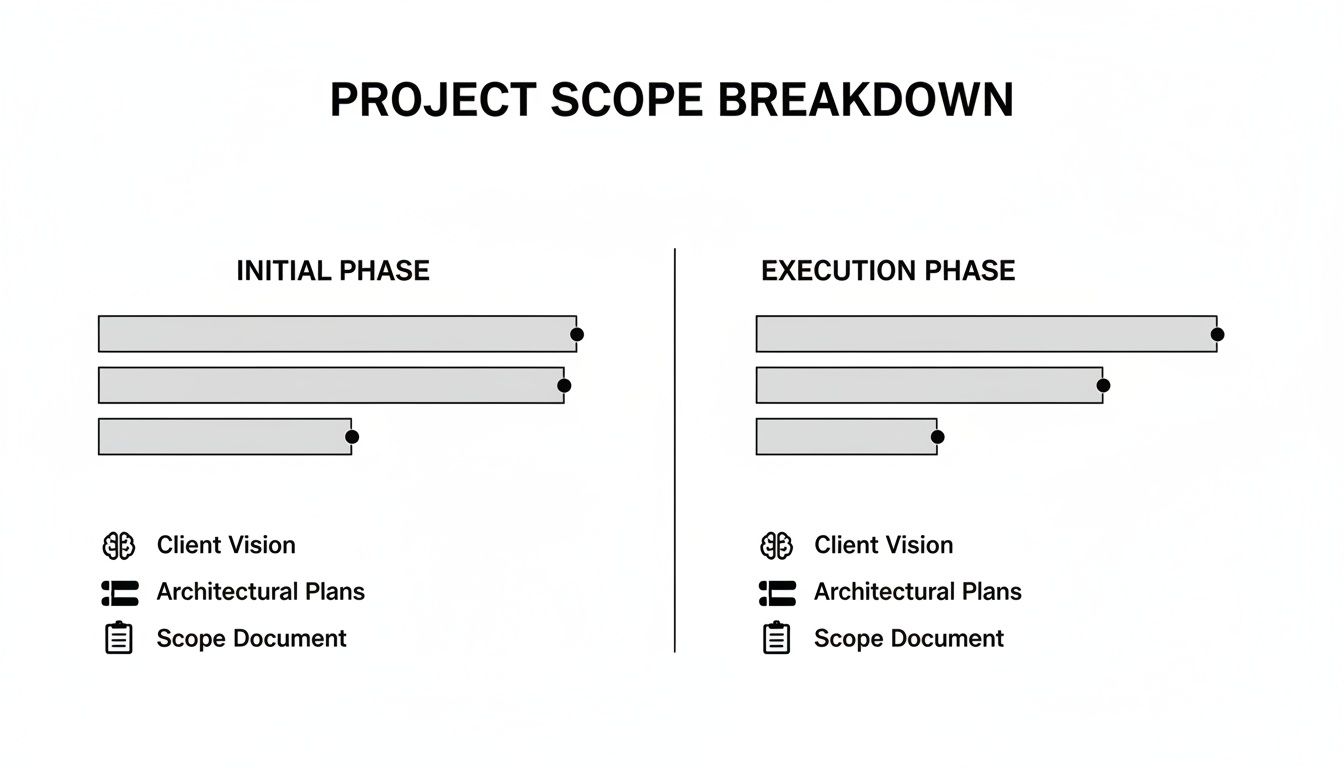
As you can see, a solid budget can only be built upon clearly defined parameters. It’s all about moving from abstract ideas to concrete, documented plans.
Sample Line-Item Budget Breakdown for a Luxury Kitchen Renovation
To make this more concrete, let’s look at a sample breakdown. A table like this is an incredibly powerful tool to use with clients. It demystifies the numbers and shows them exactly how their investment is allocated across the different components of the project.
| Category | Line Item Example | Estimated % of Total Budget | Notes for Consideration |
|---|---|---|---|
| Cabinetry & Millwork | Custom rift-cut white oak cabinets with integrated pulls | 25-30% | Pricing varies with wood species, finish, and hardware. |
| Appliances | Professional-grade range, integrated refrigerator, wine cooler | 15-20% | Lead times for high-end appliances can be long; order early. |
| Countertops & Backsplash | 3cm Calacatta Gold marble slab, full-height backsplash | 10-15% | Slab selection and fabrication complexity impact the final cost. |
| Labor | Installation of all items, plumbing, electrical, painting | 20-25% | Ensure your contractor’s bid includes all necessary trades. |
| Fixtures & Finishes | Sink, faucet, lighting fixtures, hardware, flooring | 8-12% | Small details add up; be specific with selections. |
| Professional Fees | Designer, Architect, Engineer fees | 5-10% | Varies based on the scope of professional services. |
| Contingency | Unforeseen issues (e.g., hidden plumbing problems) | 15% | A non-negotiable buffer for the unexpected. |
This kind of detailed view turns a daunting total cost into manageable, understandable pieces. It’s about transparency and setting the stage for a collaborative and successful project from the very start.
The Art of Value Engineering
Presenting a detailed budget isn’t just about showing costs; it’s about opening a dialogue. Sometimes, a client’s dream list might stretch beyond their initial financial comfort zone. This is where you, the expert, can step in. Instead of just slashing features, you can introduce the concept of value engineering—a smart, systematic approach to finding cost-effective alternatives without compromising on quality or the overall design intent.
For instance, maybe the initial flooring selection is a rare, imported French oak that’s eating up a huge portion of the budget. You could present a stunning, domestically sourced white oak with a custom stain that achieves a virtually identical aesthetic for 25% less. This is precisely the kind of strategic thinking that clients appreciate. You can learn more about what value engineering in construction is and how to apply it. This proactive problem-solving shows you’re a true advocate for their financial interests while fiercely protecting the design’s integrity.
Navigating Market Dynamics and Regional Costs
Building a luxury renovation budget in a vacuum is a guaranteed way to start a project on the wrong foot. Even the most perfectly defined scope of work can get sideswiped by forces you don’t control, and if you haven’t accounted for them, you’re setting yourself—and your client—up for failure. This is where understanding the realities of market dynamics and regional cost differences becomes absolutely critical for estimating renovation costs with any real accuracy.
Think about it: last year’s quotes are practically ancient history in today’s market. Economic shifts, lingering supply chain kinks, and inflation hit our industry hard and fast. That specific high-end appliance or that incredible imported stone slab might have a lead time of several months, which can stall the entire project and send labor costs climbing as your crews are forced to wait. These are the on-the-ground realities we have to get in front of with clients to set their expectations from day one.
The Geographic Pricing Puzzle
One of the single biggest variables in any budget is simply the project’s zip code. You could take the exact same high-end kitchen renovation plans and find that the cost to build it varies dramatically from one city to another, sometimes by as much as 30-40%. This isn’t just a reflection of real estate values; it’s a complicated mix of local economic factors.
Here’s what’s really driving those differences:
- Labor Rates: The cost of skilled tradespeople is the number one reason for this huge swing. A master carpenter or an expert tile setter in a high-demand city like New York or San Francisco will command a much higher hourly rate than their counterpart in a smaller midwestern town.
- Material Sourcing: Getting materials to the job site costs money. Your proximity to major ports and distribution centers has a real impact on pricing. The shipping and handling fees for that perfect slab of Italian marble will be wildly different depending on whether it’s delivered to a coastal city or somewhere deep inland.
- Building Codes & Permits: Local rules and regulations can add some serious and often unexpected costs. Some municipalities have incredibly strict requirements for structural work, energy efficiency, or historical preservation, all of which demand specialized (and more expensive) labor and materials. The fee structure for a building permit in Greenwich, Connecticut, for example, is entirely different from one just down the road in Westport.
Any budget that doesn’t factor in regional cost multipliers is fundamentally flawed from the start. You have to ground your numbers in the local market, using current data on what labor actually costs and how the material supply chain is functioning in that specific area.
This focus on local conditions is everything. A gut renovation in Fairfield County, Connecticut, might have a baseline starting point of $150 to $250 per square foot, but trying to apply that same number to a project in Miami or Los Angeles just won’t work.
Staying Ahead of Market Trends
Beyond just geography, the broader economic climate is always in play. It’s our job to stay on top of current trends so we can advise clients properly and protect the budget from getting blindsided by sudden price hikes. The renovation industry is in a constant state of flux, with material and labor prices shifting based on demand, supply, and a dozen other factors.
Recent data shows just how critical this is. Home repair and remodeling costs shot up by nearly 4 percent in the first quarter of 2025 compared to the previous year—a clear sign that yesterday’s numbers are no longer a reliable guide. Interestingly, this price jump seems to be driven mostly by labor costs, not tariffs or import fees. For a deeper dive, you can explore this analysis of home renovation spending trends and their drivers.
Communicating Market Realities to Clients
This knowledge isn’t just for your spreadsheets; it’s a cornerstone of your client communication strategy. When a client inevitably questions why the budget is higher than they expected based on an article they bookmarked two years ago, you need to be ready to walk them through the why.
By breaking down these external factors—inflation, supply chain delays, local labor rates—you turn a potentially tense conversation about money into an educational moment. You can justify your numbers with real-world data, showing that your estimate is grounded in the reality of today’s construction landscape, not guesswork. This kind of transparency builds enormous trust and positions you as a true advocate for their project’s success.
Mastering Contingency Funds and Budget Presentation

No matter how meticulous your planning is, every luxury renovation has its share of surprises. This is precisely why a contingency fund isn’t just a good idea—it’s absolutely essential. Think of it as your professional answer to the inevitable “what if?” scenarios. A well-managed contingency is the key to handling unexpected hurdles without derailing the project or, even worse, damaging your relationship with the client.
The biggest hurdle is often a client’s perception. Many see a contingency as a slush fund or an optional buffer. Your first job is to shift that mindset. This isn’t just extra money; it’s a dedicated insurance policy against the unknown.
For high-end residential work, I always recommend a contingency between 15% and 20% of the total construction cost. That figure isn’t pulled from thin air. It’s a calculated buffer born from decades of experience dealing with the unique complexities of luxury renovations.
Framing the Contingency Fund Correctly
Don’t bury the contingency at the bottom of the budget. Bring it up right at the start of your presentation. Explain that this fund is specifically for legitimate, unforeseen issues that are impossible to predict before the walls come down. Being upfront about this builds immediate trust and sets realistic expectations.
I’ve seen contingency funds save projects countless times. Here are a few real-world examples of when they become a lifeline:
- Hidden Structural Problems: We once opened up a wall in a historic brownstone to find termite-damaged joists that needed immediate replacement. The contingency covered it without a single day’s delay.
- Outdated Systems: It’s common to discover old knob-and-tube wiring or leaky galvanized plumbing that has to be brought up to code. You can’t just ignore it.
- Supply Chain Hiccups: A specified marble slab for a master bath gets held up in customs for weeks. The contingency allows you to source a comparable, locally available option—even at a premium—to keep the project moving.
- Unexpected Inspector Demands: A city inspector might require an unforeseen engineering review or an extra fire damper, adding costs that no one could have anticipated.
The contingency fund is the project’s safety net. It’s not a symptom of poor planning; it’s the hallmark of smart, professional risk management. When you frame it as an essential insurance policy, you’re protecting both the project’s integrity and the client’s peace of mind.
By positioning it this way, you change the conversation entirely. The contingency is no longer a cost but a crucial service you provide—protecting their investment by planning for the unpredictable.
The Art of the Budget Presentation
The moment you share the final budget is a defining one for your client relationship. Never, ever just email a spreadsheet. A formal presentation, whether you’re sitting across a table or on a video call, is your opportunity to turn a daunting document into a collaborative planning session.
Your job is to tell the story of their project through the numbers. Don’t just point to the bottom line. Walk them through each major category—the custom cabinetry, the professional-grade appliances, the artisan labor—and connect every cost back to the quality and vision we established in the scope of work.
When you get to the contractor bids, explain your recommendation. Show them why a particular bid offers the best value, which is rarely the lowest price. Talk about the contractor’s reputation, their communication style, and the quality of their past work. This reinforces your role as their expert advocate, not just a designer.
Finally, always walk into that meeting with value engineering options ready to go. If the total estimate gives them sticker shock, you need to have a plan. Suggesting a different but equally beautiful quartzite for the island or a revised lighting plan that creates a similar effect can show flexibility without gutting the design. This simple preparation transforms the budget review from a high-stakes financial meeting into a strategic partnership, setting a positive tone for the exciting work ahead.
Navigating the Tough Questions About Renovation Costs
Even with the most detailed budget in hand, clients will always have questions about the numbers. It’s just human nature, especially when dealing with a significant investment like a high-end renovation. Being ready for these conversations with clear, confident answers is what separates a good designer from a great one. It’s how you build trust and keep the project moving forward smoothly.
When a client looks at the bottom line and asks, “Why is this so expensive?” don’t take it personally. They’re not questioning your integrity; they’re asking for help understanding where their money is going. This is your chance to walk them through the value you’re providing—the master craftspeople, the exceptional materials, and the complex orchestration required to deliver a truly luxury result.
This conversation is more relevant than ever. The U.S. home remodeling market has exploded, surging 51 percent from $404 billion in 2019 to an incredible $609 billion in 2023. This isn’t just a trend; it’s a fundamental shift in how people view their homes as investments, which has ratcheted up demand for both premium materials and elite trade professionals. You can dig deeper into this renovation rebound and its market impact.
“How Accurate Is This Initial Estimate?”
Every client wants certainty. I’ve found it’s best to be upfront: the estimate we build from a detailed Scope of Work is our professional, highly accurate financial roadmap. But it’s not set in stone.
I always explain that the final number can shift based on two key things:
- Client-Driven Changes: These are the decisions they make along the way. If they fall in love with a rare Calacatta marble after we’ve budgeted for quartzite, or decide to add a wall of custom built-ins, we’ll adjust the budget with a formal change order. No surprises.
- Unforeseen Site Conditions: These are the true unknowns that pop up after demolition. Think hidden structural problems, old wiring that isn’t up to code, or plumbing issues lurking behind a wall. This is exactly what the contingency fund is for.
Making this distinction from the start helps clients understand what we can control and what we can’t. It’s all about transparency.
“Why Is There Such a Big Difference in Contractor Bids?”
When you lay out three bids, clients’ eyes often jump straight to the lowest number. It’s your job to steer them toward the best value, not just the lowest price. A bid that comes in dramatically lower than the others should be a red flag, not a relief. It often means they’ve missed something in the scope, are using less-skilled labor, or don’t carry proper insurance.
I make a point to sit down with my clients and compare the bids line by line. I’ll point out the differences and champion my preferred contractor, explaining how their slightly higher cost translates into reliability, superior craftsmanship, and a proven ability to handle the complexities of a luxury project. They aren’t just paying for the work; they’re paying for peace of mind.
An estimate isn’t just a spreadsheet; it’s a promise. It’s a promise of quality, a reflection of a shared vision. When you can confidently explain the “why” behind every line item, you turn a tough money conversation into a moment that reinforces your value.
“Can’t We Save Money If We Buy Our Own Materials?”
I hear this one a lot, especially from clients who are savvy shoppers and enjoy the hunt. On the surface, it seems like a smart way to trim the budget, but I gently explain how it can quickly derail a project.
Sourcing materials yourself introduces huge risks to the schedule and quality. I explain that we work with a network of trusted suppliers who provide high-quality, warrantied products on a predictable timeline. What happens if a faucet the client ordered arrives damaged, or it’s the wrong finish? The entire project can grind to a halt, with tradespeople sitting idle while we wait for a replacement—and those delays cost money. It also creates a blame game if something fails later. Was it a faulty product or a bad installation?
By managing all the procurement, you maintain total control over the timeline and quality, ensuring every single element meets the project’s exacting standards. In the end, it’s about protecting their investment.
Are you ready to connect with clients who value this level of professionalism and detailed care? Join the Haute Design network to showcase your expertise and attract affluent homeowners who are actively looking for a designer just like you.