


Think of building a custom luxury home like producing a blockbuster film. The high-end residential builder is your director and executive producer, all rolled into one. They’re the one who pulls together the entire cast of world-class talent—from visionary architects to meticulous artisans—and guides every scene to ensure the final product is a masterpiece of design, comfort, and lasting value. This role goes far beyond a typical contractor; they are the central intelligence for your most personal and significant investment.
Beyond Construction: The Role of a Luxury Builder
A standard builder puts up a house. A high-end residential builder, on the other hand, curates and constructs a one-of-a-kind living environment. Their responsibilities fuse the white-glove service of a concierge with the obsessive quality control of a master craftsman and the sharp oversight of a financial steward. The distinction couldn’t be more important, because a luxury home is far more than just a building—it’s a complex asset engineered with absolute precision.
These elite firms build their reputation on three foundational pillars that set their work apart.
- Bespoke Design Integration: They join the conversation at the very beginning, collaborating with architects and designers to ensure the dream on paper is both breathtaking and buildable—on time and within budget.
- Uncompromising Craftsmanship: They don’t just hire subcontractors; they maintain a private roster of master tradespeople. These are the artisans who live and breathe their craft, from hand-laid stonework to flawless custom cabinetry, ensuring every detail is executed to an impeccable standard.
- Flawless Systems Execution: They are masters of orchestrating complex, behind-the-scenes systems. Think geothermal HVAC, sophisticated home automation, and multi-layered security, all integrated to work together in seamless harmony.
More Than a Contractor: A True Partner
Seeing a high-end builder as simply “the person who builds the house” misses the point entirely. They are your most essential partner, tasked with the immense responsibility of turning abstract blueprints into a physical, high-performance reality. This partnership means they are constantly protecting your interests, whether that’s value-engineering the initial designs to find efficiencies or providing completely transparent financial reporting every step of the way.
At its core, the high-end residential builder acts as a guarantor of quality and a single point of accountability. They are responsible for delivering a home that not only meets but exceeds the expectations set by the design, budget, and timeline.
The desire for this caliber of service is fueling a massive, and growing, market. Analysts have pegged the global custom luxury home building segment at around USD 57.12 billion in 2024, with projections showing it could nearly double by 2030. This boom is led by discerning clients who understand the value of single-point accountability and are willing to invest in specialized expertise, especially in sustainable building practices and smart home integration. You can find more about the trends in the expanding custom luxury home market on TechSci Research.
In the end, selecting the right high-end residential builder is the single most critical decision you’ll make in your journey. It’s the move that lays the groundwork for a smooth, transparent process and ensures the final result is a true legacy home, built to be cherished for generations.
Key Differences Between Standard and Luxury Builders
At first glance, you might think a standard builder and a high-end residential builder do the same thing: they build houses. But that’s a bit like saying a local diner chef and a Michelin-starred culinary artist both make food. While technically true, the philosophy, process, and final experience are worlds apart. The distinction isn’t just about the price tag; it’s baked into the very DNA of how they operate.
A standard builder typically works from a set portfolio of floor plans, offering a menu of customizations. Their business model is built around efficiency and volume. They use reliable, readily available materials and dependable local subcontractors to deliver a predictable, code-compliant home.
A high-end residential builder, on the other hand, begins with a completely blank canvas. Each project is a one-of-a-kind creation, born from a deep collaboration between the client, architect, and interior designer. They don’t just put up a structure; they orchestrate the creation of a unique living environment, managing immense complexity with surgical precision.
The Philosophy of Project Management
The most profound difference really comes down to project management. A standard builder manages a construction project. Their focus is on the core logistics: hitting schedules, staying within budget, and checking off tasks. It’s a linear, repeatable process designed for efficiency.
In the high-end world, you get what we call concierge-level project management. This isn’t just about logistics; it’s a holistic, client-first service that anticipates needs, solves thorny problems before they ever become problems, and ensures the entire experience is seamless. The builder becomes the single point of accountability for everything, from navigating byzantine permitting processes to coordinating the installation of a custom wine cellar flown in from Italy.
This elevated oversight is absolutely necessary. Luxury projects are layered with complexities that standard homes simply don’t have—think fully integrated smart home ecosystems, geothermal HVAC systems, and architectural features that push the very limits of engineering. The builder’s team is structured to manage this intricate dance of specialists, materials, and timelines with an unwavering eye for detail.
A World of Difference in Materials and Craftsmanship
Another defining split is in the network of suppliers and artisans. A standard builder’s rolodex is typically local and functional, designed to source builder-grade windows, cabinets, and flooring dependably.
A high-end residential builder operates on a global stage. They’ve spent years, sometimes decades, cultivating relationships with quarries in Tuscany for rare marble, specialty mills in the Pacific Northwest for reclaimed lumber, and boutique European manufacturers for bespoke fixtures. Their network isn’t just a list of vendors; it’s a curated collection of the best in the world.
This same principle applies to the people on site. Instead of generalist subcontractors, they command a team of true master craftspeople.
- Specialized Artisans: These are the people who have dedicated their lives to a single craft, whether it’s ornamental plasterwork, custom metal fabrication, or intricate stone masonry.
- Vetted Professionals: Every person on site is hand-picked not just for their skill, but for their professionalism, discretion, and experience working in high-stakes residential settings.
- Long-Term Partnerships: These relationships are often built over decades, ensuring everyone shares a commitment to excellence and a deep understanding of the builder’s exacting standards.
The quality of a luxury home is not determined by a single element, but by the flawless execution of thousands of details. It’s the perfect alignment of a hand-laid tile, the seamless integration of custom millwork, and the invisible hum of a perfectly balanced climate control system.
To make these distinctions even clearer, the table below offers a side-by-side look at how these different philosophies play out in the real world. This comparison really highlights why choosing a true high-end residential builder is an investment in certainty, quality, and your own peace of mind.
Standard Builder vs High End Residential Builder Comparison
| Attribute | Standard Residential Builder | High End Residential Builder |
|---|---|---|
| Project Scope | Often uses stock plans with limited modifications. | Fully custom, bespoke designs from the ground up. |
| Client Communication | Typically periodic updates on major milestones. | Proactive, detailed, and transparent communication with dedicated points of contact. |
| Material Sourcing | Relies on local suppliers and standard-grade materials. | Sources premium and rare materials from a global network of specialized vendors. |
| Subcontractors | Hires competent, local tradespeople for general tasks. | Employs a vetted roster of master artisans and specialized craftsmen. |
| Project Management | Focuses on logistical execution and timeline adherence. | Offers concierge-level management, overseeing every detail with a client-first approach. |
| Technology | Basic home systems and optional smart home features. | Deep expertise in integrating complex systems (automation, security, HVAC). |
| Budgeting | Often fixed-price based on pre-defined specifications. | Transparent, open-book accounting, often using cost-plus or GMP models. |
| Post-Completion | Standard warranty for structural and system defects. | Comprehensive post-completion support and detailed home handover process. |
As you can see, the gap between the two is significant. It’s not just about building a bigger or more expensive house; it’s about a fundamentally different approach to quality, service, and the client experience itself.
The Custom Home Building Journey Explained
Building a custom home from the ground up is a massive undertaking. It’s easy to see it as a tangled, overwhelming process. But when you partner with the right high-end residential builder, that complexity melts away, replaced by a structured, and honestly, exciting journey.
Think of your builder as an expert guide on a challenging expedition. They know the terrain, anticipate the obstacles, and lead you through a series of clear, predictable phases. The entire lifecycle is designed to move from broad ideas to the finest details, ensuring the home you end up with is the one you first envisioned. It’s a journey broken down into five distinct stages.
Phase 1: Vision and Feasibility
This is where it all begins—the dream phase. But it’s also about grounding those dreams in reality. You’ll work side-by-side with your builder and design team to translate your lifestyle and aesthetic into a workable concept. What kind of space do you truly want to live in?
A great builder’s role here is invaluable. They act as a strategic advisor, helping you evaluate properties, navigate confusing zoning laws, and shape a preliminary budget that makes sense.
Key activities include:
- Site Evaluation: Analyzing a piece of land for its views, build-readiness, and any potential construction headaches.
- Conceptual Budgeting: Developing a high-level cost estimate to confirm the project is financially viable before you get too far down the road.
- Team Assembly: Solidifying the core group—you, the builder, the architect, and the interior designer.
This phase is complete once everyone shares a clear vision and feels confident it can be built within the agreed-upon parameters.
Phase 2: Architectural Design and Development
With a solid strategy in place, the creative work kicks into high gear. This is where your abstract ideas are meticulously translated into detailed architectural plans. It’s a deeply collaborative process.
Your builder works in lockstep with the architect, providing constant, real-world feedback on material costs, structural options, and construction methods. This ensures the design isn’t just stunning but also practical and efficient to build—a core principle of the design-build approach. To see how this integrated model works on luxury projects, it’s worth understanding what design-build construction truly entails.
This graphic helps visualize the difference between a high-end builder’s integrated process and a more conventional approach.
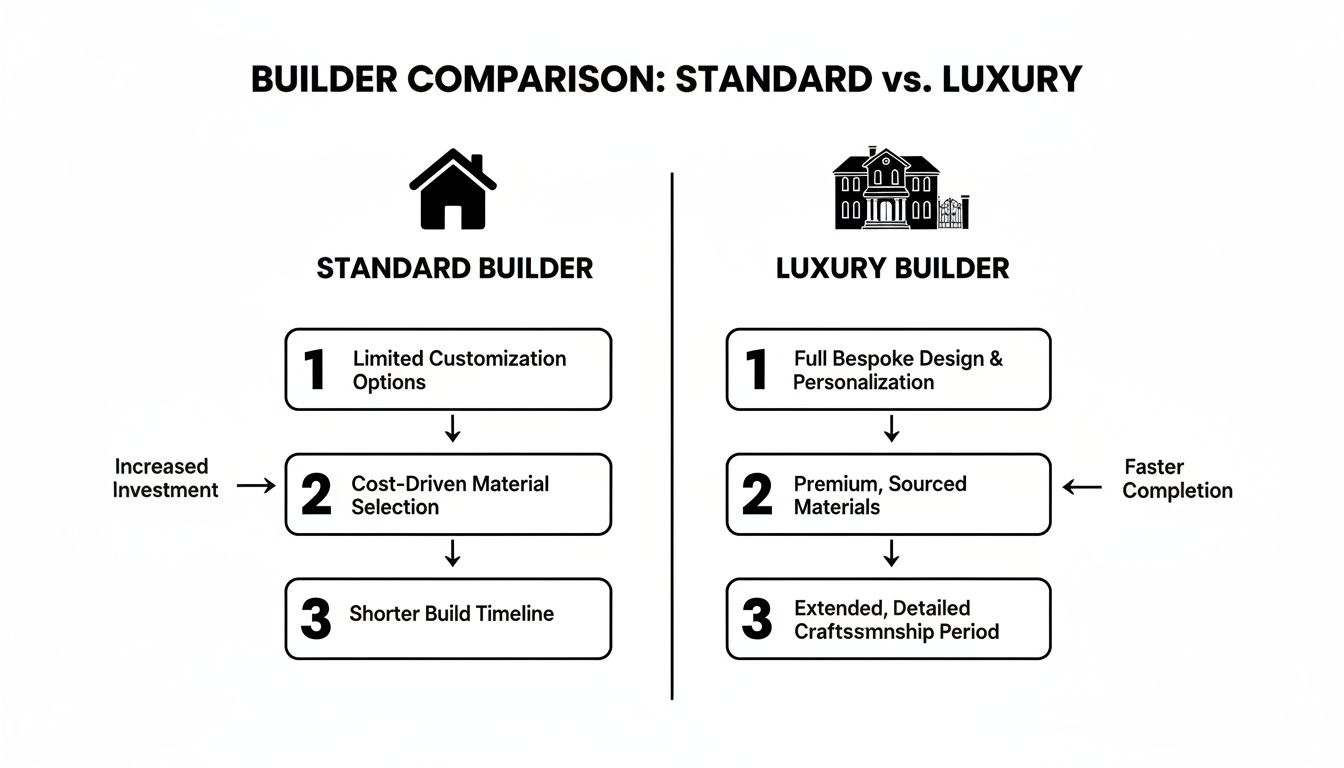
As you can see, a true luxury builder is at the table from day one, creating a seamless path from concept to completion.
Phase 3: Pre-Construction Logistics
This is where the magic happens behind the scenes. Your builder takes the finalized plans and lays all the groundwork for a smooth, efficient build. Honestly, this is probably the single most important stage for preventing delays and cost overruns later on.
The team creates a detailed construction schedule, secures every necessary permit, and lines up the master artisans and tradespeople who will bring the project to life.
During pre-construction, the builder transforms blueprints into a detailed, actionable roadmap. Every material is specified, every subcontractor is scheduled, and every potential challenge is anticipated and solved before a single shovel hits the ground.
Contracts are finalized, and long-lead items like custom windows or imported stone are ordered. This meticulous planning means that when construction finally starts, it’s an organized, purposeful push forward.
Phase 4: Active Construction
And here we go. Your vision finally begins to rise from the ground. This is the most visible and dynamic part of the journey, as the physical structure of your home takes shape.
Your builder manages all the day-to-day operations on-site, from coordinating the foundation pour to overseeing the intricate work of the finish carpenters. You should expect regular, transparent updates—weekly progress reports, site meetings, and clear financial statements. A top builder makes sure you’re always in the loop, bringing you in for key decisions on finishes and fixtures as the project moves forward.
Phase 5: Post-Completion and Handover
The journey isn’t over just because the last nail is in place. This final phase is all about perfecting every last detail for a flawless transition into your new home.
Your builder will walk through the home with you multiple times, creating a “punch list” to identify and fix any final adjustments. Nothing is overlooked.
Once every item is perfected, you’ll receive a comprehensive handover package with all warranties, appliance manuals, and a guide to maintaining your new home’s systems. The best builders also provide a robust warranty and ongoing support, cementing their role not just as a contractor, but as a long-term partner in your home’s legacy.
Deconstructing the Cost of a Luxury Home
Trying to nail down the cost of a luxury home with a simple price-per-square-foot formula is like valuing a masterpiece by the cost of its canvas and paint. It gives you a number, sure, but it completely misses the point. The final budget for a truly high-end residence is a complex tapestry woven from architectural vision, rare materials, human artistry, and sophisticated technology.
A top-tier builder’s first job is to make this complex equation transparent. Where a standard home’s cost is largely driven by its size, a luxury home’s budget is a story of its complexity and character. These projects are defined not by their footprint but by the exceptional quality poured into every last square inch.
Beyond Square Footage: The Real Cost Drivers
The true cost of a luxury home is shaped by a handful of core elements that have little to do with basic construction. These are the areas where your investment translates directly into unparalleled quality, longevity, and a home that is uniquely yours. Understanding them is the key to seeing exactly where your money goes.
Four big-ticket items really drive the budget:
- Architectural Complexity: A simple, boxy structure is worlds away from one with soaring cantilevers, intricate rooflines, or massive, floor-to-ceiling walls of custom glass. These dramatic features require serious structural steel, specialized engineering, and a team of highly skilled craftspeople to execute flawlessly.
- Premium and Bespoke Materials: The price difference between standard granite and a single, perfect slab of Calacatta marble flown in from a specific quarry in Italy is immense. This principle applies to everything—from hand-scraped European oak floors to custom-forged metalwork for a grand staircase.
- Master Craftsmanship: The labor cost for a luxury home is significantly higher because you’re hiring artisans, not just tradespeople. The talent needed to install intricate tile mosaics, apply Venetian plaster without a single flaw, or build custom millwork that fits like a glove is a rare commodity, and it commands a premium.
- Integrated Home Technology: Modern luxury homes are marvels of smart engineering. Geothermal HVAC, fully automated lighting and security systems, and whole-home entertainment networks require specialized design, meticulous wiring, and expert programming that adds a significant layer to the project budget.
Choices That Shape the Bottom Line
Every single decision made during the design phase has a ripple effect on the final cost. For instance, opting for a geothermal heating and cooling system might add $30,000 to $75,000 upfront compared to a traditional HVAC unit, but the long-term energy savings and superior comfort are substantial.
Similarly, choosing a custom, floor-to-ceiling window system from a German manufacturer to capture a perfect view could easily cost three times as much as high-quality domestic windows. A good builder’s job is to present these options with crystal-clear pricing, so you can make informed decisions that line up with what matters most to you.
A premier builder’s job isn’t just to build the home; it’s to provide the financial clarity needed to balance vision with value. They ensure every dollar is accounted for and contributes directly to the project’s quality and integrity.
The wider market plays a role, too. Recent luxury market reports show that while sales dynamics are normalizing, properties are still selling for around 97–99% of their list price, and values are climbing. These trends impact material costs and labor availability, making a builder’s skill in managing budgets and timelines more critical than ever. For a closer look, you can explore detailed North American luxury market reports.
Ultimately, understanding these cost drivers empowers you to have much more productive conversations with your builder. By getting clear on what you value most—be it architectural drama, rare materials, or cutting-edge tech—you can work together to shape a budget that brings your vision to life. For a more detailed breakdown, check out our guide on decoding luxury home construction costs.
How to Vet and Select the Right Builder
Picking your high-end residential builder is, without a doubt, the single most important decision you’ll make during this entire journey. This isn’t just about hiring a crew to put up walls; it’s about choosing a partner who will become the steward of your vision, your investment, and a significant part of your life for the next few years. A disciplined, methodical vetting process is the foundation of a successful project, ensuring you find a firm with the right expertise, financial footing, and a collaborative spirit that fits your own.

Think of this selection process as an exercise in serious due diligence. It’s about looking past the glossy portfolios to see the real operational strengths—and potential weaknesses—of each builder you’re considering. By following a structured approach, you can confidently compare your options and make a choice that gives you peace of mind from day one.
Start with the Fundamentals
Before you get lost in the details of past projects, you need to verify the absolute non-negotiables. This first pass is a quick filter that weeds out any firms lacking the basic credentials needed for a project of this scale. It’s a simple check to confirm they are legitimate, insured, and stable.
Here’s what to confirm right out of the gate:
- Licensing and Insurance: Make sure the builder holds all required state and local licenses. You’ll want to see proof of their general liability insurance and workers’ compensation coverage. This isn’t just paperwork; it’s what protects you from liability for any on-site accidents.
- Financial Stability: A builder’s financial health is a direct reflection of their ability to see your project through to completion without issues. Don’t be shy about asking for financial references from their bank or key suppliers to ensure they are on solid ground.
- Company History and Structure: How long have they been in business? Who are the key people on the team you’ll be working with? Understanding their history and the depth of their team gives you a good feel for their experience and long-term stability.
Go Beyond the Portfolio
Let’s be honest—at this level, a beautiful portfolio is table stakes. Every high-end builder will have a website filled with stunning, professionally shot photos. Your job is to peer behind the curtain of those perfect images and get a sense of the real-world quality and consistency of their work.
This means you have to dig deeper.
A portfolio shows you what a builder has done. Visiting a job site and speaking with past clients shows you how they do it. This distinction is the core of an effective vetting process.
Ask to visit two things: a completed project and a currently active job site. A finished home, especially one that’s a few years old, lets you see the quality firsthand and assess how it has held up over time. An active site, on the other hand, is incredibly revealing. It shows you their process in real time—you can observe the organization, the cleanliness, and the professionalism of the crews. A well-managed, safe, and respectful site is a powerful indicator of a well-managed company.
The Power of References
Speaking directly with former clients is probably the most valuable research you can do. A great builder will be more than happy to provide you with a list of references. The trick is to ask for a mix of clients—not just the ones whose projects wrapped up last month, but also people who have been living in their homes for five or even ten years.
This variety gives you the full story. Recent clients can give you the play-by-play of the construction experience itself. Long-term homeowners, however, can speak to the home’s durability and tell you how the builder handled any post-completion support or warranty items.
Have a few targeted questions ready for these calls:
- How was the communication throughout the project?
- Did the builder stick to the budget and schedule? If things changed, how were those discrepancies handled?
- How did they manage unexpected challenges or your own change requests?
- Were you truly satisfied with the quality of the craftsmanship and the subcontractors they used?
- After you moved in, how has the builder responded to any questions or warranty issues that came up?
Finalizing Your Decision
After you’ve done your homework, the last step is to sit down for in-depth interviews with your top two or three candidates. This is where you really gauge personality fit and communication style, which are crucial for a successful partnership. You need to feel confident that your builder truly listens, understands your priorities, and communicates with absolute clarity and transparency.
Once you’ve made your choice, the focus shifts to the contract. This legal document is the blueprint for your entire project, and it needs to be meticulously detailed. It should cover everything from the payment schedule and materials allowances to the process for change orders and resolving disputes. It is always wise to have your attorney review it. For a more detailed breakdown, our guide to your custom home builder contract offers a deep dive into what this critical document should include.
Ultimately, selecting the right high-end builder comes down to finding a partner who inspires complete trust—a firm whose commitment to quality, transparency, and collaboration aligns perfectly with your own.
Your Top Questions About Building a Luxury Home, Answered
Stepping into the world of custom home building always brings up a host of questions. When you’re commissioning a truly high-end residence, getting clear, straightforward answers on timelines, contracts, and what happens after you move in is absolutely critical.
Think of this as your cheat sheet. We’ll walk through the most common questions clients ask, giving you the kind of direct insight you need to move forward confidently with your builder.
How Long Does a Custom Luxury Home Take to Build?
This is usually the first question on everyone’s mind. While every project has its own unique rhythm, a good rule of thumb for a high-end custom home is 18 to 24 months from the first design meeting to the day you get the keys.
Of course, several factors can shift that timeline:
- Design Complexity: An intricate, architecturally ambitious home with complex engineering simply takes longer to plan and execute.
- Permitting & Approvals: Navigating local building departments can be a lengthy process, and the time it takes varies wildly from one municipality to another.
- Site Conditions: A perfectly flat, ready-to-go lot is one thing. A sloped, rocky, or otherwise challenging site requires far more prep work upfront.
- Material Sourcing: When you’re specifying one-of-a-kind materials like hand-quarried Italian marble or custom-fabricated German window systems, you have to account for significant international lead times.
A great builder won’t just give you a number; they’ll provide a detailed, phase-by-phase schedule during pre-construction, showing you exactly how they plan to manage these variables.
Fixed-Price vs. Cost-Plus Contracts: What’s the Difference?
Getting the financial structure right is fundamental. In the luxury market, builders generally operate on one of two contract models.
- Fixed-Price Contract: Just like it sounds, the builder commits to delivering the home for a single, agreed-upon price. This gives you budget certainty, which is a major plus. The catch? Every last detail—down to the doorknobs and drawer pulls—has to be decided before the contract is signed. Changing your mind mid-stream requires a formal, and often expensive, amendment.
- Cost-Plus Contract: This is the preferred model for most truly custom projects. It’s an open-book approach where you pay the actual costs for labor and materials, plus a pre-negotiated fee (either a fixed amount or a percentage) that covers the builder’s overhead and profit. It’s far more flexible, allowing you to make decisions and refinements as you see the home take shape.
The choice really boils down to what you value more: absolute budget certainty from day one, or the creative flexibility to perfect your home as it evolves. The cost-plus model truly fosters the kind of collaborative partnership that a bespoke project demands.
How Are Changes Handled During Construction?
It’s almost a guarantee that you’ll want to make a change or two during the build. Maybe you see a new appliance you love, or you decide to reconfigure a closet. A seasoned builder has a clear, professional system for this: the Change Order.
Here’s how it works. When you request a change, the builder will:
- Formally document exactly what you’re asking for.
- Provide a transparent cost breakdown for the new materials and labor.
- Explain how the change might affect the overall project schedule.
You get this document for review and have to sign off on it before any work proceeds. This simple process eliminates any confusion or surprise bills down the road, ensuring you’re always in the driver’s seat.
What Does a Builder’s Warranty Actually Cover?
The relationship doesn’t end when the build is complete. A builder’s warranty is their pledge to stand behind the quality of their work long after you’ve moved in. Most offer a multi-level guarantee.
You should expect a one-year warranty covering all materials and craftsmanship. This is for things like a finicky light fixture or a small defect in the trim work. Beyond that, a two-year warranty typically covers the major systems—think HVAC, electrical, and plumbing. For the ultimate peace of mind, a ten-year structural warranty protects your investment against any major defects in the home’s foundation and frame.
Finding a builder who operates with this level of transparency and aligns perfectly with your vision is the single most important decision you’ll make. The vetted professionals in the Haute Design network are the best in the business, known for master craftsmanship and an unwavering commitment to their clients.
Discover the nation’s top builders and connect with the right partner for your project by exploring our network at https://hauteliving.com/designnetwork.