


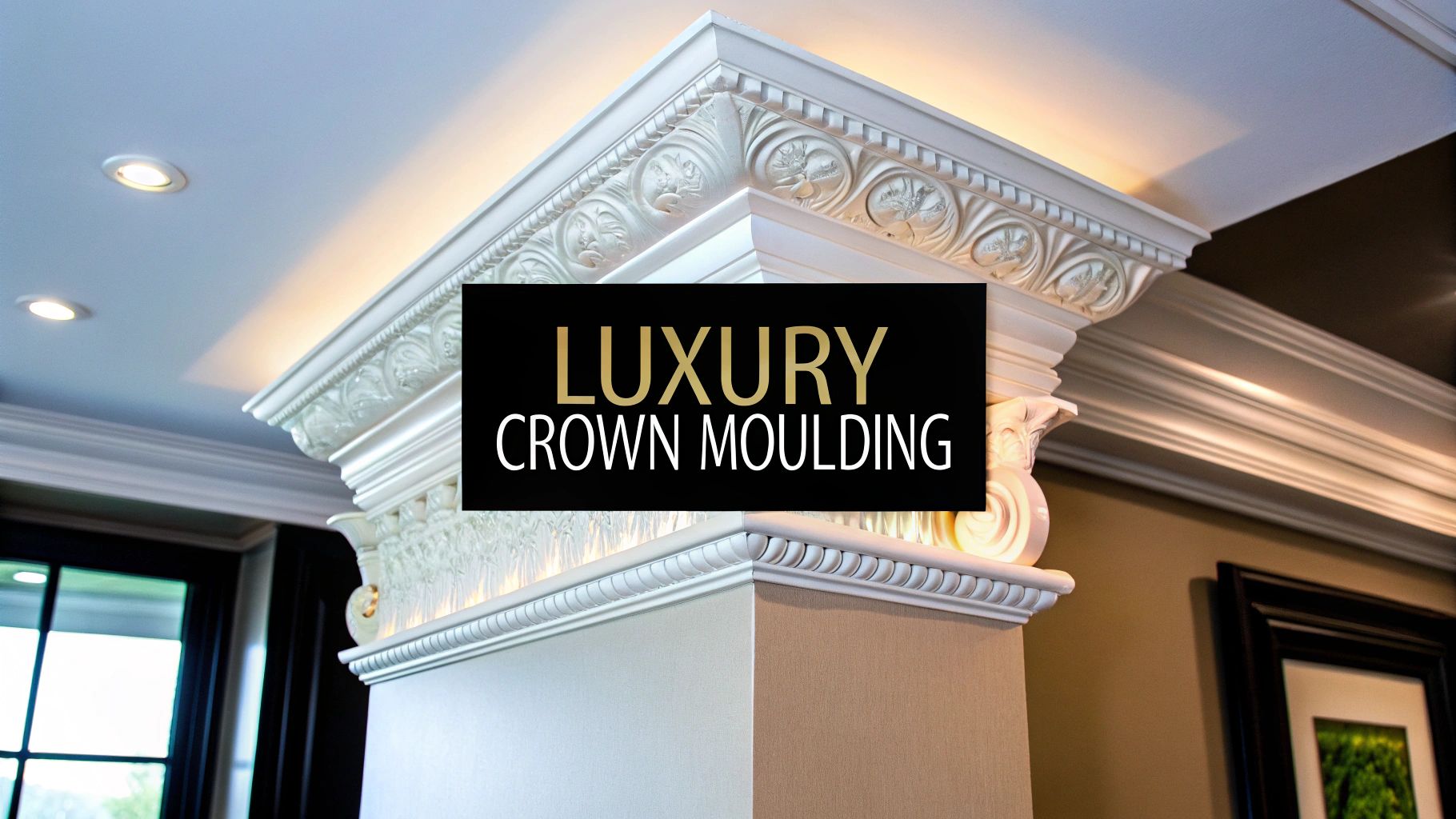
Crown moulding is more than just a decorative trim; it’s the architectural element that bridges the wall and ceiling, defining a room’s character and lending it a sense of completion and grandeur. For the discerning homeowner and interior professional, selecting the right profile is a critical decision that impacts the entire aesthetic of a space. This curated roundup moves beyond generic options to explore a world of sophisticated crown moulding designs, each with the power to transform an ordinary room into an extraordinary one.
This guide provides a comprehensive gallery of high-end concepts, tailored for luxury residential and commercial projects. We will delve into the nuances of style, material, and application, providing actionable insights to help you specify the perfect moulding for any interior. Forget basic advice; this article is a practical resource for implementation.
Inside, you will find detailed specifications for each design, including:
- Recommended Room & Ceiling Heights: Ensure perfect scale and proportion.
- Profile & Material Suggestions: From plaster and wood to modern composites.
- Finish & Paint Guidance: Achieve the ideal aesthetic effect.
- Lighting & Trim Pairings: Create a cohesive and layered design.
- Estimated Budget & Sourcing: Plan your project with clarity.
From the opulent details of Victorian designs to the clean lines of modern minimalism, you will learn precisely how to select and apply this essential architectural feature. Our goal is to equip you with the knowledge to elevate your interiors from simply beautiful to truly breathtaking, making every selection a confident and informed one. Let’s explore the possibilities.
1. Ornate Victorian Crown Moulding
Ornate Victorian crown moulding designs are an ode to 19th-century architectural opulence, characterized by their elaborate details, significant depth, and intricately carved elements. This style is not merely a trim but a statement piece, often incorporating multiple stacked profiles, acanthus leaves, egg-and-dart patterns, and detailed dentil work. The result is a grand, formal aesthetic that commands attention and defines the architectural character of a space, making it a cornerstone of historic restoration and luxurious traditional interiors.
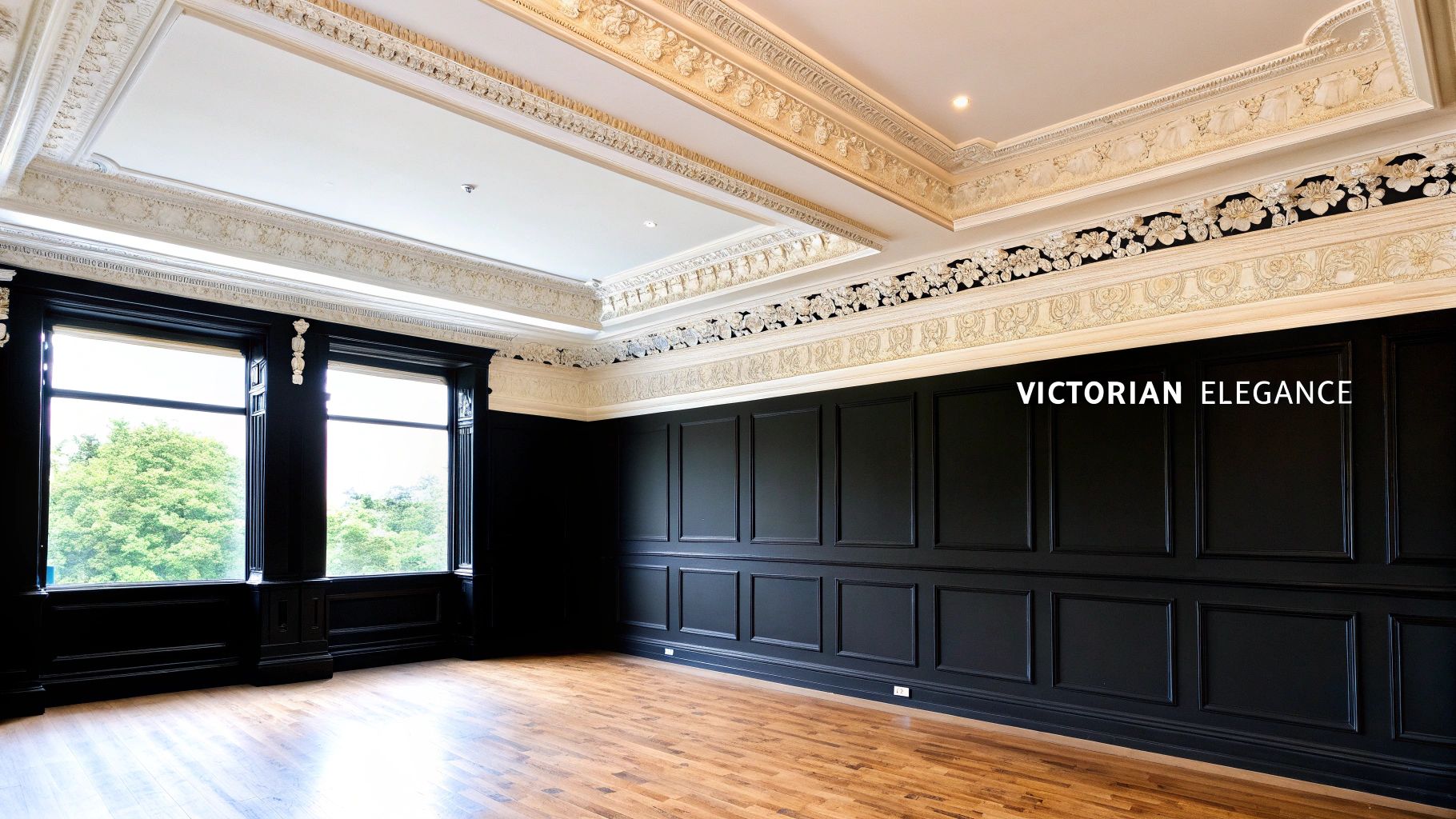
This approach is best suited for spaces intended to convey a sense of history and grandeur, such as formal living rooms, dining rooms, libraries, and primary suites. Its dramatic scale is a perfect match for the soaring ceilings found in historic townhouses, antebellum estates, and custom-built luxury homes aiming for a classic, palatial feel.
Key Implementation Details
- Ideal Room & Ceiling Height: Best reserved for rooms with ceiling heights of 10 feet or higher. The substantial profile of Victorian moulding can overwhelm rooms with lower ceilings, making them feel compressed. It thrives in spaces where its scale can be fully appreciated.
- Profile & Material Suggestions: For authenticity, plaster is the traditional material, offering crisp details and seamless installation. However, high-density polyurethane and modern composite materials provide a cost-effective, lightweight, and durable alternative that replicates the look with precision and is easier to install. Look for profiles at least 7 inches in height, often combined with additional trim pieces to build up a more complex look.
- Finish & Paint Guidance: A classic semi-gloss or satin white finish will highlight the intricate shadows and details of the carving. For a more dramatic and historically accurate effect, consider painting the moulding a slightly different shade than the ceiling to create a subtle but impactful distinction. In rooms with dark, moody wall colors, a crisp white moulding provides a striking, elegant contrast.
Expert Insight: When selecting a Victorian profile, pay close attention to the scale of the motifs. In a very large room, a pattern that is too small or repetitive can get lost. Conversely, an overly large pattern can dominate a moderately sized space. Always order samples to view in the actual room.
Sourcing & Installation
Sourcing authentic Victorian profiles can be done through specialty millwork suppliers or companies that focus on historic architectural reproductions. Installation is a task for highly skilled carpenters or artisans, especially when working with heavy plaster or navigating complex corners and uneven walls common in older homes. The precision required to match intricate patterns and create seamless joints is critical to achieving a high-end, professional result. The investment in an experienced installer familiar with period details is non-negotiable for this type of project.
2. Modern Minimalist Crown Moulding
Modern minimalist crown moulding designs represent a shift from ornamentation to functional elegance, prioritizing clean lines and subtle architectural definition. This style is characterized by simple, often geometric profiles with little to no decorative detail, focusing instead on creating a crisp, seamless transition between the wall and ceiling. Rather than dominating a room, it serves as a quiet, sophisticated backdrop that enhances modern art, high-end furnishings, and a sense of uncluttered space. The result is an intentional, polished aesthetic that complements contemporary and transitional interiors perfectly.
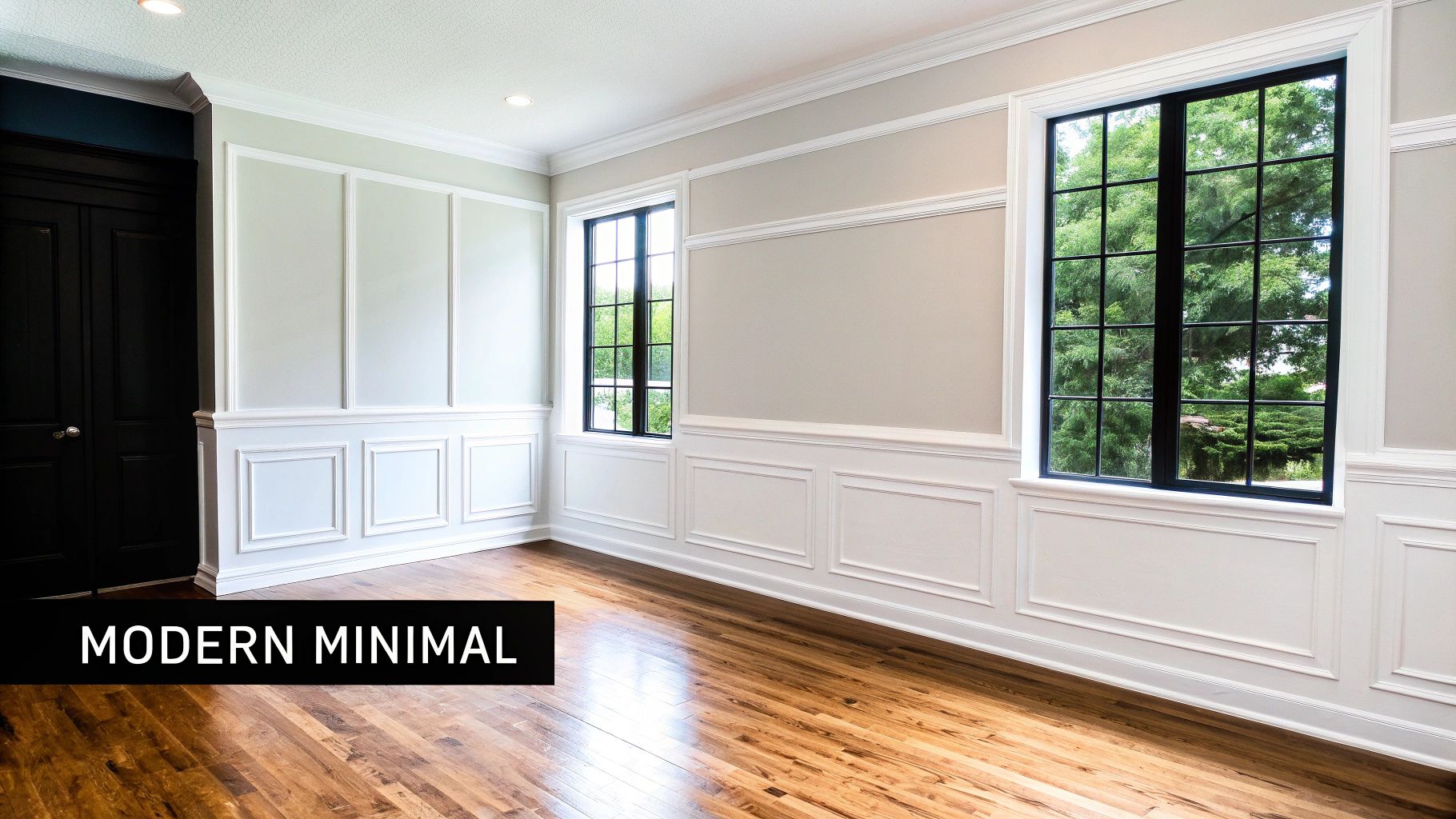
This understated approach is ideal for spaces that celebrate simplicity, light, and form, such as modern lofts, Scandinavian-inspired homes, and contemporary new builds. It adds a layer of architectural finish without compromising the core principles of minimalism. Its clean look is particularly effective in living areas, kitchens, and home offices where the goal is a sleek, organized, and tranquil environment. For more design ideas, see how to design a modern white living room.
Key Implementation Details
- Ideal Room & Ceiling Height: Suited for rooms with standard 8 to 10-foot ceilings. Unlike ornate styles, its restrained profile (typically 2-4 inches in height) does not overwhelm lower ceilings and adds a refined touch to taller, modern spaces. It is exceptionally versatile for a wide range of room sizes.
- Profile & Material Suggestions: Look for profiles with flat faces, single-step bevels, or simple cove shapes. Medium-Density Fiberboard (MDF) is a popular and cost-effective choice, providing a perfectly smooth surface for paint. For higher-end applications, solid wood like poplar offers sharp, clean edges and superior durability.
- Finish & Paint Guidance: A matte or satin finish is recommended to maintain the minimalist aesthetic and avoid unwanted sheen. Painting the moulding the same color as the ceiling (typically a crisp white) creates a seamless, monolithic look that subtly elevates the space. Alternatively, painting it the same color as the walls can produce a modern, color-drenched effect.
Expert Insight: For the ultimate minimalist statement, consider a “reveal” style moulding. This involves creating a thin, recessed channel between the top of the wall and the ceiling. It offers a sharp, shadow-line detail that is the epitome of modern architectural precision.
Sourcing & Installation
Modern minimalist profiles are widely available from most millwork suppliers and home improvement stores. The key to a successful installation lies in precision. Mitered corners must be perfectly cut and joined to maintain the clean, unbroken lines that define the style. Hiring a detail-oriented trim carpenter is essential, as any imperfections, gaps, or uneven seams will be highly visible against the simple profile. Ensure the installer uses a high-quality caulk and sanding process to create completely invisible joints before the final paint is applied.
3. Classical Crown Moulding
Classical crown moulding designs draw their inspiration from the enduring principles of Greco-Roman architecture, defined by symmetrical proportions, refined details, and an air of timeless elegance. This style utilizes traditional profiles like the cyma, ogee, and dentil in balanced, harmonious combinations, avoiding the opulence of Victorian designs for a more restrained and structured aesthetic. The result is a sophisticated finish that enhances architectural integrity without overwhelming the space, making it a versatile choice for formal, transitional, and historically-inspired interiors.
This approach is perfectly suited for spaces that aim for a dignified and graceful atmosphere, such as formal dining rooms, libraries, home offices, and primary living areas. Its balanced proportions are a hallmark of Neoclassical and Federal-period homes, but its clean lines also integrate beautifully into modern traditional and transitional designs seeking a touch of classic character.
Key Implementation Details
- Ideal Room & Ceiling Height: Functions exceptionally well in rooms with ceiling heights from 9 to 12 feet. Unlike more ornate styles, classical profiles can be scaled effectively to suit this range without appearing too dominant or too diminutive.
- Profile & Material Suggestions: Traditional solid wood such as poplar (for painting), oak, or cherry (for staining) is the quintessential material choice. MDF is a practical, cost-effective alternative for painted applications. Look for profiles ranging from 4 to 8 inches in height, often featuring a simple S-curve (ogee) or C-curve (cyma) combined with flat planes. For a more detailed look, consider profiles that incorporate a dentil strip.
- Finish & Paint Guidance: A crisp, semi-gloss white or off-white paint is the standard, accentuating the clean lines and subtle shadows of the profile. This classic finish creates a graceful transition between wall and ceiling. For an authentic look in a historic home, consider a historically accurate paint color that coordinates with the trim and wall palette.
Expert Insight: The key to successful classical crown moulding is proportion. The height of the moulding should be in a balanced ratio to the ceiling height. A common architectural guideline is to use approximately 1/2 inch of moulding height for every foot of ceiling height as a starting point.
Sourcing & Installation
High-quality classical profiles in wood, MDF, and polyurethane are widely available from lumberyards, millwork suppliers, and home improvement retailers. For a deeper understanding of how these elements come together, you can find a guide to crown molding design on Haute Living. Installation requires a skilled carpenter with a precision miter saw, as creating perfect joints at inside and outside corners is crucial for a seamless look. Using traditional crown backing blocks behind the moulding can provide a solid nailing surface and simplify the installation process.
4. Art Deco Crown Moulding
Art Deco crown moulding designs are a celebration of the Roaring Twenties’ glamour and industrial modernity, defined by bold geometric forms, symmetry, and streamlined elegance. This style rejects ornate, organic details in favor of crisp lines, stepped profiles, chevron patterns, and stylized motifs like sunbursts and ziggurats. It serves as a sophisticated architectural element that bridges the gap between classic opulence and modern simplicity, creating a luxurious and polished aesthetic reminiscent of the grand hotels and theaters of the 1920s and 30s.
This design is ideal for spaces that aim to be glamorous, theatrical, and uniquely stylish, such as home theaters, formal dining rooms, upscale bars, or entry foyers. It thrives in interiors that fully commit to the Art Deco theme, where it can be paired with geometric patterns, lacquered furniture, and metallic accents. It offers a powerful alternative to traditional profiles for those seeking a look that is both historic and strikingly modern.
Key Implementation Details
- Ideal Room & Ceiling Height: Art Deco profiles work well with ceilings from 9 to 12 feet. The clean, often linear, nature of the designs doesn’t overwhelm rooms like more intricate styles might, but the inherent boldness requires adequate height to feel balanced and intentional.
- Profile & Material Suggestions: Look for profiles featuring distinct steps, sharp angles, and geometric repetition. Wood (MDF or Poplar) is an excellent choice as it holds crisp edges well and is easy to paint with a high-gloss finish. Plaster and polyurethane can also be used to create more complex, stylized motifs. Profiles are often simpler but can be stacked to build a more substantial, layered look true to the period.
- Finish & Paint Guidance: This is where Art Deco crown moulding truly shines. A high-gloss black or white lacquer creates a dramatic, reflective finish. For ultimate glamour, consider incorporating metallic paints in gold, silver, or bronze, either as an accent on a specific step or for the entire profile. Pairing a dark moulding with light walls (or vice versa) creates the high contrast that defines the style.
Expert Insight: The success of Art Deco crown moulding designs depends on cohesion. The moulding should be a starting point that informs other choices, from lighting fixtures and hardware to textiles and furniture. A standalone Art Deco moulding in an otherwise traditional room will feel out of place.
Sourcing & Installation
Sourcing authentic Art Deco profiles can be done through specialty millwork suppliers or custom woodworkers who can replicate historic patterns. Given the emphasis on sharp lines and perfect symmetry, installation demands an installer with exceptional precision. Mitered corners must be flawless, and seams must be invisible, especially when using high-gloss finishes that reveal every imperfection. For complex profiles or rooms with unconventional angles, hiring a carpenter specializing in finish work is a worthwhile investment to achieve the crisp, polished look this style requires.
5. Farmhouse/Rustic Crown Moulding
Farmhouse and rustic crown moulding designs embrace a philosophy of simple, authentic charm over ornate complexity. This style is defined by clean lines, understated profiles, and a focus on natural materials, evoking the relaxed and inviting atmosphere of rural farmhouses and country estates. Rather than commanding attention, these mouldings serve to frame a space with warmth and character, often featuring the natural grain of wood, a distressed finish, or a simple painted look that complements other rustic architectural elements.
This aesthetic is perfectly suited for spaces designed to feel comfortable, lived-in, and connected to nature. It excels in great rooms with vaulted ceilings, cozy family kitchens, and primary bedrooms aiming for a serene, cottage-like feel. Its unpretentious elegance makes it a staple in modern farmhouse builds, coastal cottage renovations, and French country-inspired interiors.
Key Implementation Details
- Ideal Room & Ceiling Height: This versatile style works well with standard 8 to 10-foot ceilings. The modest profiles do not overwhelm lower ceilings, while in taller spaces, they can be paired with exposed beams or shiplap to create a cohesive, layered look without appearing undersized.
- Profile & Material Suggestions: Natural wood is the quintessential material, with pine, poplar, and oak being popular choices. Reclaimed wood adds unparalleled character and authenticity. Profiles are typically simpler, such as a basic cove or a stepped design, usually ranging from 3 to 5 inches in height. Avoid complex curves or intricate details.
- Finish & Paint Guidance: Leaving the wood in its natural state with a clear sealant is a classic choice. For a lighter feel, consider a whitewash, limewash, or milk paint finish that allows the wood grain to show through. A simple, flat, or satin white paint offers a clean, modern farmhouse look that contrasts beautifully with natural wood floors or ceiling beams.
Expert Insight: The key to successful rustic moulding is texture. A perfectly smooth, factory-finished piece can feel out of place. Opt for materials with subtle imperfections, or consider hand-distressing techniques to create an authentic, time-worn appearance that feels integral to the home’s character.
Sourcing & Installation
Sourcing for farmhouse crown moulding designs can range from standard home improvement stores for simple pine or poplar profiles to specialty lumberyards and reclamation specialists for authentic reclaimed wood. Installation is generally more straightforward than ornate styles due to the simpler profiles, but working with reclaimed wood may require a skilled carpenter to handle variations in dimension and hardness. Achieving tight joints while preserving the wood’s rustic character is the primary goal.
6. Crown Moulding with Integrated Lighting
Crown moulding with integrated lighting is a sophisticated, contemporary solution that merges architectural detail with ambient illumination. This design conceals linear LED strips or other light sources within a specially designed moulding profile, casting a soft, indirect glow upward onto the ceiling or downward along the wall. The result is a seamless, modern aesthetic that enhances the perception of space and adds a layer of warmth and drama, transforming a traditional trim element into a functional and atmospheric feature.
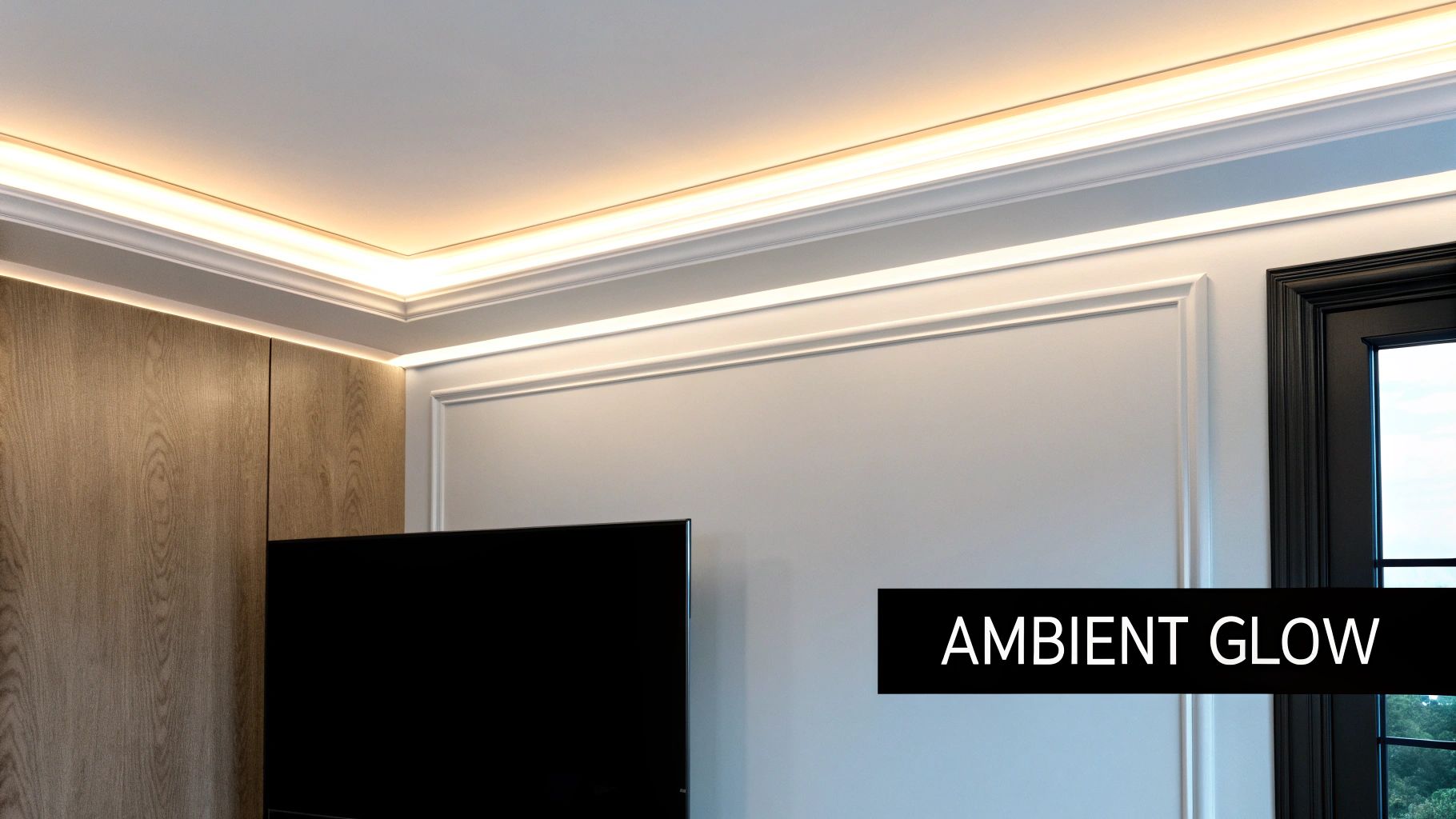
This dual-purpose approach is exceptionally versatile, fitting perfectly in modern living rooms, home theaters, primary bedrooms, and high-end kitchens where mood lighting is essential. It is also a popular choice in luxury hospitality and commercial spaces, such as hotel lobbies, restaurants, and galleries, where it creates an inviting and upscale ambiance while highlighting architectural lines.
Key Implementation Details
- Ideal Room & Ceiling Height: Suitable for rooms with ceiling heights of 8 feet or higher. While effective at any height, the floating effect is most pronounced with standard to tall ceilings. In rooms with lower ceilings, it can create an illusion of height by drawing the eye upward.
- Profile & Material Suggestions: Look for moulding profiles specifically designed with a channel or cove to house LED strips. These are often made from high-density polyurethane or extruded aluminum, which are lightweight, easy to install, and help dissipate heat. Profiles can range from simple, clean-lined modern shapes to more transitional designs.
- Finish & Paint Guidance: A matte or satin white finish is most common, allowing the moulding to blend with the ceiling and reflect the light softly. Painting the interior of the light cove a highly reflective white can maximize brightness. For a bold, contemporary look, the moulding itself can be painted a dark color to contrast with the light it emits.
Expert Insight: The quality of the LED system is paramount. Opt for high-quality, dimmable LED tape with a high CRI (Color Rendering Index) of 90+ for accurate color representation. Select a warm color temperature (2700K-3000K) to create a cozy, inviting atmosphere similar to incandescent light.
Sourcing & Installation
Specialty lighting suppliers and modern millwork companies are the best sources for integrated lighting profiles. Installation is a two-part process that requires both a skilled carpenter and a certified electrician. The moulding is installed first, followed by the low-voltage wiring and LED strips. Meticulous planning is crucial to ensure all wiring is concealed before the drywall is finished, and dimmer controls must be integrated for full functionality.https://www.youtube.com/embed/WKMpJ89JNZA
7. Mediterranean Crown Moulding
Mediterranean crown moulding designs evoke the sun-drenched warmth and rustic elegance of European coastal architecture. This style moves away from the rigid formality of other classical designs, instead featuring softer, more organic details. You will find gracefully curved profiles, rounded edges, and often the incorporation of textural elements like hand-painted motifs, aged wood finishes, or even ceramic tile inlays. The aesthetic emphasizes Old-World charm, creating a relaxed yet sophisticated atmosphere ideal for spaces that celebrate natural light and artisanal craftsmanship.
This approach is perfectly suited for homes inspired by Tuscan, Spanish Colonial, or Greek Revival architecture. It shines in great rooms, kitchens, and master suites where the goal is to create an inviting, sunlit retreat. Its textured and often colorful nature pairs beautifully with arched doorways, terracotta floors, and warm, earthy wall palettes, making it a staple in luxury estates across California, Florida, and the American Southwest.
Key Implementation Details
- Ideal Room & Ceiling Height: Best suited for rooms with ceiling heights of 9 feet or higher. While not as massive as Victorian profiles, Mediterranean moulding relies on texture and warmth, which needs adequate space to be appreciated without closing in the room.
- Profile & Material Suggestions: Solid wood, particularly knotty alder, walnut, or cypress, is an excellent choice as it can be stained, glazed, or distressed to achieve an authentic aged look. Plaster and glass fiber reinforced gypsum (GFRG) are also ideal for creating custom, seamless profiles with soft curves. Look for profiles with gentle S-curves, rope details, or wide, simple bands that can serve as a canvas for decorative finishes.
- Finish & Paint Guidance: Embrace warm, natural tones. A classic approach is to stain and glaze wood moulding to highlight its grain and create a sense of history. For a painted look, opt for creamy off-whites, soft ochres, or muted terracotta tones in a matte or eggshell finish to enhance the rustic texture. Commissioning a local artisan to add subtle, hand-painted details can elevate the design significantly.
Expert Insight: Texture is paramount in Mediterranean design. Consider a lightly distressed finish or a subtle glaze on the moulding to create depth and an aged patina. This technique prevents the trim from looking too new and helps it integrate seamlessly with other natural materials in the space.
Sourcing & Installation
Sourcing for Mediterranean crown moulding designs often leads to custom millwork shops or artisans who specialize in wood and plaster. Finding a carpenter or plasterer with experience in creating distressed or glazed finishes is crucial. The installation should feel robust and integrated, not delicate. For designs incorporating tile or hand-painted elements, collaborating between the installer and the artisan is essential to ensure a flawless and cohesive final look.
8. Transitional Crown Moulding
Transitional crown moulding designs masterfully bridge the gap between traditional grandeur and modern simplicity. This style is defined by its clean lines, gentle curves, and sophisticated profiles that are elegant without being overly ornate. It avoids the intricate carvings of Victorian styles and the stark minimalism of modern trim, offering a timeless and versatile aesthetic. The result is a refined architectural element that enhances a room’s character while seamlessly integrating with a mix of classic and contemporary furnishings, making it a cornerstone of today’s sophisticated interiors.
This approach is perfectly suited for spaces that aim for a sophisticated yet comfortable feel, such as primary living areas, open-concept kitchens, and primary bedrooms. Its balanced proportions make it an ideal choice for modern suburban homes, renovated townhouses, and custom builds where design flexibility and enduring appeal are paramount.
Key Implementation Details
- Ideal Room & Ceiling Height: Transitional moulding is highly versatile, working well in rooms with ceiling heights of 9 to 12 feet. Its moderate scale adds architectural interest without overwhelming the space, making it a safe yet elegant choice for most modern constructions.
- Profile & Material Suggestions: Look for profiles that are between 4 and 7 inches in height, often featuring simple, sweeping curves like a cove or cyma recta. MDF (Medium-Density Fiberboard) is an excellent material choice, offering a smooth, paintable surface and stability. For higher-end applications, solid wood (like poplar or pine) provides crisp, classic lines.
- Finish & Paint Guidance: A satin or semi-gloss finish in the same color as the ceiling creates a cohesive, seamless look that subtly elevates the space. For a more defined look, painting the moulding in a soft white or cream that contrasts gently with the wall color can highlight the architectural lines without creating a stark separation.
Expert Insight: The success of transitional moulding lies in its balance. Pair it with similarly understated trim, such as simple baseboards and window casings. This ensures the crown moulding feels like an integrated part of a deliberate design scheme rather than a singular, out-of-place element.
Sourcing & Installation
Transitional profiles are widely available from major millwork suppliers, lumberyards, and home improvement retailers, making them one of the most accessible crown moulding designs. Installation is typically straightforward for a skilled carpenter or a proficient DIYer, as the profiles are less complex to cut and join than highly ornate styles. However, achieving perfectly mitered corners and a flawless, caulked finish still requires precision and attention to detail, so investing in a professional installer is recommended for a high-end result.
9. Shaker-Style Crown Moulding
Shaker-style crown moulding embodies the principles of simplicity, utility, and honest craftsmanship. Rooted in the American Shaker tradition, this design avoids ornate decoration in favor of clean lines, subtle angles, and functional elegance. Its character comes from its unadorned profile, which often features a simple, flat-faced board topped with a minimal cove or bevel. This understated approach creates a sense of calm and order, defining the transition from wall to ceiling without distracting from the room’s overall harmony.
This style is perfectly suited for interiors that prioritize a clean, uncluttered aesthetic, such as modern farmhouse, Scandinavian-inspired, and minimalist designs. It excels in kitchens, family rooms, and bedrooms where a peaceful and practical atmosphere is desired. Its straightforward form complements spaces with standard ceiling heights, adding a finished look without visual weight.
Key Implementation Details
- Ideal Room & Ceiling Height: Best for rooms with ceiling heights between 8 and 9 feet. The modest scale of Shaker-style moulding adds architectural definition without overpowering standard-height rooms, making it a versatile choice for a wide range of homes.
- Profile & Material Suggestions: Look for profiles that are flat with a simple angled or coved top element, typically between 3 to 5 inches in height. Poplar or pine are excellent wood choices, as they hold paint well and can be stained to reveal natural grain, honoring the Shaker appreciation for quality materials. MDF is a practical, cost-effective alternative for a smooth, painted finish.
- Finish & Paint Guidance: A crisp, matte, or satin white finish aligns perfectly with the clean, bright feel of modern farmhouse and Scandinavian interiors. For a more traditional or rustic look, a natural wood stain or a muted, historical paint color (like soft gray, blue, or green) can provide warmth and authenticity, highlighting the quality of the wood.
Expert Insight: The success of Shaker-style moulding lies in its precision. Unlike ornate profiles that can hide minor imperfections, the clean lines of this style demand perfectly mitered corners and seamless joints. Meticulous craftsmanship is essential to achieve a high-quality, professional appearance.
Sourcing & Installation
Sourcing Shaker-style crown moulding is relatively straightforward, as its simple profile is widely available from most lumberyards and millwork suppliers. Custom profiles can also be milled at a reasonable cost for specific projects. While the design is simple, installation requires a skilled carpenter who can execute flawless cuts and joins. The lack of decorative elements means there is no room for error; every line must be straight, and every corner must be tight. For a truly authentic Shaker look, consider using square-cut nails for a subtle, handcrafted detail.
10. Crown Moulding with Wainscoting Integration
Crown moulding with wainscoting integration is a sophisticated design strategy that creates a cohesive and architecturally unified interior. This approach treats the room’s trim work as a complete system, where the crown moulding acts as the upper frame, visually balancing the wainscoting or paneling on the lower portion of the walls. This creates a powerful sense of order and intentionality, enhancing room proportions and adding a layer of rich, textural detail that defines luxury spaces from formal entryways to historic dining rooms.
This holistic approach is ideal for rooms intended to feel established, formal, and thoughtfully designed, such as libraries, dining rooms, home offices, and primary bedrooms. By connecting the ceiling to the floor with complementary millwork, this technique adds depth and character, making it a hallmark of high-end traditional, Colonial, and modern farmhouse interiors.
Key Implementation Details
- Ideal Room & Ceiling Height: This design excels in rooms with ceilings of 9 feet or higher. The wainscoting draws the eye upward, and the crown moulding provides a definitive cap, a combination that adds perceived height and grandeur. In rooms with lower ceilings, a shorter wainscot (32-36 inches) is preferable to avoid a compressed feel.
- Profile & Material Suggestions: Consistency is key. The crown profile should complement the style of the wainscoting, such as board-and-batten, raised panel, or flat panel. For a traditional look, select a crown with similar curves or steps as the chair rail and baseboard. Primed MDF or poplar are excellent, stable materials for both elements, ensuring a uniform paint finish.
- Finish & Paint Guidance: For a classic, cohesive look, paint the crown, wainscoting, and all other trim in the same color and finish, typically a durable satin or semi-gloss. This creates a unified frame around the wall color. Alternatively, for a more contemporary or dramatic effect, paint the wainscoting and trim a contrasting color to the walls, such as a deep charcoal or navy.
Expert Insight: The success of this design hinges on proportion. The height of the wainscoting chair rail, typically one-third of the wall height, must be perfectly balanced with the scale of the crown moulding. Mismatched scales can disrupt the room’s harmony. Learn more about how to achieve this balance with proper interior design space planning.
Sourcing & Installation
Sourcing is often done through quality lumberyards or specialty millwork suppliers that can provide matching profiles for all trim components. Installation requires precision and a clear plan. The wainscoting and chair rail should be installed first, establishing the room’s foundational lines. The crown moulding is then installed to complement this lower framework. Hiring a finish carpenter with experience in full-room trim packages is highly recommended to ensure all elements align perfectly and transitions are seamless, especially around windows, doors, and electrical outlets.
10-Design Crown Moulding Comparison
| Style | Implementation Complexity 🔄 | Resource & Cost ⚡ | Expected Outcomes ⭐📊 | Ideal Use Cases 💡 | Key Advantages |
|---|---|---|---|---|---|
| Ornate Victorian Crown Moulding | Very high 🔄 — intricate carving, professional install | Very high ⚡ — premium materials (plaster/wood), skilled labor | Dramatic, formal elegance; increases perceived height ⭐⭐⭐⭐⭐ 📊 | Historic mansions, grand formal rooms, restorations | High visual drama; period authenticity; good acoustic/light diffusion |
| Modern Minimalist Crown Moulding | Low 🔄 — simple profiles, DIY-friendly | Low ⚡ — common materials, minimal labor | Clean, subtle architectural finish; understated elegance ⭐⭐⭐ 📊 | Contemporary homes, lofts, small rooms | Cost-effective; easy to install/maintain; versatile backdrop |
| Classical Crown Moulding | Moderate 🔄 — traditional profiles, skilled finish | Moderate ⚡ — quality wood/plaster, professional install | Timeless, refined appearance; balanced ornamentation ⭐⭐⭐⭐ 📊 | Traditional and transitional interiors, restorations | Timeless appeal; elegant proportions; broadly compatible |
| Art Deco Crown Moulding | High 🔄 — geometric patterns, precise execution | High ⚡ — custom fabrication, special finishes | Bold, distinctive character; strong photographic impact ⭐⭐⭐⭐ 📊 | Period restorations, statement rooms, boutique hotels | Strong personality; glamorous geometric motifs; statement-making |
| Farmhouse/Rustic Crown Moulding | Low 🔄 — simple profiles, DIY possible | Low–Moderate ⚡ — reclaimed or softwoods, modest labor | Warm, casual charm; textured, lived-in look ⭐⭐⭐ 📊 | Farmhouses, cottages, modern farmhouse renovations | Inviting warmth; affordable; conceals imperfections; DIY-friendly |
| Crown Moulding with Integrated Lighting | Very high 🔄 — trim + electrical coordination, specialized install | Very high ⚡ — wiring, LEDs, electrician & materials | Ambient, indirect lighting + decorative trim; high functional impact ⭐⭐⭐⭐⭐ 📊 | Luxury residences, hospitality, galleries, high-end renovations | Merges form & function; energy-efficient mood lighting; dramatic ambiance |
| Mediterranean Crown Moulding | Moderate–High 🔄 — curved profiles, artisan finishes | Moderate–High ⚡ — hand-painting, glazed or tiled options | Warm, Old‑World charm; artistic, textured detail ⭐⭐⭐⭐ 📊 | Tuscan/Spanish colonial homes, sunlit rooms, coastal estates | Unique handcrafted character; warm color palette; textured interest |
| Transitional Crown Moulding | Moderate 🔄 — balanced profile, standard install | Moderate ⚡ — common materials, professional finish | Versatile, sophisticated backdrop; adaptable to styles ⭐⭐⭐⭐ 📊 | Homes blending modern and traditional elements | Broad appeal; resale-friendly; adaptable to future changes |
| Shaker-Style Crown Moulding | Low 🔄 — very simple linear profiles, easy install | Low ⚡ — minimal materials, DIY-friendly | Understated, functional finish; timeless simplicity ⭐⭐⭐ 📊 | Minimalist interiors, simple cottages, modern farmhouses | Extremely affordable; easy maintenance; timeless simplicity |
| Crown Moulding with Wainscoting Integration | Very high 🔄 — coordinated upper/lower trim, complex install | Very high ⚡ — extensive materials, design & pro labor | Highly finished, formal interiors; improved proportions and protection ⭐⭐⭐⭐⭐ 📊 | Formal dining rooms, libraries, historic and high‑end homes | Sophisticated cohesion; protects walls; strong resale value |
From Inspiration to Installation: Executing Your Vision
The journey through the diverse world of crown moulding designs reveals a fundamental truth of interior architecture: the details are not just details, they make the design. From the opulent curves of Victorian profiles to the clean, crisp lines of modern minimalism, crown moulding serves as the essential finishing touch that frames a space, defines its character, and elevates it from merely functional to truly extraordinary.
As we’ve explored, the selection of a specific style is only the beginning. The true measure of success lies in a masterful execution that respects the principles of scale, proportion, and architectural integrity. The right crown moulding design, when thoughtfully integrated, can make ceilings appear higher, add a layer of sophisticated depth, and create a seamless transition between walls and ceiling, unifying the entire room.
Key Takeaways for Architectural Excellence
Recapping our exploration of elite crown moulding designs, several core principles stand out as universally critical for achieving a high-end, polished result. Committing these to your design process will ensure your investment translates into timeless elegance.
- Proportion is Paramount: The scale of the moulding must be in perfect harmony with the ceiling height and room dimensions. A grand, ornate profile in a room with eight-foot ceilings will feel oppressive, while a diminutive trim will be lost in a grand two-story great room. Always reference height-to-profile ratios as a starting point.
- Material Matters: The choice between plaster, wood, MDF, or polyurethane is not just about budget. It impacts the crispness of the details, the installation complexity, and the long-term durability. Plaster offers unparalleled sharpness for historical reproductions, while high-density polyurethane provides resilience in moisture-prone areas.
- Finish Forges the Final Impression: A finish is more than just a color. A high-gloss sheen can modernize a traditional profile, while a matte or satin finish can soften a contemporary space. Consider how the finish interacts with your wall color, trim, and the natural and artificial light within the room to create the desired mood.
- Integration is Non-Negotiable: The most successful crown moulding designs do not exist in isolation. They are part of a cohesive architectural language that includes baseboards, window casings, and wainscoting. Ensure the style and scale of your chosen moulding complement these other elements for a unified, intentional design.
Moving from Concept to Flawless Execution
With your inspiration solidified, the next phase demands precision and expertise. The difference between an amateur and a professional installation is immediately apparent in the details: the crispness of mitered corners, the seamlessness of joints, and the perfect integration with uneven wall or ceiling surfaces. For projects of this caliber, where the goal is architectural perfection, partnering with a skilled professional is not an indulgence but a prerequisite.
An experienced interior designer, architect, or specialized builder brings an invaluable perspective. They can help you navigate the nuances of selecting the perfect profile from a limitless catalog of options, ensuring the final choice aligns with your home’s inherent architectural style. Furthermore, they manage the technical complexities of installation, sourcing craftsmen who possess the specific skill set required for intricate plasterwork or complex, multi-piece wood buildups.
This collaboration safeguards your vision, ensuring that the final installation not only meets but exceeds your expectations. It transforms a conceptual idea into a tangible element of beauty and sophistication that will define your home for years to come. By entrusting the execution to a vetted expert, you guarantee that your investment in premium crown moulding designs yields a return in both aesthetic splendor and lasting value.
Ready to bring your architectural vision to life with the perfect team? Connect with the industry’s leading interior designers and architects through the Haute Design network. Explore a curated portfolio of elite professionals who specialize in luxury residential projects and find the ideal partner to execute your crown moulding designs with unparalleled precision and artistry. Visit Haute Design to begin your search.