


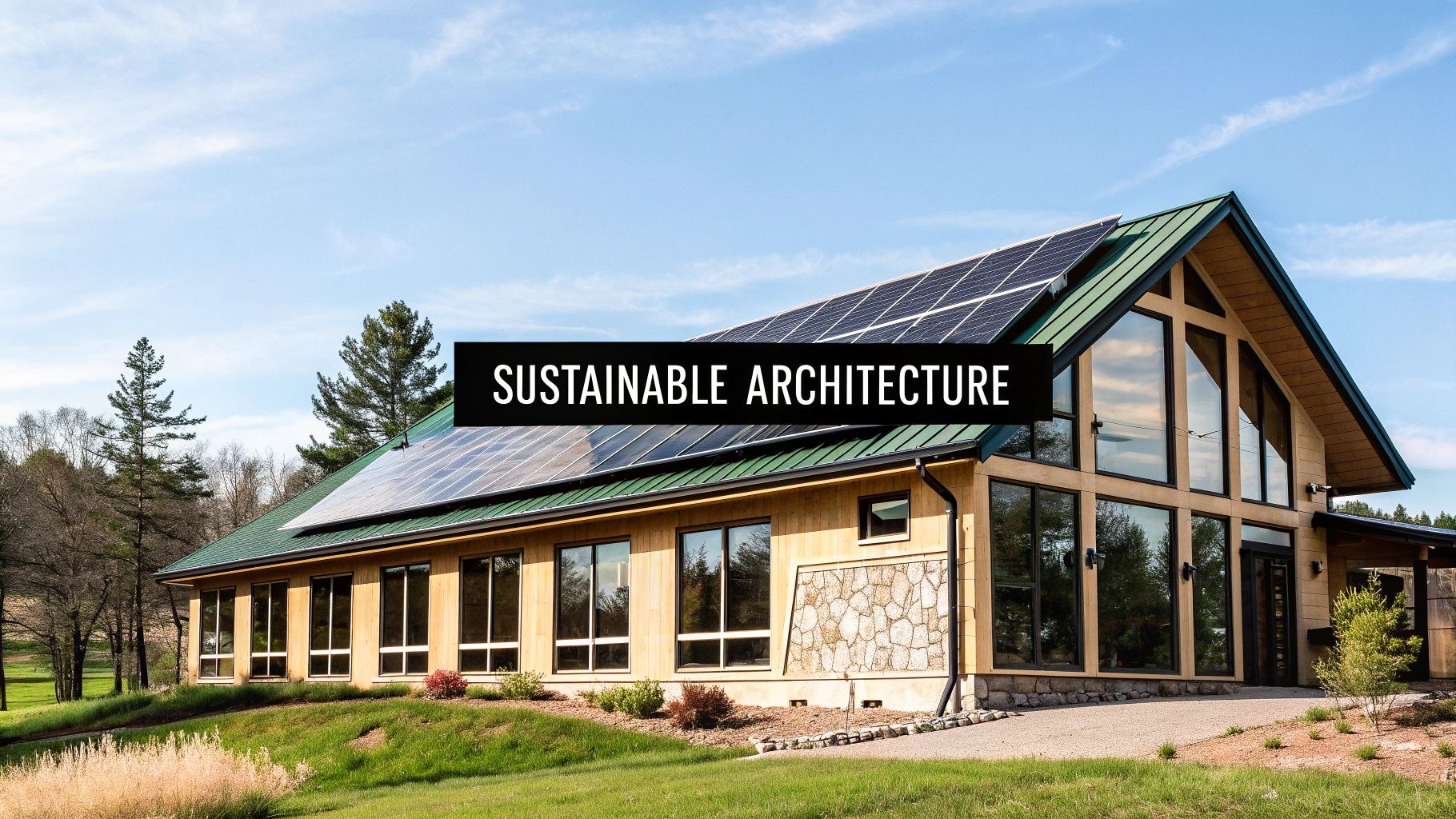
Sustainable architecture feels like having a building that acts like a village blacksmith: it takes what’s around, transforms it into something valuable, and leaves the site in better shape. This design mindset shrinks negative impacts while boosting energy performance, healthy indoor life, and resource renewal.
Defining Sustainable Architecture
A sustainable building is like a self-sustaining organism, tapping into local resources rather than draining them. Picture a mature oak: it soaks up sunlight, captures rainwater, and creates a microclimate that benefits the forest floor. Borrowing from nature’s playbook, architects aim for regeneration instead of mere resource extraction.
The Three Core Goals
- Reducing Environmental Impact: Source recycled materials, cut construction waste, and protect ecosystems to shrink carbon footprints.
- Boosting Energy Efficiency: Combine passive solar layouts, proper insulation, and renewable systems to lower power demands.
- Enhancing Occupant Well-being: Prioritize clean air, ample daylight, and low-toxicity finishes so people feel healthier and more productive.
Below is a quick reference table highlighting the three pillars that guide sustainable projects from concept to completion.
The Pillars of Sustainable Architecture
| Pillar | Core Strategy | Desired Outcome |
|---|---|---|
| Reducing Environmental Impact | Use recycled or locally sourced materials; optimize site selection | Lower carbon footprint and less resource waste |
| Boosting Energy Efficiency | Integrate passive design principles; install solar panels | Minimized energy bills and reduced emissions |
| Enhancing Occupant Well-being | Maximize daylight; ensure ventilation; select non-toxic finishes | Healthier indoor air and improved comfort |
By weaving these pillars into every stage—planning, construction, and operation—projects evolve from buildings into living environments.
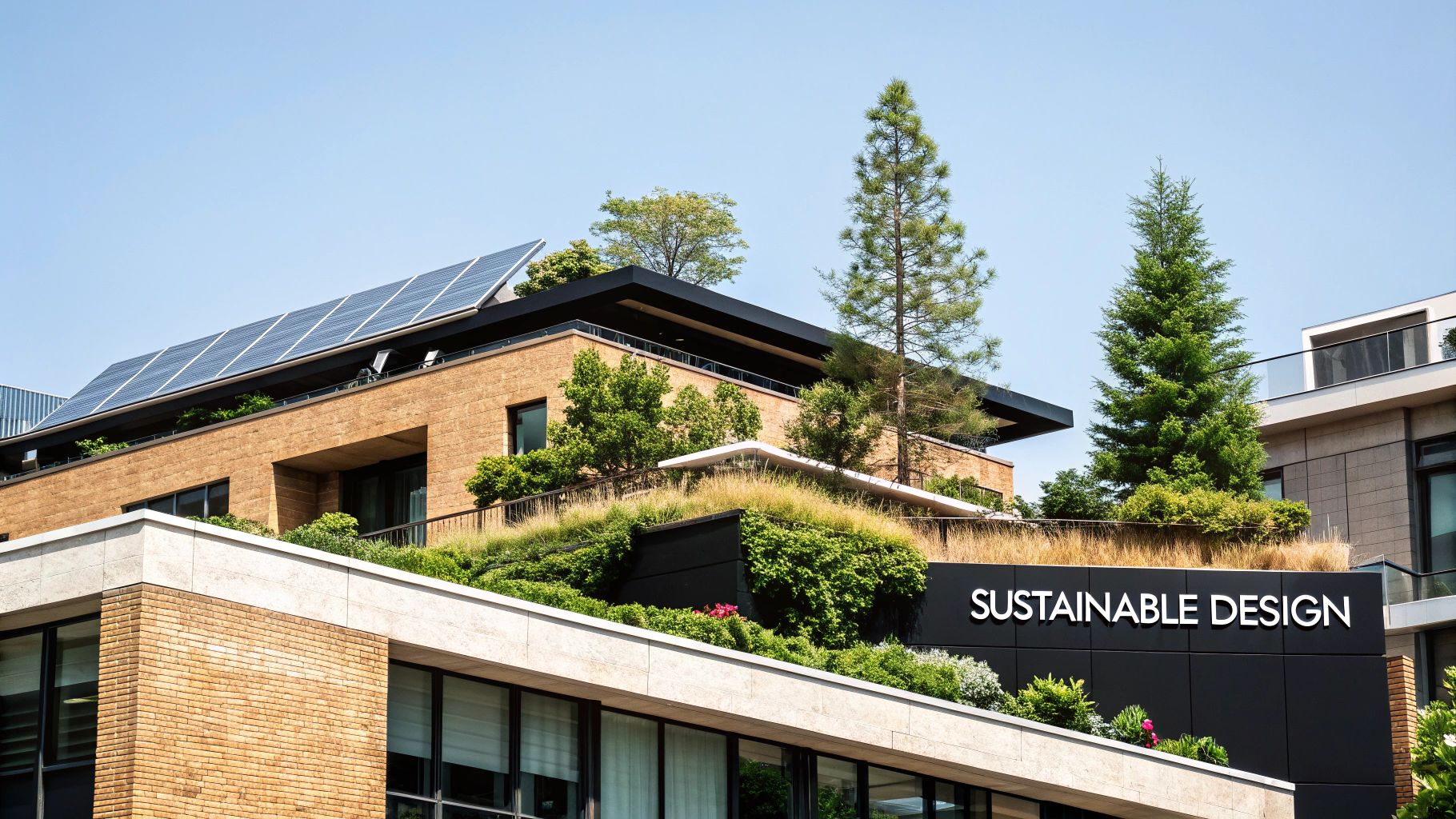
At its core, this design philosophy balances social, environmental, and economic pillars. The result? Buildings that minimize harm and actually improve life for people and the planet.
Understanding The Core Principles
At its heart, sustainable architecture is a balancing act between three core ideas: environmental stewardship, social well-being, and economic sense. It’s about designing buildings that don’t just stand there, but actively contribute to the health of the people inside them, the community around them, and the planet as a whole.
Think of a truly sustainable home as you would a mature tree in a forest. It works with its environment, not against it. It uses sunlight for energy, provides shade to cool itself, and even purifies the air. Every decision, from the angle of the roof to the type of insulation, is part of this larger, living system.
This approach is built on three pillars:
- The Environmental Pillar is all about resourcefulness. It means minimizing a building’s footprint by being smart with energy, water, and materials. Think maximizing natural light and using renewable power.
- The Social Pillar focuses on people. It’s about creating spaces that improve our quality of life through things like clean indoor air, ample green space, and a connection to the community.
- The Economic Pillar ensures the project makes long-term financial sense. This isn’t just about initial construction costs, but about creating value through lower utility bills, durable materials, and higher property value down the line.
A simple choice like designing for natural ventilation, for instance, can slash cooling needs by up to 30%, making a home more comfortable and far less expensive to run.
Building Resilience and Context
A smart, sustainable home is also a resilient one. It’s designed to handle whatever the local climate throws at it, whether that’s a heatwave, a hurricane, or a heavy snowstorm. This means choosing materials and a building form that are inherently suited to the site.
This way of thinking is gaining serious traction. A recent global survey of construction professionals across 27 countries revealed that 67% now recognize the importance of sustainable building—that’s a 6-point jump from last year. Even more telling is the 32-point increase in awareness among elected officials. The public is on board, too, with 60% viewing it as a priority.
There’s still work to do, of course. In the US, for example, 34% of the public isn’t familiar with these concepts, highlighting a real opportunity for education. You can explore the full findings in the 2025 sustainable construction barometer.
Designing For Local Needs
Truly great design is rooted in its location. Using local materials not only cuts down on transportation emissions but also gives a building a sense of place and supports regional economies. Think reclaimed brick from a nearby demolition or stone quarried just a few miles away.
This “think local” approach varies globally:
- In Asia-Pacific, Africa, and the Middle East, the focus is often on resilience to climate-related hazards.
- Latin America has a rich tradition of using ecological materials like bamboo and rammed earth.
- Europe is leading the way in prioritizing the renovation of existing buildings over new construction.
- Here in North America, a key challenge is balancing high-performance design with affordability.
If this idea of people-centric design resonates with you, our article on wellness architecture approaches delves deeper into creating spaces that support human health.
The best sustainable projects weave environment, society, and economy into every beam and finishing detail.
Holistic Integration
Everything is connected in a sustainable home. Water management, waste reduction, and indoor air quality aren’t afterthoughts; they’re integral to the design from day one. This means systems like rainwater harvesting and greywater reuse are planned from the start, and materials are chosen specifically for their low impact on health, like paints and finishes with no volatile organic compounds (VOCs).
The process generally involves a mix of strategies:
- Passive Strategies: This is the first line of defense. It’s about using the building’s own shape and materials to manage the climate, like orienting windows to capture winter sun or using thermal mass to keep interiors cool.
- Active Systems: After passive design has done the heavy lifting, active systems like high-efficiency heat pumps, solar panels, and smart thermostats provide the rest of the energy needed.
- Material Choices: Every material is scrutinized for its entire lifecycle, favoring recycled content, low embodied carbon, and local sourcing whenever possible.
Ultimately, this integrated approach means every element has to work hard, often performing multiple functions. A well-placed overhang, for example, provides shade, protects the facade from rain, and becomes a defining architectural feature.
The economic benefits tie it all together. A thoughtfully designed sustainable building can easily see a return on investment of more than 20% over its lifetime through energy savings and lower maintenance alone.
From the first sketch to the day you move in and beyond, these principles guide every decision. It’s not just about building a house; it’s about creating a home that will thrive for generations.
Harnessing Passive And Active Design Strategies
At the heart of any truly sustainable building lies a clever partnership between two core approaches: passive design and active design. Think of it as a one-two punch for energy efficiency. Passive strategies work with nature, while active strategies use smart technology to pick up the rest of the slack.
This dual approach is really the essence of what sustainable architecture is in the real world.
Passive design is all about working smarter, not harder. It’s about orienting a home to capture the sun’s warmth in the winter or designing window placements to catch a cooling summer breeze. Just like a plant turns its leaves toward the light, a passively designed home is finely tuned to its environment.
For example, large, south-facing windows can flood a room with natural light and heat on a cold day. That warmth can then be absorbed and stored by materials with high thermal mass, like a thick concrete floor or a stone wall, which will slowly release the heat as the evening cools. It’s a beautifully simple, low-tech way to create a comfortable space.
Other passive tactics include:
- Carefully orienting the home to maximize winter sun and minimize summer heat gain.
- Using deep roof overhangs that block the high summer sun but let in the low winter sun.
- Placing windows strategically to create natural cross-ventilation, pulling fresh air through the home.
- Using landscaping, like deciduous trees, to provide shade in the summer and allow sunlight through in the winter.
Active Strategies: The High-Tech Helping Hand
Once passive design has done the heavy lifting, active systems step in to handle the rest. This is where efficient technology comes into play. Think of these as the high-performance tools that fill in any gaps left by the passive strategy.
We’re talking about things like solar photovoltaic (PV) panels on the roof generating clean electricity, or incredibly efficient heat pumps that provide heating and cooling while using a fraction of the energy of traditional systems.
Top-tier active systems you’ll find in modern sustainable homes include:
- Solar PV arrays on rooftops or even integrated into the building’s facade.
- ENERGY STAR certified HVAC systems and appliances, which are the gold standard for efficiency.
- Smart thermostats and home automation that learn your habits and adjust settings automatically to save energy.
- Heat recovery ventilators (HRVs), which are fantastic for bringing in fresh air without losing all your precious indoor warmth.
The magic happens when you blend these two approaches. The passive design dramatically reduces the building’s overall energy demand from the get-go. Then, the highly efficient active systems only have to meet that much smaller remaining demand.
“The smartest design reduces energy waste before turning on the equipment.”
This integrated process ensures the home is teaming up with nature first. Technology only steps in when needed, and when it does, it’s as efficient as possible. The result is a home that feels incredibly comfortable all year round, with significantly lower running costs and a much smaller environmental footprint.
You can dive deeper into how these elements come together in our guide on smarter design and spatial planning.
By understanding this balanced approach, clients can have more meaningful conversations with their architects, asking precisely how passive and active elements will work together on their specific site to create a home that is both beautiful and brilliantly efficient.
Choosing Materials And Measuring Embodied Carbon
Every building material tells a story—and that story carries a carbon price tag. What we call embodied carbon is the total CO₂ emitted from digging up raw resources, manufacturing items like steel beams or concrete blocks, and hauling them to the construction site.
Imagine a building’s carbon footprint in two parts:
- Operational Carbon covers the energy used for heating, cooling, and lighting once you move in.
- Embodied Carbon is the “carbon debt” incurred before the first light switch flips on.
That upfront hit is massive, happening all at once at the start of a building’s life. In luxury projects, designers are increasingly choosing materials with lower embodied carbon, marrying high-end finishes with environmental responsibility.
The Lifecycle Of Building Materials
To gauge a material’s true impact, we need a full-picture approach. A Life Cycle Assessment (LCA) serves as a deep dive into every phase of a product’s existence—from birth to end of life. Here’s what an LCA typically examines:
- Extraction: Where and how were raw resources obtained?
- Manufacturing: How energy-intensive is the production process?
- Transportation: What distances did components travel to reach the job site?
- Use: Does the material require frequent upkeep or easily stand the test of time?
- End-of-Life: Can we recycle, repurpose, or compost it, or will it stagnate in a landfill?
This holistic lens empowers architects to compare alternatives side by side and pick the ones that align with genuine sustainability goals.
The following visual shows how building efficiency is achieved through a combination of passive design, which reduces the need for energy, and active systems, which efficiently meet the remaining demand.
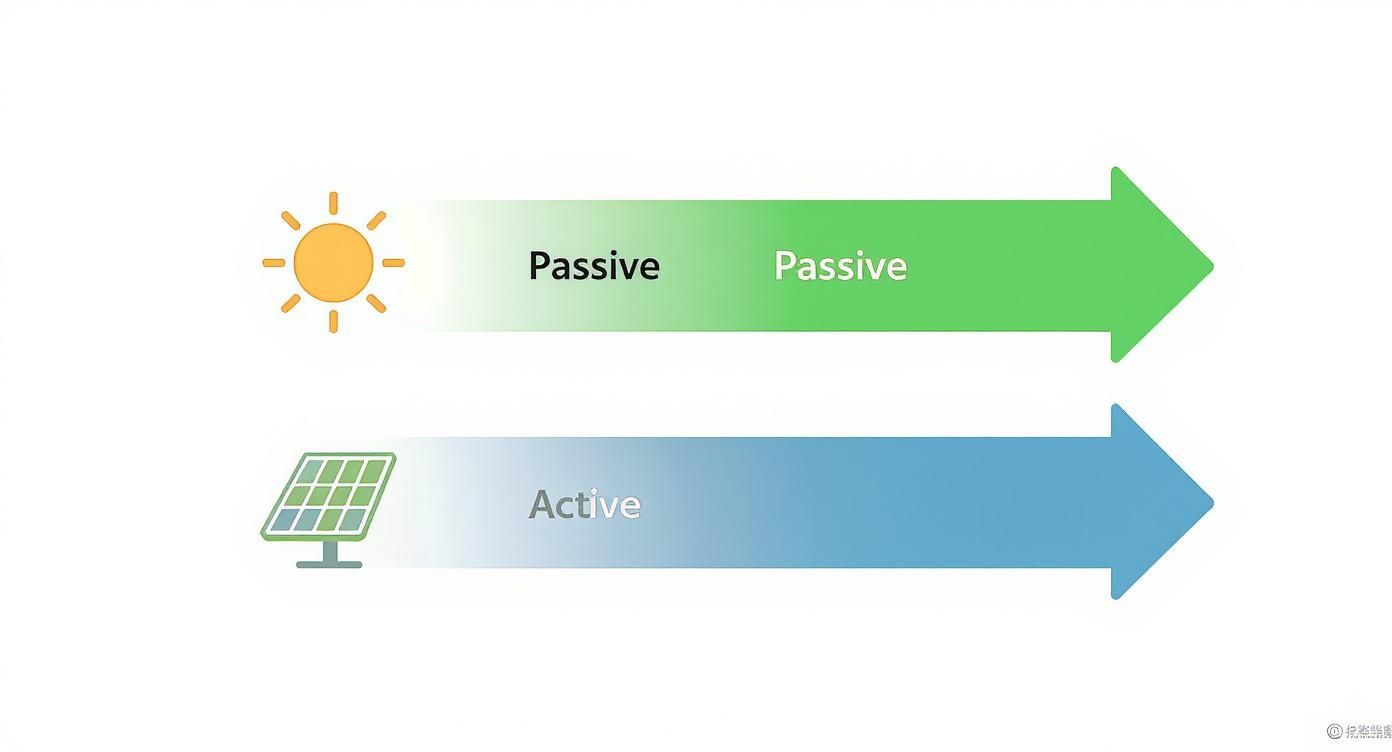
By prioritizing nature-inspired, passive strategies first—then layering in innovative technologies—we set the stage for both high performance and low impact, starting with the materials themselves.
Smart Material Choices And Circular Design
Sustainable materials don’t mean “second best.” In fact, when you source thoughtfully, you often unlock hidden character and story. Consider these options:
- Reclaimed Wood: Brings warmth, patina, and a century of history into a modern home.
- Recycled Steel: Delivers the same strength as new steel but slashes its carbon footprint by up to 75%.
- Low-Carbon Concrete: New formulations can cut emissions by 20–30% without sacrificing durability.
Designing for deconstruction, not demolition, is a core principle of the circular economy. This means planning for a building’s end-of-life from the very beginning, ensuring valuable materials can be recovered and reused in future projects.
This forward-thinking mindset is no longer optional. The construction sector drives 32% of global energy demand and generates 34% of CO₂ emissions. While operating systems play a big role, materials and construction alone contribute roughly 2.9 gigatonnes of embodied carbon every year.
To explore how our industry is charting a course toward lower emissions, see the full Global Status Report for Buildings and Construction.
Navigating Green Building Certifications
When you’re evaluating sustainable design, certification programs like LEED, Passive House, and the Living Building Challenge provide a transparent, numbers-driven roadmap. Each framework acts as a performance checklist, covering energy use, indoor air quality, water management, and material sourcing. Earning one of these badges not only validates a project’s green credentials but also appeals to discerning buyers who value both efficiency and wellness.
Comparing Certification Standards
On their own, each standard zeroes in on particular goals. Yet together, they help you match the right benchmark to your local climate, budget, and client priorities.
- LEED
A point-based system across categories such as energy, water, materials, and indoor environmental quality. - Passive House
Emphasizes a super-insulated, airtight envelope to cut heating demand by 90%. - Living Building Challenge
Pushes for net-positive energy and water performance—100% renewable supply and output. - BREEAM
Focuses on UK and European projects, with strict targets for carbon emissions and resource use. - Green Star
An Australian standard that rates resource efficiency and occupant well-being.
Below is a quick side-by-side look at the most recognized green building standards.
A Comparison Of Green Building Certifications
| Certification | Primary Focus | Key Energy Goal | Material Guidelines |
|---|---|---|---|
| LEED | Broad sustainability metrics | 20% reduction from baseline | Encourages recycled and low-VOC products |
| Passive House | Envelope efficiency | 90% lower heating demand | Prefers airtight construction materials |
| Living Building Challenge | Net positive energy and water | 100% renewable supply and output | Requires local and eco-friendly sourcing |
| BREEAM | Regional emissions reduction | Varies by certification level | Emphasizes sustainable procurement |
| Green Star | Resource efficiency & indoor air | Performance-based targets | Supports locally sourced, low-toxicity materials |
Each framework brings its own strengths, so selecting the right path depends on your project’s performance goals, regional priorities, and desired return on investment.
Screenshot Of LEED Credit Categories
The chart above breaks down how LEED allocates points, spotlighting energy and water savings as top priorities.
Investing In Certified Buildings
The global market for green building materials reached USD 368.7 billion and is on track to climb to USD 708.9 billion by 2030 at a 14% CAGR. For a deeper dive, check out the BCC Research Market Forecast.
Certification boosts resale value by up to 10% while cutting operating costs by roughly 20%.
In luxury residential projects, that adds up quickly:
- Significantly lower utility bills thanks to efficient HVAC systems and LED lighting
- Stronger market appeal among eco-conscious buyers
- Reduced upkeep expenses from durable, high-performing materials
- Typical energy savings of at least 25% compared to code-minimum buildings
- Ongoing maintenance costs can drop by as much as 15%
Bringing green standards into a project from day one eliminates expensive retrofits and ensures a cohesive design narrative. On platforms like Haute Design, architects often highlight these certification milestones in client presentations to underscore both performance and prestige.
Key Questions For Architects
Before settling on a certification path, clients should get clarity on:
- What percentage of energy reduction can we expect over a baseline code building?
- Which materials or finishes deliver the most certification credits?
- How will the chosen standard impact our construction schedule and budget?
Answering these questions early turns sustainable aspirations into concrete, verifiable achievements—making green architecture both an art and a science.
Seeing Sustainable Architecture in Action
It’s one thing to talk about principles and carbon metrics, but where sustainable architecture truly shines is in the real world—in the homes people actually live in. To really grasp what we mean by sustainable design, let’s move beyond the theory and look at some incredible projects that put these ideas into practice.
These homes show that sustainability isn’t a one-size-fits-all style. Instead, it’s a smart, adaptable approach that responds to a specific climate, a unique piece of land, and the owner’s vision.
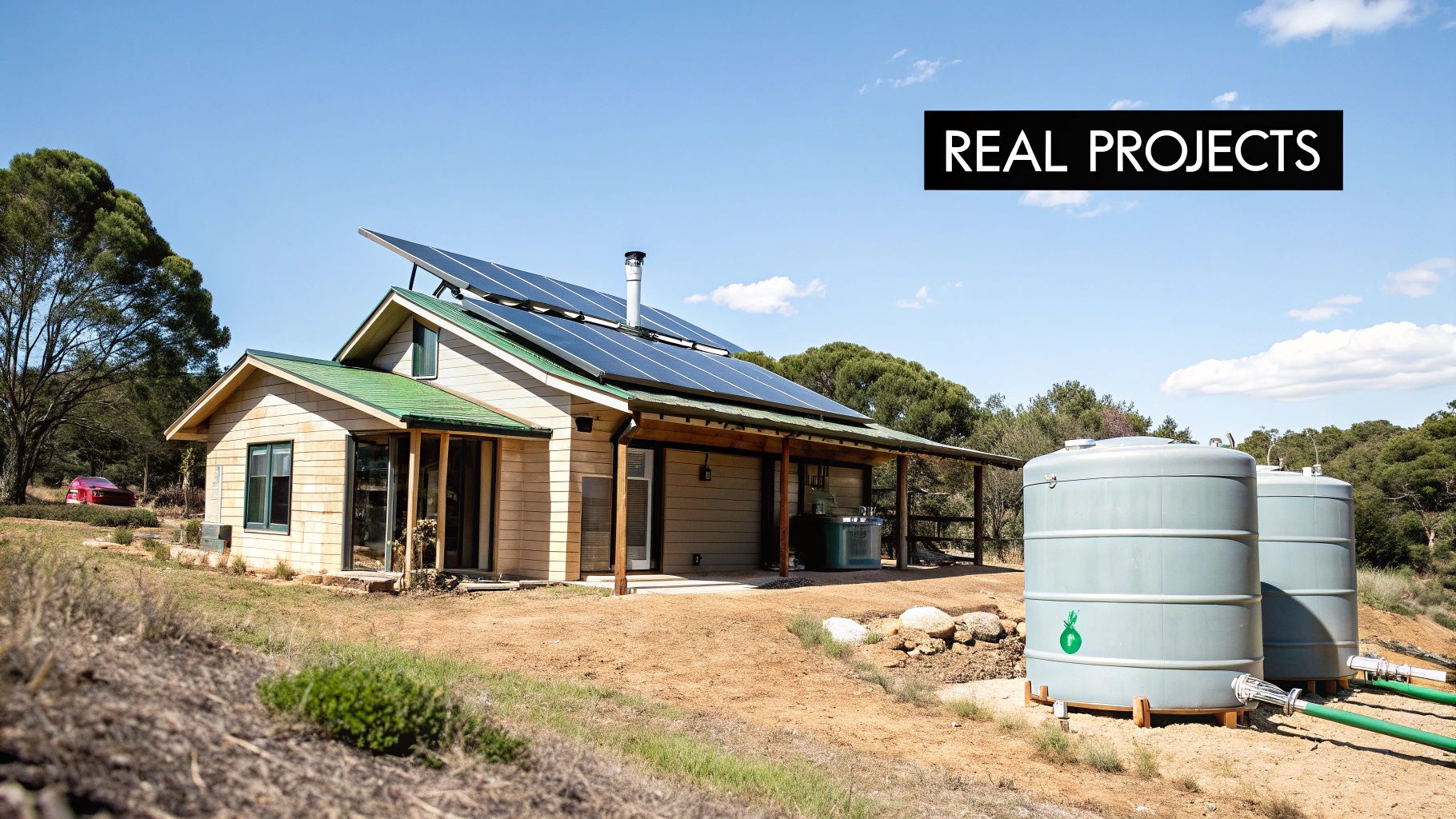
Here are three distinct examples that bring these concepts off the drawing board and into everyday life. Each one tackled different challenges, using a custom mix of passive strategies, active systems, and thoughtful material choices to achieve something remarkable.
Case Study 1: The Modern Home with a Green Roof
Picture a modern home nestled into a hillside, its roof a living carpet of native grasses that shifts colors with the seasons. This isn’t just an aesthetic choice. That green roof is a workhorse, providing a thick layer of natural insulation that dramatically lowers heating and cooling bills. It also drinks up rainwater, which reduces storm runoff and helps support the local ecosystem.
The design goes even further, working in harmony with its surroundings:
- Passive Solar Design: Huge, triple-glazed windows are oriented to the south, soaking up the low winter sun for warmth. Deep roof overhangs act like the brim of a hat, shielding those same windows from the high, intense sun of summer to keep the interior cool.
- Natural Ventilation: Windows are placed strategically to capture prevailing breezes, creating natural cross-ventilation that all but eliminates the need for air conditioning.
- Local Materials: The home is built with stone and timber sourced from the region, which not only grounds the structure in its landscape but also slashes the embodied carbon that comes from long-distance transportation.
The result? A beautiful home that feels completely connected to its environment and uses an astonishing 60% less energy for heating and cooling than a typical home of its size.
Case Study 2: The Urban Geothermal Retrofit
Bringing an older, historic apartment building up to modern performance standards is a completely different puzzle. In this case, a classic brick building was updated without sacrificing its original architectural charm. The secret weapon was a geothermal heating and cooling system.
By drilling deep into the ground, the system taps into the earth’s constant, stable temperature. In winter, it pulls heat from the ground to warm the building; in summer, it sends heat back into the ground to cool it. It’s an incredibly efficient way to manage the climate year-round.
This powerful active system was paired with high-performance windows, which added a serious layer of insulation and quieted the city noise. The project achieved a 45% reduction in the building’s total energy use while making the apartments far more comfortable for residents.
This project proves that sustainability isn’t just for new builds. A smart retrofit can give an old building a new lease on life—preserving its character while drastically cutting its carbon footprint.
Case Study 3: The Net-Zero Luxury Villa
On a stunning coastal property, this luxury villa was designed from day one with a clear goal: to be net-zero energy. This means that over the course of a year, the home actually produces as much renewable energy as it consumes. Achieving this required a sophisticated blend of strategies perfectly suited for a sunny, warm climate.
Here’s how they did it:
- Integrated Solar Array: The roof features a sleek, high-efficiency solar panel system that was designed to be a seamless part of the home’s architecture, not a clunky add-on.
- Advanced Water Recycling: A greywater system captures water from showers and sinks, treats it on-site, and then reuses it to irrigate the landscape—a critical feature in a coastal area.
- Smart Home Automation: An intelligent system acts as the home’s brain, automatically managing lights, shades, and the climate system based on who is home and the time of day to optimize every last watt of energy.
This combination of technologies doesn’t just zero out the owner’s electricity bill; it also creates a resilient home that can function off-grid during a power outage. It’s a perfect illustration of how high-end luxury and deep sustainability can go hand-in-hand. To get a better sense of how projects of this complexity come together, you can read more about the architectural design process and its key steps in our comprehensive guide.
Common Questions About Sustainable Architecture
Diving into sustainable design often brings up questions about cost, feasibility, and real-world benefits. Untangling these points reveals that green building isn’t just an eco-friendly buzzword—it’s an investment in healthier, more efficient living.
At its heart, sustainable architecture is about asking how a building can thrive alongside its environment instead of draining resources. Think of it as crafting a home that breathes, conserves, and endures from day one through decades down the road.
“Sustainable architecture focuses on reducing a building’s environmental footprint by optimizing energy and material use, managing water wisely, and preserving land. It strikes a balance between ecological health, social well-being, and lasting economic sense.”
Simply put, it’s about creating spaces that feel good, perform well, and cost less to run over time.
Does Sustainable Always Mean More Expensive
People often assume that ‘green’ equals sticker shock. The truth is more nuanced. Sure, systems like geothermal heating or rooftop solar arrays carry higher upfront expenses, but not every eco-friendly feature blows the budget.
Passive strategies—like orienting windows for optimal daylight or adding overhangs to block summer heat—come at minimal cost and can slash energy bills for years. A typical lifecycle analysis shows that these efficiencies and any tax rebates frequently offset initial outlays. In many cases, a well-planned sustainable home ends up costing less over its lifetime.
Can You Make An Existing Home More Sustainable
Absolutely. Retrofitting an older house can be more resource-efficient than starting from scratch. Small upgrades, when combined, deliver surprisingly big wins.
Here are a few powerful ways to enhance an existing home’s performance:
- Improve Insulation
Add foam or cellulose in walls, attics, and crawl spaces to cut heating and cooling demand. - Seal Air Leaks
Apply caulk and weatherstripping around windows, doors, and vents to stop drafts. This can save 10-20% on energy costs. - Upgrade Windows
Swap out single-pane glass for double- or triple-glazed units to lock in comfort. - Install Efficient Systems
Move to ENERGY STAR appliances, low-flow fixtures, and a smart thermostat for automated savings.
Even simple moves—choosing low-VOC paints or planting shade trees—nudge your home toward healthier, more sustainable living. Every improvement counts.
At Haute Design, we connect discerning clients with top-tier architects and designers who specialize in luxurious, high-performance homes. Explore our network to find a professional who can bring your sustainable vision to life. Learn more at Haute Design