


If you’re dreaming of building a custom luxury home, the first question on your mind is likely about the cost. It’s a big one, and the answer isn’t always simple.
Nationally, you can expect the cost to build a luxury home to fall somewhere between $280 and $450 per square foot. Of course, in high-demand markets, that number can climb significantly higher. Think of it less like buying something off the shelf and more like commissioning a one-of-a-kind masterpiece—every single choice, from the architect you hire to the marble you select for the countertops, shapes the final budget.
The True Cost of Building a Dream Home
The word ‘luxury’ itself means different things to different people. For some, it’s about a stunning architectural design that captures a specific view. For others, it’s about sourcing rare, imported materials or integrating sophisticated smart home technology that makes life seamless.
Getting a firm grasp on the financial commitment from the very beginning is the key to a smooth and successful project. Instead of a single, all-in-one price, the total cost is a mosaic of several major categories, each demanding careful thought and planning.
Demystifying the Core Cost Categories
To set a realistic budget, you need to understand where the money actually goes. While every custom home is unique, the financial breakdown tends to follow a surprisingly consistent pattern. According to a recent construction cost analysis, high-end custom homes are hitting record price points, with the average now firmly in that $280 to $450 per square foot range. In prime locations like coastal California or the Hamptons, it’s not uncommon to see projects push past $500 per square foot.
Building a luxury home is an exercise in balancing vision with practicality. The most successful projects are those where the client, architect, and builder collaborate transparently on the budget from day one.
Before we get into the nitty-gritty of each cost, it helps to see the entire journey. For a complete look at what to expect, our guide to the custom home building process offers an invaluable roadmap from start to finish.
To give you a clearer picture, here’s a quick overview of the main cost buckets.
Quick Overview of Luxury Home Cost Components
This table summarizes the primary categories that make up the total budget for a luxury home build. Understanding these percentages will help you and your team allocate funds effectively.
| Cost Category | Typical Percentage of Total Budget | Key Elements |
|---|---|---|
| Land & Site Preparation | 15% – 25% | Land acquisition, surveys, demolition, excavation, utility hookups |
| Architectural & Design Fees | 8% – 15% | Blueprints, structural engineering, interior design, permit fees |
| Construction Hard Costs | 50% – 60% | Foundation, framing, roofing, plumbing, electrical, HVAC, labor |
| Interior & Exterior Finishes | 10% – 25% | Flooring, cabinetry, countertops, appliances, lighting, landscaping |
| Contingency Fund | 10% – 20% | Unforeseen expenses, material price changes, desired upgrades |
Think of these categories as the foundational pillars of your budget. Each one plays a critical role in bringing your vision to life, and we’ll explore them in more detail next.
Breaking Down Costs Per Square Foot
When you first start exploring luxury home construction, the “cost per square foot” is the number everyone talks about. It’s a quick, easy benchmark, but frankly, it can be incredibly misleading if you don’t know what’s behind it. How can one custom home come in at $280 per square foot while another, just down the road, soars past $600?
Think of it like buying a car. The sticker price gets you the basic model, but it doesn’t include the upgraded engine, the hand-stitched leather interior, or the premium sound system. It’s the exact same with your home. That final per-square-foot cost is a direct reflection of thousands of individual choices you’ll make on everything from the design and materials to the level of craftsmanship.
What Does Per-Square-Foot Cost Usually Include?
So, what are you actually getting when a builder throws out a per-square-foot estimate? Typically, they’re talking about the “hard costs”—the fundamental expenses to get the physical structure built.
This baseline figure generally covers the essentials:
- Foundation and Framing: The concrete, steel, and lumber that form the home’s skeleton.
- Exterior Work: This usually means basic roofing, siding, and standard-grade windows and doors.
- Core Systems: Standard installation for plumbing, electrical wiring, and HVAC.
- Basic Finishes: Think drywall, a standard coat of paint, and builder-grade flooring and fixtures.
This gets you a well-built house, but it doesn’t get you a luxury house. The real magic—and the higher costs—comes from the custom details and high-end selections that make it uniquely yours.
The Hidden Costs Excluded from the Base Figure
What’s even more critical to understand is what that initial number almost always leaves out. These are significant expenses that can easily add 20-35% or more to your total project cost, and they often catch people by surprise.
You’ll need to budget separately for these common exclusions:
- Land Acquisition: The cost of the lot itself is never included in the construction estimate.
- Professional Fees: This covers your architect, interior designer, engineers, and land surveyors.
- Site Preparation: Costs for demolition, major excavation, or connecting to distant utilities can add up fast.
- High-End Finishes: Custom cabinetry, imported marble, professional-grade appliances, and designer lighting are all upgrades.
- Landscaping and Exterior Features: Don’t forget the pool, outdoor kitchen, elaborate gardens, and driveway.
This infographic gives a great visual of how these costs stack up, showing the typical range for the construction itself before you add these other crucial elements.
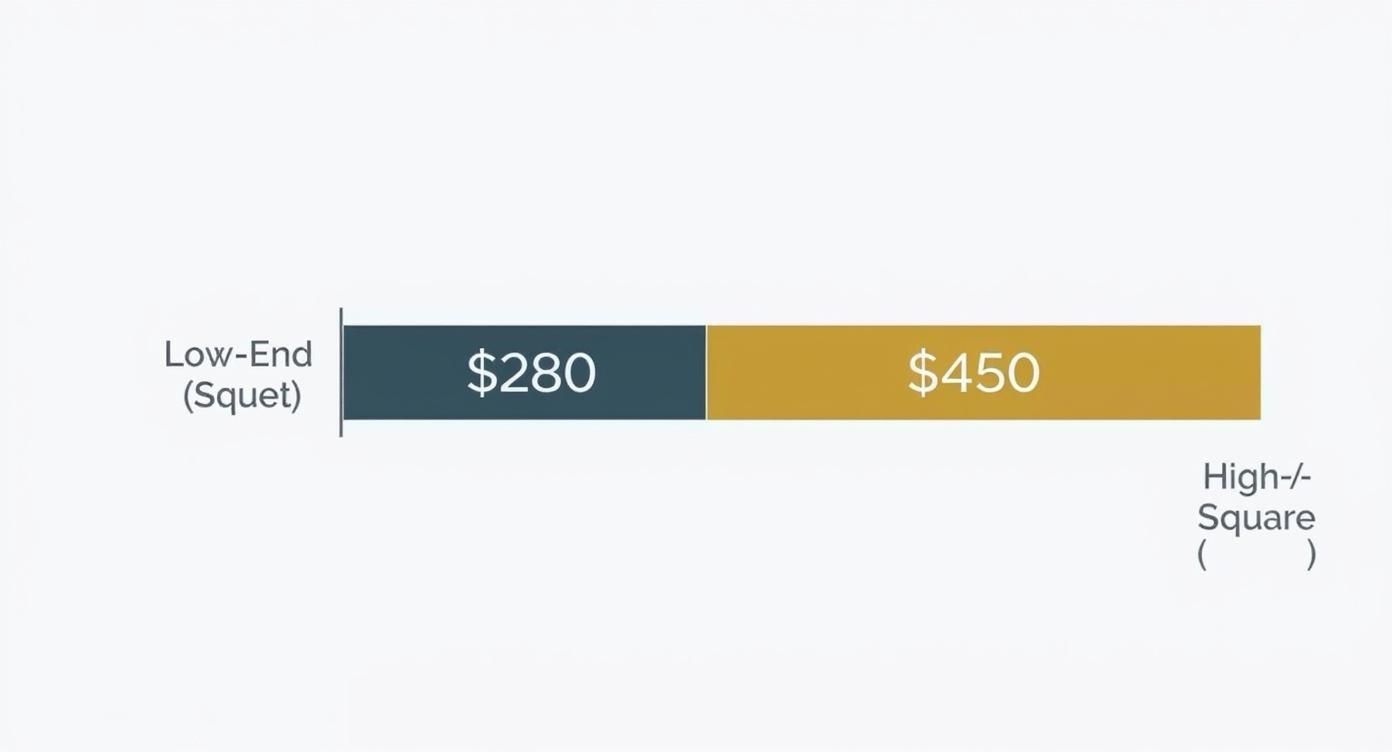
As you can see, the base construction for a luxury home often starts around $280 per square foot but can quickly climb to $450 and well beyond as the finishes and features become more sophisticated.
From Semi-Custom to Bespoke: The Tiers of Luxury
The word “luxury” isn’t one-size-fits-all; it’s a wide spectrum. A semi-custom home in a high-end development might average around $300 per square foot. On the other end, a truly bespoke, architect-designed estate with one-of-a-kind structural features and rare materials can easily shoot past $600 per square foot.
This trend holds true on a global scale. Major cities like Geneva, London, and New York consistently rank among the most expensive places in the world to build. The average cost for a high-end home in these markets often exceeds $400 per square foot, with premier projects hitting $600 or more. For a deeper dive into these figures, the Arcadis International Construction Costs report provides an excellent breakdown of global building expenses.
As luxury construction costs vary dramatically by location, here’s a look at what you can expect in some of the world’s most sought-after cities.
Average Luxury Construction Costs Per Square Foot by City
| City | Average Cost Range (per sq. ft.) | Key Market Factors |
|---|---|---|
| New York, NY | $450 – $650+ | High labor costs, strict building codes, logistical challenges |
| San Francisco, CA | $400 – $600+ | Seismic requirements, expensive labor, limited space |
| London, UK | $420 – $600+ | High demand, historic preservation rules, material import costs |
| Geneva, CH | $480 – $700+ | Extremely high labor and material costs, stringent regulations |
| Los Angeles, CA | $350 – $550+ | Demand for high-tech homes, specialized labor, hillside building |
| Miami, FL | $300 – $500+ | Hurricane-resistant construction standards, luxury waterfront demand |
These figures reflect the unique blend of labor costs, material availability, and regulatory hurdles in each market, underscoring why a “one-price-fits-all” approach simply doesn’t work.
The difference between a high-quality home and a true luxury residence is craftsmanship. The premium you pay per square foot is an investment in the artisans who can execute intricate designs flawlessly.
In the end, that per-square-foot number is not a fixed price but a dynamic calculation. It’s a direct result of your vision, your choice of location, and your commitment to quality at every step of the journey.
The Five Pillars of Your Construction Budget
While price-per-square-foot is a handy shorthand, it barely scratches the surface. In my experience, the real story of luxury home construction costs is told through five key drivers that shape every single line item in your budget. Getting a handle on these is how you move from a ballpark guess to a solid, workable financial plan.
Think of it like this: each of these pillars is a major ingredient in a complex recipe. You can adjust the quality and quantity of each, but every decision directly impacts the final result—and the final bill. Let’s break them down one by one.
1. Architectural Complexity and Design Fees
Every custom home starts as an idea, an inspiration that a talented architect translates into a buildable plan. Right here, at the very beginning, is your first major cost driver: the complexity of that plan.
A simple, rectangular home with a traditional roof is always going to be more straightforward—and less expensive—to build than a sprawling design with dramatic angles, cantilevered balconies, or sweeping curved walls. Every one of those “wow” features requires more advanced engineering, specialized labor, and unique materials.
And don’t forget the architect’s fee itself. For top-tier firms, this can easily be 8% to 15% of the total construction cost. You’re not just paying for drawings; you’re investing in their expertise, creativity, and problem-solving skills. An ambitious design is thrilling, but it’s crucial to understand that architectural daring has a price tag to match.
2. Material Quality and Finishes
This is where the idea of “luxury” becomes tangible, and it’s often where a budget can really start to climb. What separates a high-quality house from a true luxury home often comes down to the materials and finishes you can see and touch.
Just look at the cost differences for common items:
- Flooring: You could choose a beautiful, high-end engineered hardwood for around $15 per square foot. Or, you could source rare, reclaimed wide-plank oak from a historic European barn, which could easily top $50 per square foot.
- Countertops: A high-grade quartz is a fantastic, durable choice. But if you have your heart set on a single, perfectly bookmatched slab of Calacatta Gold marble imported from Italy, you’re looking at an expense that’s three to five times higher.
- Fixtures: A premium faucet from a well-known brand is a great product. But custom-milled bronze fixtures, designed and fabricated just for your home, are on another level of artistry and cost entirely.
Every choice matters, from the window casings to the cabinet pulls. This is where you infuse the home with your personal style and define its lasting quality.
3. Land and Site Preparation
Before you can even think about pouring a foundation, you have to deal with the land itself. This is, without a doubt, one of the most underestimated cost centers in the entire building process. A flat, clear lot with utilities ready to go is the dream scenario, but the most stunning luxury homes are often built on sites that are anything but simple.
One of the biggest mistakes I see people make is underestimating the ground beneath their feet. The land dictates the first and often most unpredictable costs of the entire project.
Site prep costs can spiral when you’re dealing with:
- Challenging Terrain: That incredible hillside view? It might require tens of thousands of dollars in excavation, massive retaining walls, and a complex engineered foundation to make it buildable.
- Demolition: If there’s an old structure on the property, you have to account for the cost of taking it down and hauling away the debris.
- Utility Connections: Running water, sewer, and power lines a quarter-mile down a private drive to your secluded property can be a shockingly expensive undertaking.
This is why a thorough geotechnical survey early on isn’t optional—it’s essential for uncovering any expensive surprises hiding underground.
4. Advanced Systems and Technology
A modern luxury home isn’t just a pretty face; it’s a high-performance machine. It’s intelligent, efficient, comfortable, and secure. Integrating the advanced systems that make this possible is now an expectation, and the technology comes at a premium.
These aren’t afterthoughts; they require specialized design and expert installation from the very beginning.
Key tech investments often include:
- Smart Home Automation: A fully integrated system that seamlessly controls lighting, climate, security, and entertainment can add anywhere from $50,000 to $150,000+ to the budget.
- High-Efficiency HVAC: Systems like geothermal heating and cooling provide unparalleled comfort and long-term energy savings, but their upfront cost is significantly higher than traditional equipment.
- Integrated Security: We’re talking more than just an alarm. Sophisticated networks of high-definition cameras, motion sensors, and smart access control are a major investment in peace of mind.
5. Skilled Labor and Artisanship
Finally, you can have the best plans and the finest materials, but they’re worthless without the right people to put it all together. A luxury home demands true master craftspeople, not just standard construction crews. The premium you pay for this level of skill is a fundamental part of luxury home construction costs.
Whether it’s the stonemason meticulously setting a custom fireplace, the finish carpenter installing intricate millwork, or the plasterer achieving a flawless Venetian wall finish, their expertise is what turns an architect’s vision into a breathtaking reality. In today’s market, getting the best tradespeople on your project means paying for their talent and their time. It’s an investment in craftsmanship that ensures the final home isn’t just built, but beautifully executed.
How Location Shapes Your Final Building Cost

It’s the oldest truth in real estate, and it holds just as firm in construction: location is everything. You can have the most breathtaking design for a 5,000-square-foot home on paper, but its final price tag can swing by millions of dollars based on one simple factor—where you decide to build it. Geography isn’t a passive backdrop; it’s a powerful force that actively shapes your luxury home construction costs.
Think of your architectural plans as a recipe. The cost to create that dish changes dramatically depending on the kitchen you’re in. A chef in a remote mountain village will pay a premium for fresh seafood that a counterpart in a coastal city gets for a fraction of the price. In the same way, the exact same building materials and skilled labor come with wildly different price tags across the country and the world.
Getting a handle on these regional differences isn’t just a minor detail. It’s the cornerstone of creating a realistic budget right from the start.
The Urban Premium and Rural Realities
It’s no secret that major metropolitan areas almost always come with the highest construction costs. This “urban premium” is a perfect storm of factors that drive up prices. In a red-hot market like Austin, Texas, a high-end custom home can easily run from $300 to over $400 per square foot. That price is inflated by fierce demand for a relatively small pool of elite builders and master craftsmen.
Now, contrast that with building in a more rural or suburban location. While the land itself might be a bargain, a whole new set of expenses can pop up.
- Labor Availability: In a major city, you have your pick of specialized tradespeople. In a remote area, you might find yourself paying travel and lodging just to bring in the talent needed for a sophisticated luxury build.
- Material Logistics: Getting a truckload of imported Italian marble to a secluded mountain retreat means navigating tricky roads and paying hefty transportation fees. Those costs simply don’t exist for a project in a planned suburban development.
- Supply Chain Access: Cities are logistical hubs, making it faster and cheaper to source a wide array of materials. Building far from these hubs can mean delays and extra costs for every single delivery.
Location isn’t just a backdrop for your home; it’s an active participant in your budget. From land value to labor rates, geography dictates a significant portion of the final cost.
Permitting and Regulations
Beyond the straightforward costs of labor and materials, you have to contend with local bureaucracy. Every town, county, and state has its own unique web of building codes, zoning laws, environmental regulations, and permitting processes. A project in a historically protected district or a sensitive coastal zone will face layers of review and specific rules that add significant time and money to the project.
For example, building in a high-velocity hurricane zone in Florida means paying a “hurricane tax” for specialized engineering and materials designed to withstand extreme weather. Likewise, building in a seismic zone in California requires a heavy investment in earthquake-resistant structural engineering—a non-negotiable expense dictated entirely by geography. These regulatory hurdles are a massive part of why costs vary so much from one place to another.
The Global Perspective on Location Costs
These same principles apply on an international scale, where land values and local economies create even more dramatic cost differences. In the world’s most sought-after cities, the land alone can eat up over 50% of the total project cost. The luxury real estate market in Paris shows this dynamic with stunning clarity.
Despite broader economic shifts, the average price for luxury homes in Paris has jumped 3% in the last two years. In premier districts like the Left Bank, high-end properties can fetch prices of €40,000 per square meter or more—a figure driven almost entirely by the prestige and pure scarcity of the location. You can dig deeper into these trends in the Christie’s International Real Estate report.
Ultimately, the piece of land you choose is the first and most defining line item in your budget. It sets the stage for every cost that follows, from excavation and foundation work to the final landscaping, proving once and for all that where you build is just as important as what you build.
A Practical Framework for Budgeting Your Build
With a solid grasp of what drives costs, it’s time to move from abstract ideas to actual numbers. This is the moment where meticulous planning meets action, and having a strategic framework is the only way to keep your project anchored in financial reality. A well-thought-out budget isn’t just a spreadsheet; it’s the single most important tool you have to ensure your vision comes to life without a world of financial stress.
Think of your budget as a detailed financial roadmap for the entire build. You start with one realistic, all-in number and then carefully break it down into smaller, more manageable categories. This simple exercise transforms a potentially overwhelming figure into a series of clear, calculated decisions.
Defining Hard Costs vs. Soft Costs
The very first step in organizing your funds is to split your budget into two primary buckets: hard costs and soft costs. This fundamental separation immediately clarifies where your money is going and makes tracking every dollar infinitely easier.
- Hard Costs: These are the tangible, physical expenses of the actual construction. This includes everything from pouring the foundation and erecting the frame to the labor needed to install your custom windows and roofing. Put simply, if you can walk up and touch it as part of the finished house, it’s a hard cost.
- Soft Costs: These are the less tangible but equally critical services and fees that make the build possible. This category covers architect and engineer fees, interior design services, municipal permits, land surveys, and various inspection fees.
Splitting your budget this way helps you see the true cost of the physical structure versus the professional expertise required to design, approve, and manage the project.
As a reliable rule of thumb, expect soft costs to make up anywhere from 15% to 25% of your total project budget. Underestimating this portion is a classic mistake that can create a significant financial hole before a single shovel ever hits the ground.
Once you have these categories defined, you can start itemizing expenses. But before you get too deep, there’s one non-negotiable line item that every successful luxury home budget must include.
The Critical Role of a Contingency Fund
No matter how perfectly you plan, surprises are a given in any custom home project. You might discover an unexpected soil issue that demands a more robust foundation, or a rare material you’ve chosen could face a sudden price spike. Sometimes, you’ll just see an opportunity for an upgrade you simply can’t resist. This is precisely why a contingency fund is your financial safety net.
This isn’t a slush fund for frivolous last-minute additions. It’s a planned reserve, intentionally set aside to handle the unexpected. Most experienced builders and financial advisors will tell you to earmark 10% to 20% of your total construction cost for contingency. For a relatively straightforward project, 10% might suffice. But for a complex build on a challenging lot, you’ll want to be closer to that 20% figure.
Forgetting to budget for this is one of the most common and painful mistakes people make. Without it, a single unforeseen problem can force you to make heartbreaking compromises on the finishes and features you’ve dreamed about.
Navigating Construction Financing
Financing a custom home build works a bit differently than getting a standard mortgage for an existing house. Instead of a single lump-sum loan, you’ll most likely need a construction loan. This type of financing is paid out in stages, or “draws,” as your project reaches specific, predetermined milestones. Typically, the bank will send an inspector to verify that a phase—like framing or plumbing rough-in—is complete before releasing the next payment to your builder.
This process demands detailed documentation and a strong, transparent relationship between you, your builder, and your lender. A rock-solid contract is absolutely essential to making this process run smoothly. To get a better handle on this, this guide to understanding your custom home builder contract offers invaluable insights into the key clauses that protect everyone involved.
By using this framework—separating costs, securing a contingency, and understanding your financing options—you can take control of your luxury home budget and manage the process with confidence from start to finish.
Building Your Vision Within Your Budget
Building a luxury home is a massive undertaking, but it doesn’t have to be a journey filled with one financial shock after another. If there’s one thing to take away from this guide, it’s this: a realistic, in-depth understanding of luxury home construction costs is your single greatest asset. It’s what turns uncertainty into confident, strategic decision-making.
Success in a project of this scale is never an accident. It comes directly from meticulous planning and putting the right team in place. We’ve seen how the primary cost drivers—things like architectural complexity, the quality of materials, location, and skilled labor—aren’t just roadblocks. Think of them as variables you can control with enough foresight, levers you can adjust to perfectly align your vision with a realistic budget.
From Blueprint to Reality
The path from an initial idea to a breathtaking finished home is definitely complex, but it becomes far more manageable when you’re an informed and prepared partner in the process. This really comes down to a few non-negotiable elements:
- Meticulous Planning: Take your time. Spend the necessary energy in the design and budgeting phase before a single shovel hits the dirt.
- A Strong Professional Team: Your architect and builder are the most important allies you’ll have. Taking the time to learn how to choose a home builder is one of the most critical steps you can take.
- A Healthy Contingency Fund: That 10-20% reserve isn’t just a suggestion; it’s the essential buffer that protects your project and your peace of mind from the inevitable surprises.
By approaching your project with clarity and preparation, you shift from being a passive client to the empowered director of your dream home’s creation.
Ultimately, navigating the financial side of a custom build is all about empowerment. When you’re armed with knowledge, you can confidently make the thousands of decisions required to bring your unique vision to life. The result is so much more than just a structure—it’s a tangible, valuable asset and a personal sanctuary built to last for generations.
A Few Common Questions
When you’re diving into the world of luxury home construction, a lot of questions come up. Let’s walk through some of the most common ones that clients ask, so you can plan your project with more clarity and confidence.
How Long Does It Typically Take to Build a Luxury Home?
This is a big one, and the honest answer is: it varies. For a truly custom home, you should realistically plan for a timeline of 12 to 24 months from the day you hire your architect to the day you move in.
A huge chunk of that time—often several months—is spent on the front end before a single shovel hits the dirt. This includes architectural planning, detailed engineering, and navigating the local permitting process. Things like complex designs, sourcing unique materials from abroad, or running into unexpected site conditions can easily stretch that timeline out even further.
Are Architect Fees Included in the Per-Square-Foot Cost?
That’s a common misconception. Generally, the per-square-foot cost you hear quoted refers to “hard costs”—the actual labor and materials that go into building the physical structure. The architect’s fee falls under “soft costs,” which are budgeted separately.
These professional service fees typically include:
- Architectural design
- Interior design services
- Structural and civil engineering
- Landscape architecture
Just for the architect, you can expect to budget anywhere from 8% to 15% of the total construction cost, depending on their experience and how involved they are in the project.
Think of the per-square-foot estimate as the starting point for the house itself. It’s not an all-in number. You have to account for all those professional services separately to get a true picture of your total investment.
What Is the Biggest Unforeseen Cost in Luxury Construction?
Without a doubt, the biggest budget-busters are often hidden underground. Site work and foundation issues are the most common—and costly—surprises you can run into. We’re talking about things like poor soil that needs to be replaced, hitting a massive rock ledge that requires blasting, or dealing with a high water table. These problems can easily add tens of thousands of dollars to your budget and cause major delays.
This is exactly why a professional geotechnical survey early on is non-negotiable. It’s also why a contingency fund of at least 10-15% isn’t just a suggestion; it’s an absolute necessity to handle these kinds of financial shocks without derailing your entire project.
How Can I Reduce Costs Without Sacrificing Quality?
Smart, strategic decisions are your best friend here. It’s not about going cheap; it’s about being clever. A great way to do this is through “value engineering,” where you work with your architect to find high-quality alternatives that deliver the look you want for less.
For instance, instead of a rare, imported exotic wood for your floors, you might choose a top-of-the-line engineered hardwood that looks stunning and offers incredible durability. The key is to decide what matters most to you. Splurge on the showstoppers like your kitchen and master suite, and then choose more standard—but still high-quality—finishes for secondary spaces like guest bedrooms. Even simplifying the home’s overall shape and roofline can lead to big savings in both labor and materials.
Ready to connect with the visionary architects and builders who can bring your dream home to life? Haute Design is the premier network for finding the most distinguished professionals in the luxury market.