


A modern Georgian style house represents a beautiful marriage between 18th-century classical elegance and the demands of contemporary life. It’s a style defined by its signature symmetry, grand proportions, and an air of understated luxury. Think of it as a timeless design language, carefully updated for today’s lifestyle—one that delivers formal beauty without ever sacrificing modern comfort.
The Enduring Appeal of Modern Georgian Style
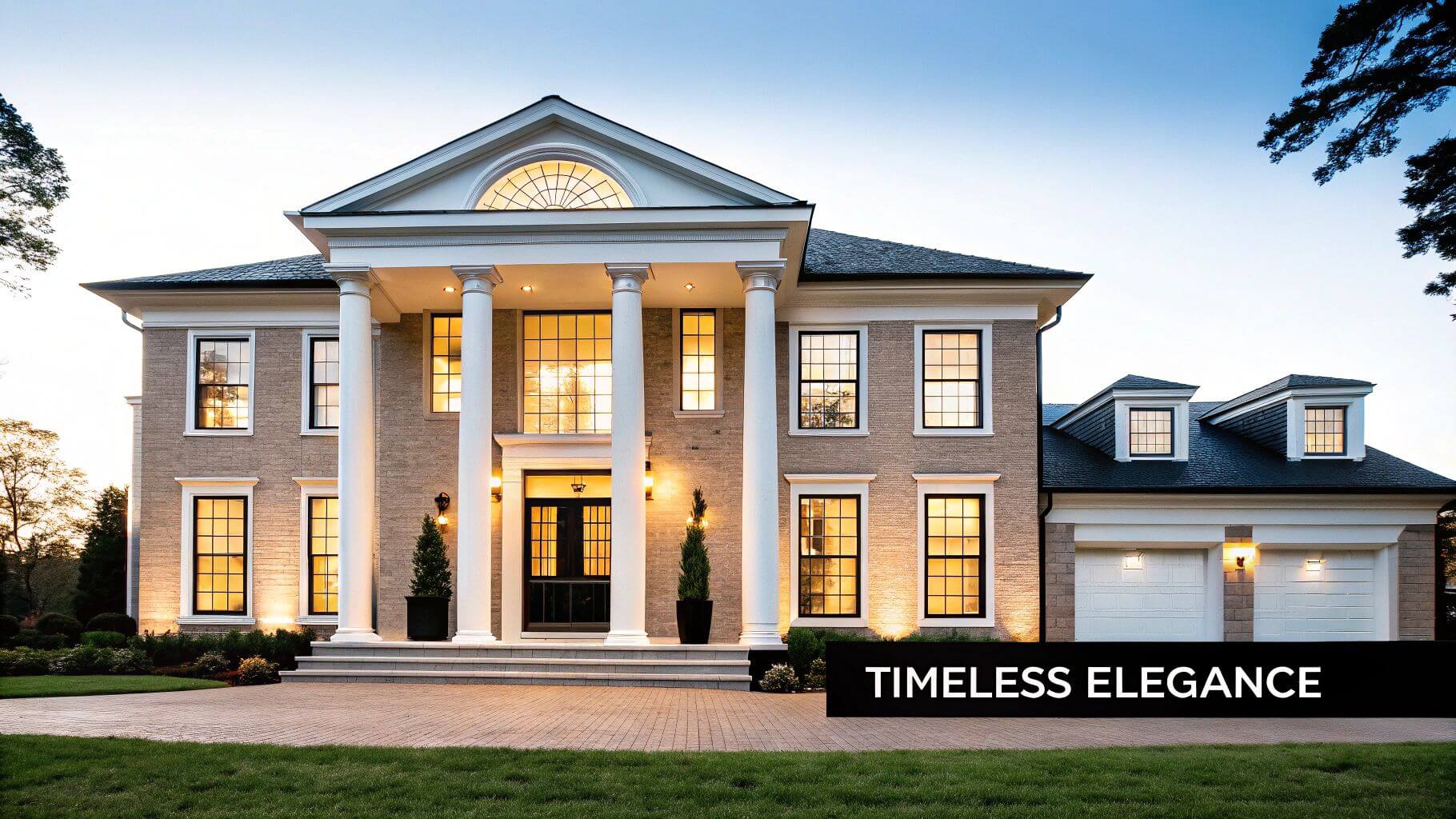
In a world filled with ever-changing design trends, what gives the modern Georgian style its remarkable staying power? The secret is in its perfect fusion of historical grace and present-day practicality. This architectural style is a bit like a masterfully restored classic car—it has the elegant, universally admired lines of a vintage model but is powered by a high-performance engine built for the modern world.
At its core, the style champions principles that simply never go out of fashion: balance, order, and a quiet confidence. It deliberately sidesteps fleeting trends, holding fast to a design that has proven its appeal for over 300 years. Every element, from the perfectly aligned windows to the stately central entrance, works in concert to create a sense of harmony and stability that is both deeply reassuring and visually stunning.
A Foundation in Classic Proportions
The real magic of modern Georgian architecture lies in its ability to honor a rich heritage while seamlessly adapting to new expectations. The goal isn’t to create a museum piece; it’s about using a classic, time-tested framework to build a home that is as livable as it is beautiful. This philosophy rests on several key pillars:
- Symmetry and Order: The unmistakable facade, with its balanced windows flanking a central doorway, provides an immediate sense of calm and predictability.
- Understated Elegance: Unlike more ornate styles, Georgian design relies on clean lines, simple forms, and high-quality materials rather than excessive decoration.
- Light and Functionality: Today’s interpretations prioritize large windows, open-plan interiors, and effortless indoor-outdoor connections—all essentials for modern family living.
A true modern Georgian style house isn’t just about replicating the past. It’s about thoughtfully reinterpreting classical principles to create a home that feels both grand and welcoming, formal yet comfortable—a space that serves the needs of a contemporary family with timeless style.
This delicate balance is precisely what makes the modern Georgian home so compelling. It provides a sophisticated backdrop that supports the realities of everyday life, from hosting elegant dinner parties to enjoying quiet family moments. Ultimately, the style promises not just a beautiful structure, but a sound investment in enduring design and quality craftsmanship that will hold its value and appeal for generations.
From 18th Century Grandeur to Contemporary Design
To really understand what makes a modern Georgian home so appealing, you have to look back at where it all started. The story kicks off in 18th-century Britain, a time of massive social and economic upheaval. During the Georgian era, which ran from 1714 to 1830, a new and ambitious merchant class was eager to show off its wealth.
Architecture was their language of choice. A house became more than just a place to live; it was a bold statement about order, prosperity, and refined taste. This shift in thinking set the stage for a new design philosophy—one that stepped away from the over-the-top ornamentation of the Baroque period and embraced harmony, symmetry, and classical elegance.
The movement drew heavily from the Italian Renaissance, especially the work of architect Andrea Palladio. Palladianism, with its deep respect for classical Roman and Greek principles of proportion, became the foundation for the Georgian style. It was a philosophy rooted in mathematical precision, resulting in facades that felt perfectly balanced and incredibly pleasing to the eye.
Spreading the Style Through Pattern Books
So, how did this sophisticated architectural style become so widespread and consistent? The credit largely goes to the rise of pattern books. Think of these as the 18th-century version of a style guide, packed with detailed engravings of floor plans, window designs, and decorative touches.
Influential architects like James Gibbs and William Kent published these books, which allowed builders in far-flung towns—and even across the ocean in the American colonies—to recreate the fashionable London look with surprising accuracy. It was a remarkably effective way to ensure the core tenets of Georgian design became the recognized standard for quality.
These books created a distinct visual language:
- The Symmetrical Façade: A central door, perfectly flanked by an equal number of windows on either side.
- Classical Details: Features like pediments above doorways, decorative cornices, and grand columns framing the entrance.
- The Sash Window: Multi-paned windows that slide up and down, giving the facade a clean, grid-like appearance.
The Georgian style wasn’t just about looks; it was a physical expression of Enlightenment ideals like logic, order, and reason. Its clean lines and balanced forms were seen as a mirror of a civilized, rational society—a world away from the drama of earlier architectural periods.
Reinterpreting Historical Constraints
While Georgian homes were famous for their grand exteriors, their interiors were sometimes shaped by some rather odd historical quirks. The notorious “window tax,” in place from 1696 to 1851, charged homeowners based on how many windows they had. Naturally, this led some builders to brick up windows to lower the tax bill, often leaving interiors darker than their impressive facades would suggest.
Interestingly, this old limitation has directly inspired a key feature of the modern Georgian home. While the classic, symmetrical window arrangement remains, today’s architects do the complete opposite: they maximize the glass to flood the interiors with natural light. The modern interpretation takes the best of the original architectural principles but adapts them with larger windows and bright, open spaces, a stark contrast to their historical counterparts. You can learn more about these shifts by exploring how British housing has changed over time on HousingDigital.co.uk.
This clever reinterpretation shows just how adaptable the style is. It honors its historical roots while turning a past limitation into a celebrated modern feature, proving that great design isn’t about blind imitation—it’s about thoughtful evolution.
The Architectural DNA of a Modern Georgian Home
To really get to the heart of what makes a modern Georgian home so captivating, you need to understand its architectural language. The exterior isn’t just a random assortment of features. It’s a meticulously composed design where every single element works together to create an atmosphere of harmony, order, and timeless grace. This design DNA is what sets it apart and gives it such an unmistakable presence on any street.
The absolute cornerstone of this style is facade symmetry. It’s non-negotiable. Picture drawing a line straight down the middle of the front door; in a true Georgian home, the left side is a near-perfect mirror image of the right. This creates an immediate, powerful sense of balance that feels both reassuring and deeply satisfying to the eye.
This dedication to balance informs every detail. Windows on one side are perfectly aligned with their counterparts on the other. Chimneys, dormers, and decorative flourishes are all placed with almost mathematical precision. This isn’t just a casual aesthetic choice; it’s the fundamental rule that governs the entire structure, guaranteeing a cohesive and orderly look from every angle.
The following infographic traces the evolution of Georgian design, showing how historical moments and influences have shaped the beautiful, light-filled homes we see today.
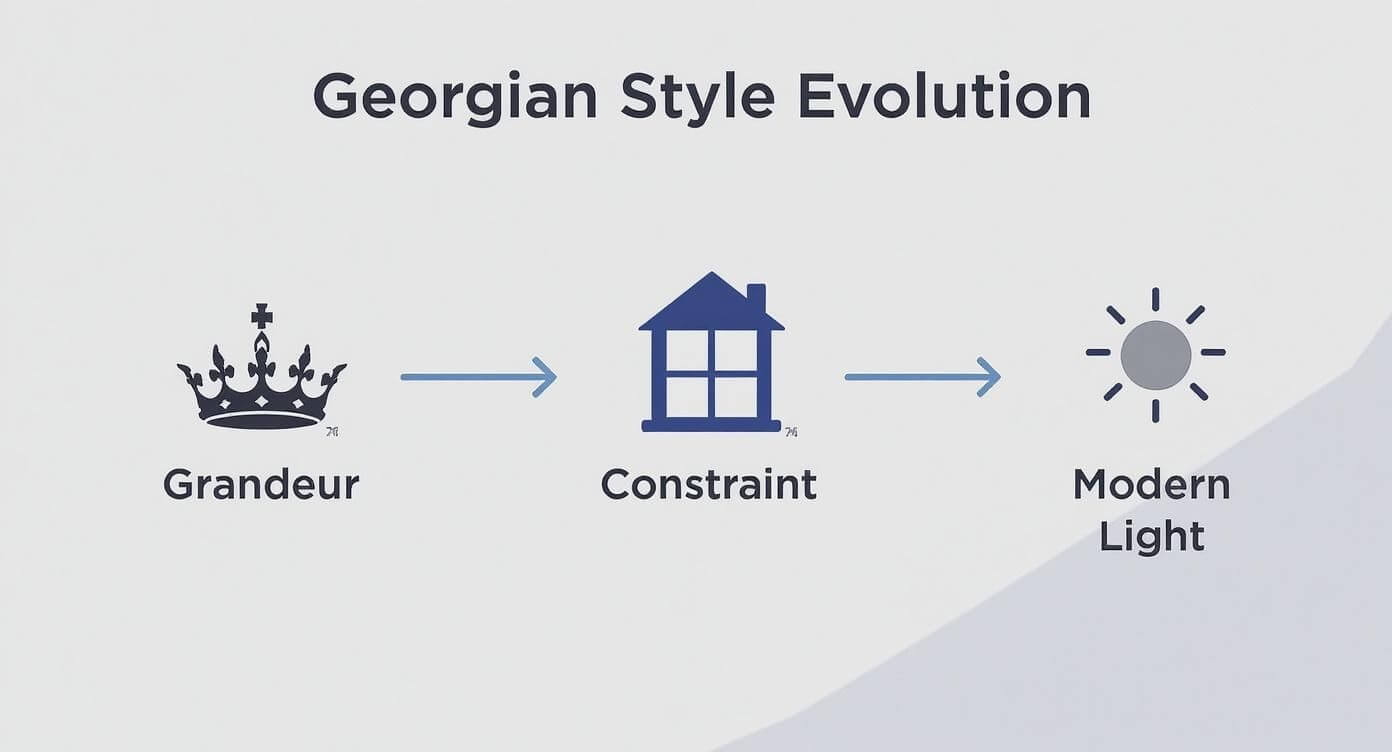
As you can see, the style has journeyed from grand formality, through periods constrained by things like the historic window tax, to arrive at its current, more open interpretation.
The Grand Entrance as a Focal Point
Every great story needs a compelling introduction, and in Georgian architecture, the grand central entryway plays that role perfectly. The front door is never just an afterthought. It’s the anchor of the entire facade, designed to command attention and set a formal, yet welcoming, tone for the entire property. Its central placement is absolutely critical for maintaining that all-important symmetry.
Modern Georgian homes often lean into this focal point by incorporating classical details that give a nod to their historical roots. Common flourishes include:
- Elaborate Surrounds: The door is often framed with decorative molding or substantial stonework to give it more visual weight.
- Columns or Pilasters: Adding columns (rounded supports) or pilasters (flattened, rectangular columns) on either side of the entrance adds a touch of classical grandeur.
- Pediments: A triangular or arched pediment placed above the door acts as a formal flourish, drawing the eye upward and reinforcing the home’s stately character.
This deliberate emphasis does more than just boost curb appeal. It creates a clear, intentional transition from the public exterior to the private interior, a vital element in thoughtful interior design and space planning.
Windows That Define Character
The windows are arguably one of the most defining features of a modern Georgian home. They aren’t just openings for light; they are essential components of the facade’s rhythmic, grid-like pattern. The most iconic style you’ll see is the multi-paned sash window, which slides vertically to open.
Traditionally, these windows had a “six-over-six” or even “nine-over-nine” pane configuration. While today’s versions often use single, large panes of glass with decorative grilles to mimic the look, the effect is the same. They create a clean, orderly pattern that reinforces the home’s symmetrical structure. The precise, repetitive placement of these windows is just as crucial as their design, establishing a pleasing rhythm across the entire facade.
The widespread adoption of these defining architectural principles, from balanced proportions to sash windows, was greatly accelerated by pattern books and engravings in the 19th and 20th centuries. This standardization allowed the style to flourish, and its influence remains prominent in premium new developments that pair classic aesthetics with modern amenities like high-performance double glazing.
Material Choices and Modern Interpretations
Classic Georgian homes were almost always built from brick or local stone, but their modern counterparts have a much broader material palette to draw from. The key is always to choose materials that convey a sense of quality and permanence. Still, how those materials are used often reflects contemporary tastes and technologies.
The table below shows how some traditional features have been reimagined in a modern context.
Traditional vs Modern Georgian Exterior Elements
| Architectural Element | Traditional Georgian Execution | Modern Georgian Interpretation |
|---|---|---|
| Facade Material | Red brick or locally sourced stone. | High-quality brick, stone, or smooth stucco finishes in lighter palettes like white or gray. |
| Windows | Single-glazed, timber sash windows with many small, individual panes of glass. | Double or triple-glazed high-performance windows, often with decorative grilles to simulate the multi-pane look. |
| Roofline | Simple, uncluttered hipped or gable roof with minimal overhang and paired chimneys. | Similar roof forms, but may incorporate modern elements like larger dormers or skylights for added interior light. |
By understanding these core components—the unwavering symmetry, the central entrance, the characteristic windows, and thoughtful material choices—you can clearly see the architectural DNA that makes the modern Georgian style an enduring symbol of elegance and order.
Crafting Interiors with Classic Grace and Modern Comfort
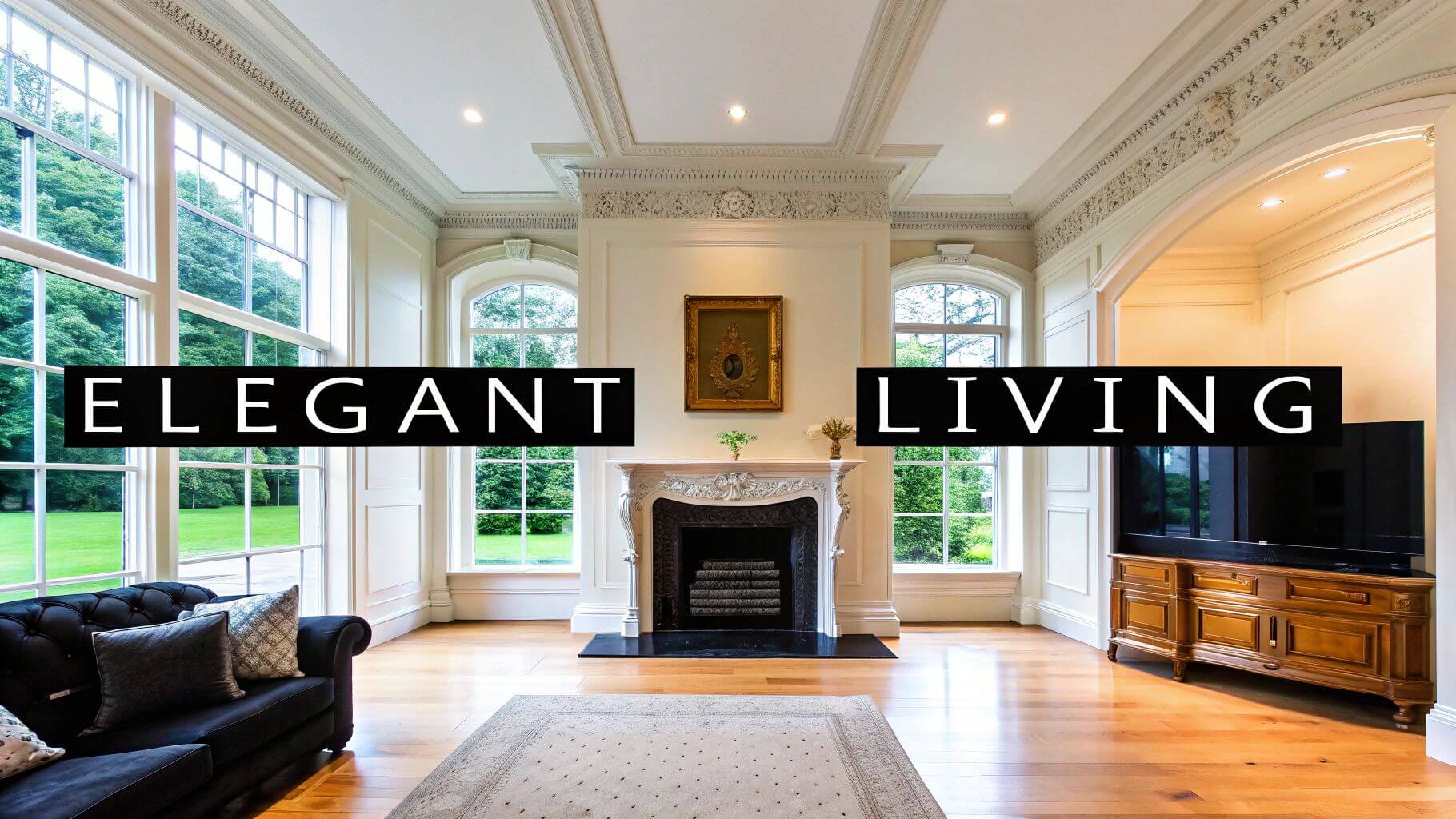
While the façade of a modern georgian style house speaks to formal order, the experience completely changes the moment you step inside. This is where classical grace and contemporary living truly connect. The interior design mirrors the exterior’s principles of proportion and symmetry but shifts the focus to creating spaces that are genuinely livable, not just beautiful to admire. It’s a nuanced art, translating historical grandeur into a backdrop for the realities of modern family life.
The first thing that hits you is a feeling of incredible airiness and light. That’s entirely by design. High ceilings, a signature of the original Georgian period, are used to create a palpable sense of volume. Ceilings reaching 10 to 12 feet are typical, making rooms feel far more expansive and open than their footprint might suggest.
This verticality isn’t just for show; it serves a crucial purpose. It makes way for taller windows, which pull in floods of natural light and beautifully illuminate the intricate details that give these interiors their soul.
Defining Spaces with Architectural Details
One of the most powerful tools in the Georgian interior playbook is the use of architectural details to build character. You can think of these elements as the “bones” of the room—they establish a framework of elegance long before a single piece of furniture is brought in.
- Intricate Moldings and Cornices: These aren’t just simple trims. The decorative work where walls meet the ceiling often features classical patterns, adding a layer of texture and sophistication that draws your eye upward and accentuates the room’s height.
- Dado and Picture Rails: A dado rail, usually set at chair height, once protected walls from furniture but now expertly breaks up tall wall spaces. Picture rails offer a smart, elegant solution for hanging art without leaving a mark.
- Detailed Architraves: The moldings framing doorways and windows are often substantial and beautifully milled, elevating a simple opening into a formal architectural statement.
These features aren’t just tacked on; they’re woven into the design’s very fabric, lending a sense of history and craftsmanship that many starkly contemporary homes lack.
Another anchor of the Georgian interior is the stately fireplace. Historically, it was the home’s heart and heat source. Today, it serves as an undeniable focal point. Even when unlit, its grand mantelpiece and surround ground the room’s design, creating a natural gathering spot and a central axis for arranging furniture.
Blending Formality with Modern Flow
Perhaps the most impressive feat of the modern Georgian style is how it solves the puzzle of historical floor plans versus today’s preference for open, connected living. Traditional Georgian homes were cellular by nature, composed of a series of distinct, formal rooms, each with a single purpose.
The genius of the modern interpretation is the hybrid floor plan. It often preserves the formal living and dining rooms at the front of the house for entertaining, while seamlessly transitioning to a large, open-plan family area at the rear, combining the kitchen, casual dining, and a comfortable living space.
This approach truly offers the best of both worlds. You get the formal elegance the style is known for, but you also get the relaxed, informal atmosphere where modern families actually live. The shift between these zones is often handled with wide archways or cased openings, which maintain architectural definition without killing the flow. Digging into an essential interior design style guide can provide even more ideas on striking this perfect balance.
This thoughtful fusion of old and new is what modern Georgian interiors are all about. It’s a style that honors its classical roots while fully embracing the comforts of contemporary life. The result is a home that feels both timeless and perfectly attuned to the here and now—sophisticated enough for a dinner party, yet comfortable enough for a quiet Tuesday night in.
The Georgian Style Goes Global
While Georgian architecture is quintessentially British, its orderly elegance was a design language that was simply too good to keep at home. The core principles of symmetry, classical grace, and understated balance resonated deeply across the world, but nowhere more so than in the American colonies.
Across the Atlantic, adopting the Georgian style wasn’t just a matter of taste—it was a statement. For a rising class of merchants and landowners, building a Georgian home was a way to signal prosperity, sophistication, and a direct connection to the refined culture of Europe. It was a visual declaration of having arrived.
Of course, the style didn’t just get copied and pasted. As it crossed the ocean, it was cleverly adapted. Colonial builders took the fundamental blueprint but began interpreting it with local materials and regional craftsmanship. The iconic brick townhouses of London, for instance, became the inspiration for the grand, stately homes that soon defined the streetscapes of Boston, Philadelphia, and Charleston.
This American embrace of Georgian design did more than just dot the landscape with beautiful buildings. It laid the foundation for a new, distinctly American architectural identity, one built on order and structure in a society busy building a new world.
A New Nation, A New Style: The American Federal Evolution
After the American Revolution, the Georgian style didn’t disappear; it evolved. It matured into what we now know as the Federal style, which flourished from roughly 1780 to 1830. You can think of it as Georgian architecture with a patriotic, neoclassical flourish.
The Federal style kept the strict symmetry and balanced proportions that made its predecessor so appealing, but it began to incorporate finer, more delicate details that felt uniquely American.
Key American adaptations included:
- Elliptical Fanlights: Those graceful, semi-circular windows above the front door became a signature feature, adding a touch of airy elegance to an otherwise formal entrance.
- Slender Columns: The robust, sometimes heavy-handed columns of early Georgian design were replaced with more slender, refined supports that felt lighter and more sophisticated.
- Patriotic Motifs: In a nod to the new nation, decorative elements like eagles and stars were often subtly woven into moldings, fireplace surrounds, and other interior details.
This transition shows just how flexible the Georgian framework really is. It provided a strong, classical foundation that could be thoughtfully customized to reflect the identity and aspirations of a brand-new country.
A Lasting Legacy in Today’s American Homes
The deep influence of Georgian architecture on American home design isn’t just a historical curiosity—it’s a living legacy that continues to shape our neighborhoods. Its principles have proven to be incredibly timeless, offering a powerful antidote to fleeting design trends.
The Georgian architectural style has left a lasting mark in the United States since the 1700s, especially within the original 13 colonies. Adapted from English classical architecture, its symmetrical facades and centered entrances remain influential in modern housing, with developers favoring its orderly features for contemporary apartments and townhomes.
This legacy goes far beyond preserving historic homes; it’s about the style’s remarkable ability to adapt. You can see just how well these classic Georgian designs remain relevant on Houzz.com and in communities all over the country. From the historic districts of New England to the grand estates of the South, the style’s DNA is everywhere you look.
Even today, developers behind luxury suburban communities and upscale townhomes consistently return to Georgian principles. The reason is simple: the style’s inherent symmetry and grand proportions project an immediate sense of stability, quality, and enduring appeal that buyers instinctively trust and value. This incredible journey, from 18th-century Britain to 21st-century America, proves that Georgian architecture is a truly universal language of elegant and orderly design.
Bringing Timeless Design into Your Own Home
Throughout this guide, we’ve walked through how the modern Georgian style house so brilliantly marries classical principles with the way we live today. It’s an architectural language founded on symmetry, elegant proportions, and a real commitment to craftsmanship—qualities that bring a powerful sense of order and grace to our often-chaotic world.
Choosing this style is about more than just aesthetics; it’s a true investment in design that lasts. While fleeting trends come and go, the core ideas of Georgian architecture have proven their staying power for centuries. This kind of longevity means your home won’t just feel current today, but will remain a point of pride and hold its value for generations.
Making the Style Your Own
Whether you’re planning a new build from scratch or hoping to bring a touch of Georgian elegance to your current home, the core strategy is the same: get the fundamentals right.
- Emphasize Symmetry: Build your design around a strong central point—a grand front door, a statement fireplace—and let everything else flow from it in perfect balance.
- Prioritize Quality Materials: Stick with honest, substantial materials like brick, natural stone, and beautiful millwork. These choices communicate permanence and quality.
- Invest in Details: The real magic is in the details. Pay close attention to the scale of moldings, the proportions of the windows, and the architectural trim. These are the elements that give a home its authentic character.
Embracing the modern Georgian style means choosing a path of timeless beauty over temporary fads. It’s about creating a home that is not only visually stunning but also functional, livable, and built to last—a true sanctuary that will stand the test of time.
Bringing such a distinct vision to life demands a deep understanding of architectural history and an exceptional eye for detail. This is where professional expertise becomes non-negotiable. To make sure your project hits that perfect note between historical accuracy and modern comfort, finding the right team is everything.
For more on taking this crucial first step, you can learn how to find an architect who can help translate your dream into a beautifully built reality. In the end, this journey is about creating a legacy home, one firmly rooted in the elegance of classic design.
Frequently Asked Questions
Thinking about building a modern Georgian home? It’s a big decision, and naturally, you’ll have questions. Let’s dig into some of the most common things people wonder about before they commit to this elegant style, from what it costs to how it fits into today’s lifestyle.
Are Modern Georgian Style Houses Expensive to Build?
There’s no sugarcoating it: a modern Georgian home usually costs more upfront than a standard new build. Why? It comes down to the style’s signature features—high-quality materials like solid brick or stone and the meticulous craftsmanship needed for things like custom moldings and impressive entryways.
But it’s crucial to see this as a long-term investment. The costs can vary wildly based on the home’s size, your location, and the specific finishes you choose. The enduring appeal and rock-solid construction of Georgian architecture mean these homes often hold their value exceptionally well, making that initial expense a smart move for the future.
Can a Modern Georgian House Be Energy Efficient?
Absolutely. This isn’t your great-great-great-grandmother’s drafty manor house. Modern Georgian homes are built with today’s energy standards firmly in mind, blending that classic look with high-tech performance.
You get the best of both worlds by integrating modern building science:
- High-Performance Windows: We’re talking double or even triple-glazed sash windows that look the part but stop heat loss in its tracks.
- Superior Insulation: The walls and roof are packed with advanced insulation, creating a sealed, comfortable interior.
- Modern HVAC Systems: State-of-the-art heating, ventilation, and air conditioning are non-negotiable, keeping your home comfortable no matter the season.
The real art of a modern Georgian home is how it marries timeless beauty with top-tier energy performance. It’s living proof that you never have to choose between style and sustainability.
Does Georgian Design Work with Open-Plan Living?
Yes, and this is where the modern interpretation truly shines. Historically, Georgian homes were a maze of separate, formal rooms. Today’s architects have brilliantly adapted the style for how we actually live.
A popular approach is to create a hybrid layout. You might keep the formal living and dining rooms at the front of the house to maintain that classic, stately feel. But as you move toward the back, the space opens up into a large, light-filled kitchen and family area. It’s the perfect blend—formal elegance where you want it, and relaxed, connected living where you need it.
At Haute Design, we introduce discerning clients to the top-tier architects and designers who can bring a modern Georgian style house to life. Discover premier professionals on the Haute Design network and start planning the home you’ve always envisioned.