


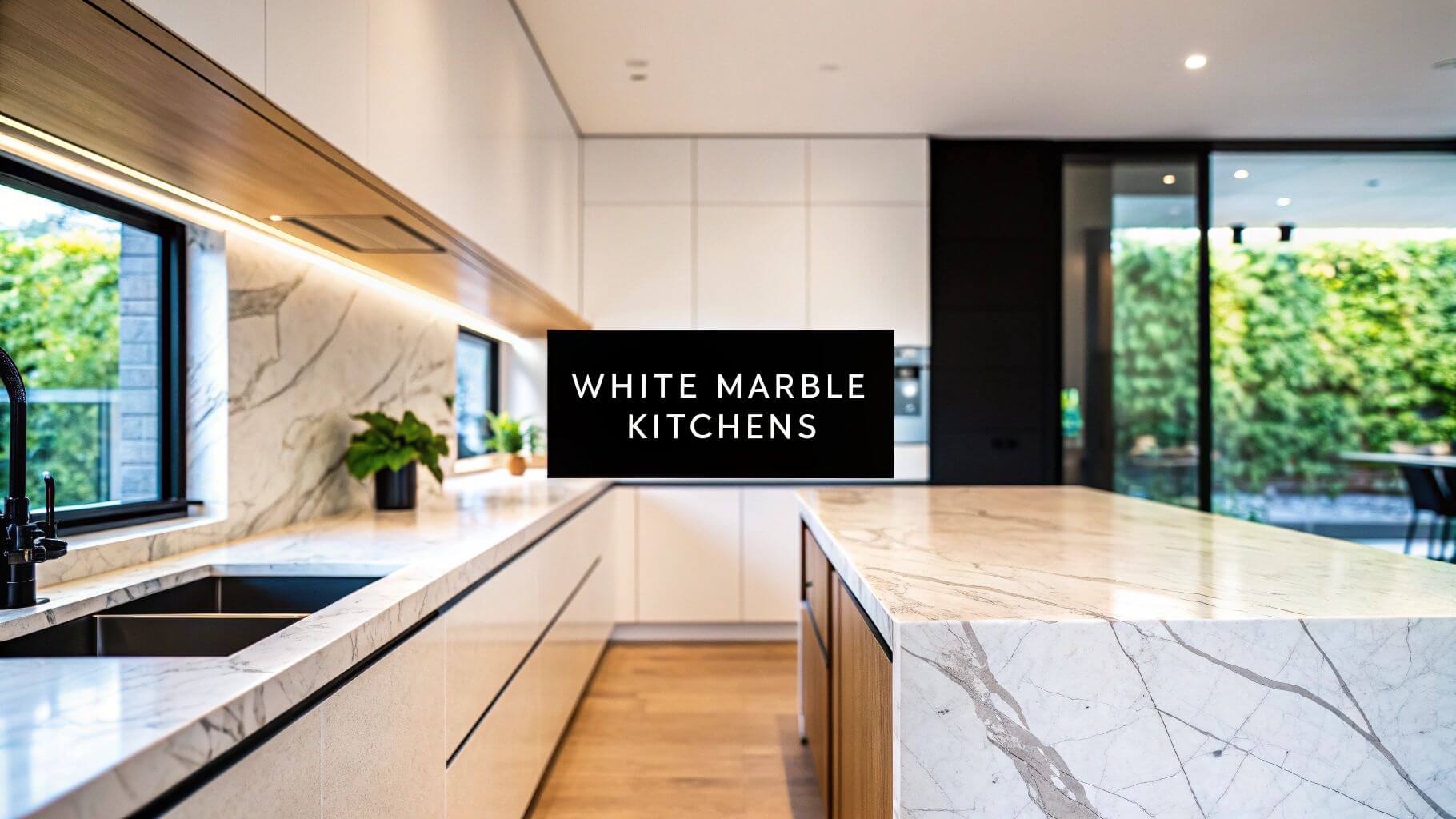
White kitchens with marble countertops represent the pinnacle of timeless design, effortlessly blending clean, bright aesthetics with the luxurious, organic beauty of natural stone. This combination has remained a favorite among top interior designers and discerning homeowners for decades, offering a versatile canvas that adapts to styles ranging from classic traditional to sleek modern.
However, achieving this iconic look requires more than just pairing white cabinets with a marble slab. It involves a strategic understanding of marble varieties, maintenance requirements, and innovative design applications. The success of a truly stunning white kitchen with marble lies in the deliberate execution of details, from the edge profile of the countertop to the veining direction on a backsplash.
In this comprehensive guide, we will deconstruct six distinct approaches to designing white kitchens with marble. We’ll move beyond simple inspiration, providing deep strategic analysis, actionable takeaways, and behind-the-scenes insights to help you replicate these high-end looks with confidence and precision. Whether you’re planning a full renovation or seeking to elevate your current space, these examples, curated for the discerning eye, will equip you with the knowledge to make informed, impactful design decisions.
1. Classic All-White Kitchen with Carrara Marble Countertops
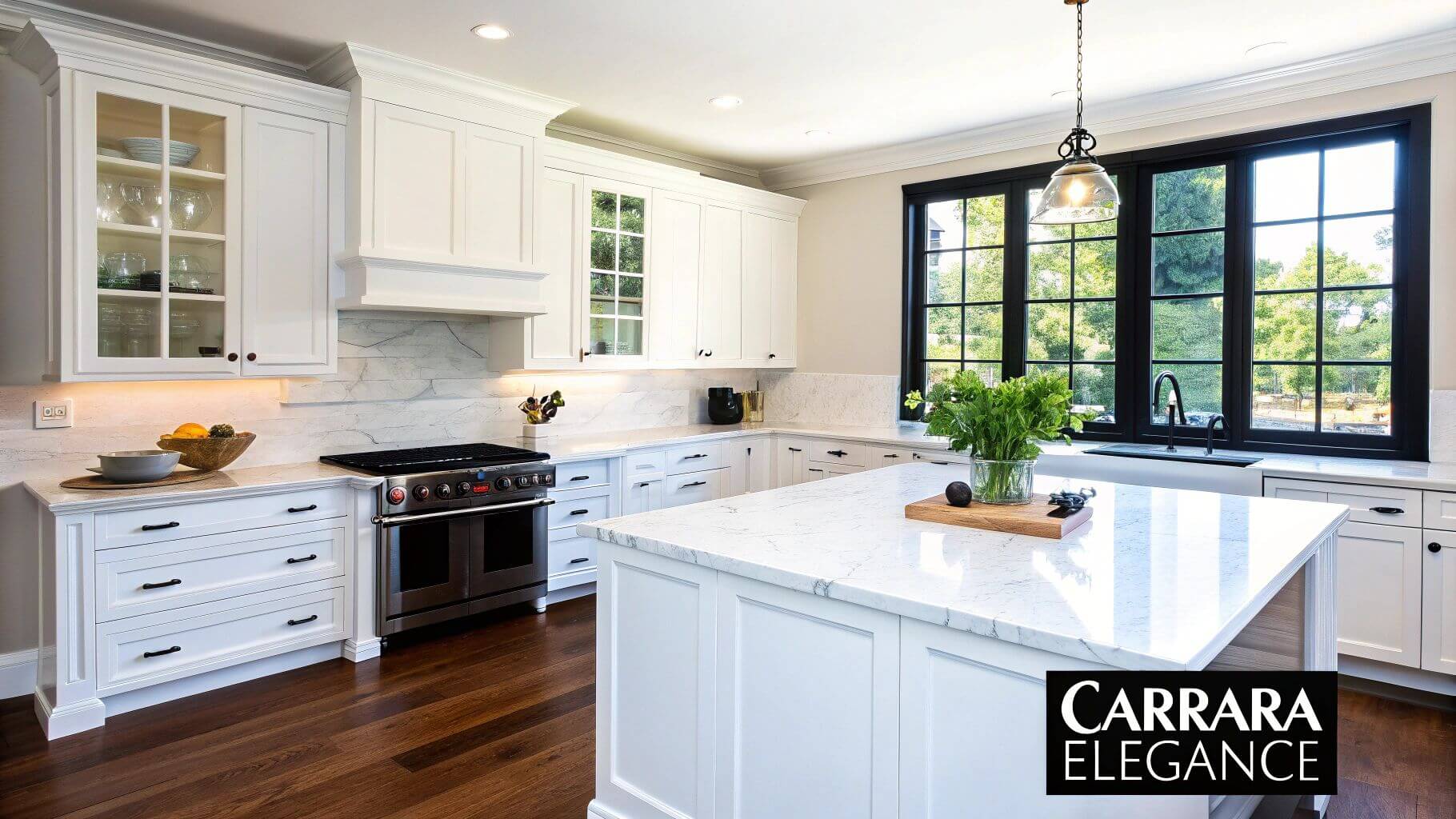
The quintessential all-white kitchen paired with classic Carrara marble countertops represents a gold standard in kitchen design. This timeless aesthetic combines the clean, expansive feel of white cabinetry with the subtle, organic beauty of Italian marble. The result is a bright, airy, and sophisticated space that serves as a versatile foundation for both traditional and contemporary styles.
This approach centers on creating a cohesive, luminous environment where the natural stone is the star. Carrara marble, known for its soft, feathery grey veining against a milky white background, introduces texture and visual depth without overwhelming the serene palette. This specific combination is a cornerstone of luxury design, famously featured in the cinematic kitchens of Nancy Meyers films and refined by designers like Studio McGee.
Strategic Analysis: Why This Combination Endures
The enduring appeal of this design lies in its balance of elegance and simplicity. White cabinetry acts as a blank canvas, maximizing light reflection and making the space feel larger. The Carrara marble then elevates this canvas from basic to bespoke, infusing it with a sense of history and luxury that manufactured materials struggle to replicate.
Key Insight: This design succeeds because it doesn’t chase fleeting trends. Instead, it relies on high-quality, natural materials and a classic color scheme that has proven its longevity for generations. It is an investment in timeless appeal over momentary style.
Actionable Takeaways & Implementation
Achieving this look requires meticulous material selection and an understanding of marble’s unique characteristics. While stunning, Carrara is a porous stone susceptible to staining and etching. This “lived-in” quality, or patina, is often embraced by design purists.
- Material Focus: Specify authentic Carrara marble and inspect the slab in person. Veining can vary dramatically, from soft and subtle to more pronounced.
- Finish Choice: Consider a honed finish over a polished one. A honed, or matte, surface is less reflective, which helps to conceal minor scratches and etching from acidic substances like lemon juice or wine.
- Maintenance Protocol: A strict maintenance schedule is non-negotiable for preserving the stone’s integrity.
- Sealant is crucial: Apply a high-quality impregnating sealer upon installation and re-seal every 6-12 months.
- Immediate Cleanup: Wipe up all spills instantly, especially oils and acids.
- Use pH-neutral cleaners: Avoid harsh, acidic, or abrasive cleaning products.
- Protect the Surface: Always use cutting boards, coasters, and trivets for hot pans to prevent thermal shock.
This classic approach is best for homeowners who appreciate natural materials and are willing to embrace the elegant patina that develops over time, viewing it as part of the kitchen’s evolving story.
2. White Kitchen with Marble Waterfall Island
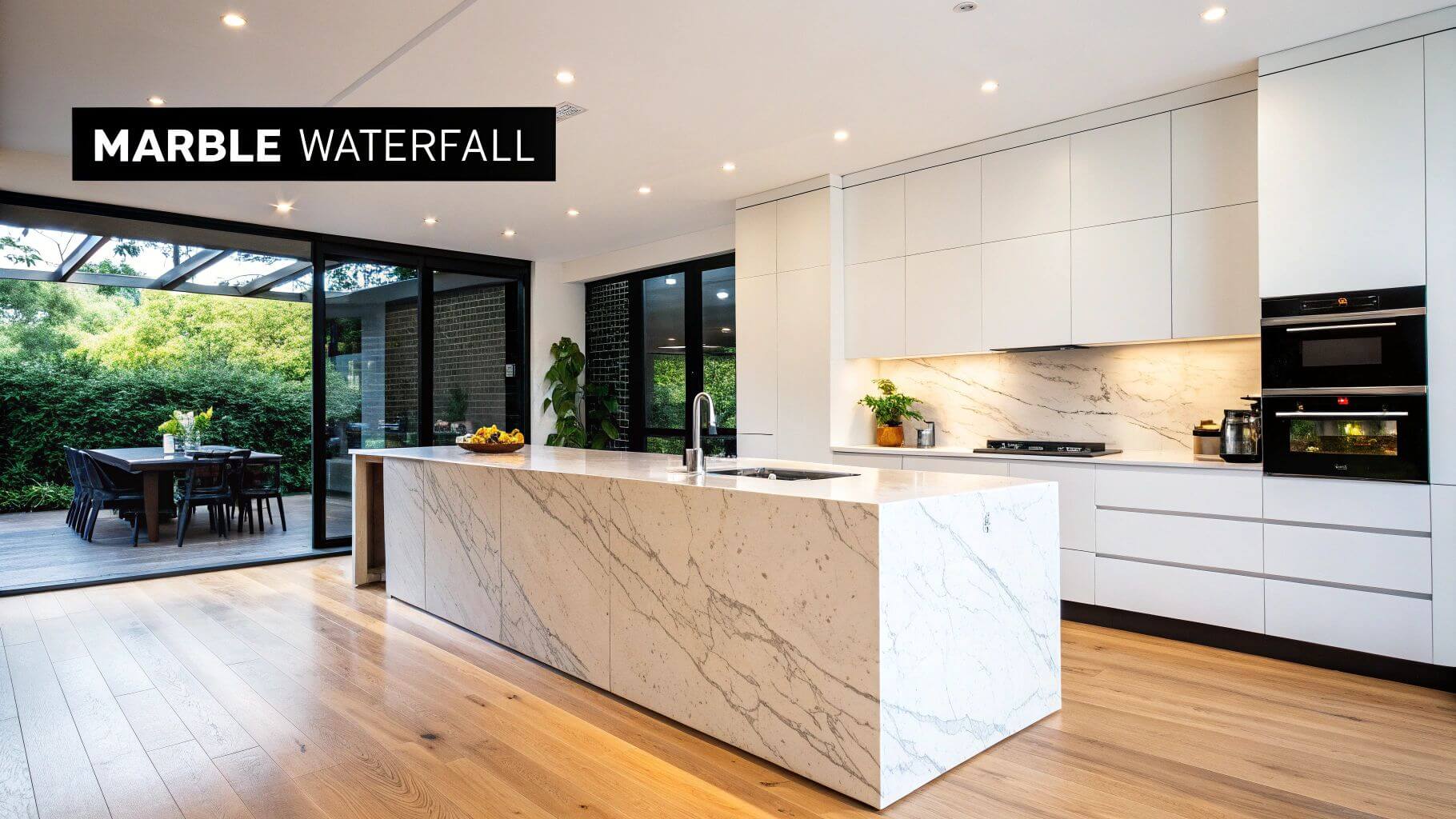
The white kitchen with a marble waterfall island is a bold, sculptural statement that transforms a functional element into a stunning centerpiece. This design features a continuous slab of marble that flows from the countertop surface vertically down the sides to the floor, creating a seamless and dramatic “waterfall” effect. It elevates the kitchen island from a mere workspace to a piece of high-design furniture, anchoring the room with architectural gravamen.
This contemporary approach is favored in high-end residential and commercial projects, often seen in luxury condominiums and the homes of design-forward clients like the Kardashian-Jenner family. Designers like Kelly Wearstler and Martyn Lawrence Bullard have popularized this look, using dramatic, book-matched marble slabs to create a perfectly symmetrical, mirror-image veining pattern that reads as a singular piece of natural art within the clean lines of a white kitchen.
Strategic Analysis: Why This Combination Endures
The power of this design lies in its fusion of minimalism and maximalism. The clean, uninterrupted lines of the waterfall edge align with minimalist principles, while the choice of a boldly veined marble slab introduces a maximalist, luxurious pattern. This contrast creates a dynamic tension that is both sophisticated and visually arresting, making it a focal point that defines the entire space.
Key Insight: This design succeeds by treating the island as a monolithic sculpture. By wrapping the vertical surfaces in the same premium material as the top, it communicates an investment in artistry and precision craftsmanship, moving beyond pure utility into the realm of architectural expression.
Actionable Takeaways & Implementation
Executing a marble waterfall island requires meticulous planning and a significant budget, as it uses substantially more stone than a standard island. Precision from the fabricator is paramount to achieving a flawless look, especially at the seams.
- Material Focus: Select a marble with dramatic, large-scale veining, such as Calacatta or Statuario. Subtle patterns get lost in the vertical application and do not justify the added cost and complexity.
- Fabrication Choice: Insist on a mitered edge where the top and side slabs meet. This 45-degree angle cut creates a nearly invisible seam, making the slab appear as one continuous, folded piece of stone.
- Planning Protocol: Address practical considerations well before installation.
- Approve the Layout: Photograph your chosen slabs and approve the book-matching layout with your fabricator before any cuts are made.
- Plan Electrical Outlets: Integrate outlets discreetly into the side panels or relocate them to the floor to avoid disrupting the clean surface.
- Protect the Sides: Use felt or silicone pads on the legs of bar stools to prevent scratching or chipping the vertical marble faces.
This high-impact design is ideal for homeowners seeking to create a show-stopping focal point in an open-concept living area. You can find more inspiration by exploring other examples of luxury kitchen islands on hauteliving.com.
3. White Kitchen with Marble Slab Backsplash
This design elevates the traditional backsplash by using full-height marble slabs instead of tile, creating an uninterrupted expanse of natural stone. Extending from countertop to the upper cabinets or ceiling, this technique showcases the marble’s veining in its full, dramatic glory, unhindered by grout lines. Paired with minimalist white cabinetry, this approach creates a gallery-like backdrop that transforms the kitchen into a sophisticated space where the marble becomes living artwork.
This bold statement is a hallmark of high-end design, famously executed in the luxurious penthouses of 432 Park Avenue in New York City and by designers like Kelly Hoppen and Jean-Louis Deniot. The large-format application allows the stone’s inherent pattern to flow continuously, turning a functional wall surface into the kitchen’s primary focal point and a powerful expression of natural artistry.
To provide a quick reference on the key considerations for this design, the following infographic summarizes crucial data points.
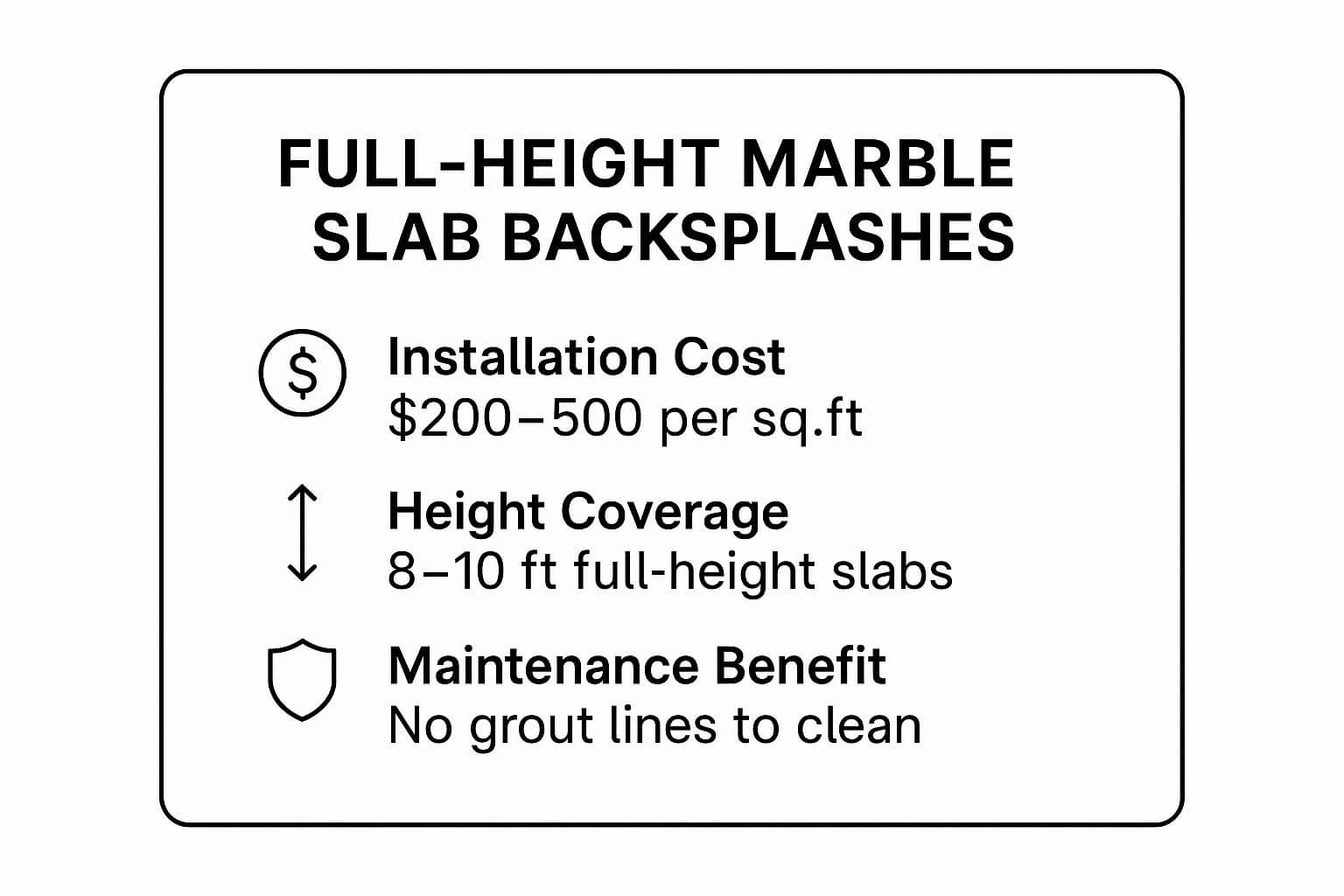
This data highlights the significant investment required for slab installation and the primary maintenance advantage: the complete elimination of grout cleaning.
Strategic Analysis: Why This Combination Endures
The power of this design lies in its dramatic scale and seamless luxury. By eliminating grout joints, the slab backsplash presents the marble as an uninterrupted canvas, maximizing its visual impact. This approach merges the functionality of a backsplash with the aesthetic gravitas of a large-scale art installation, creating a look that is both clean-lined and opulently organic.
Key Insight: The slab backsplash succeeds by treating the marble not just as a surface material, but as a central architectural feature. It’s a commitment to minimalism in form but maximalism in material expression, ideal for white kitchens with marble where the stone’s beauty is paramount.
Actionable Takeaways & Implementation
Executing a full-height slab backsplash requires precision planning far beyond that of a standard tile job. The process is less forgiving of errors and demands careful coordination from the outset. For a deeper dive into this trend, you can learn more about luxury kitchen backsplash design options available.
- Material Focus: Select slabs in person and use digital templating to plan how the veining will flow across the wall and meet the countertop. Book-matching, where two adjoining surfaces mirror each other, is a popular technique for a symmetrical, high-impact effect.
- Planning is Paramount: All electrical outlets, light switches, and plumbing locations must be finalized before the slab is fabricated. Cutting into the marble on-site is risky and can compromise the stone’s integrity.
- Installation Details:
- Reinforcement: Ensure the wall structure can support the substantial weight of a full marble slab.
- Minimalism is Key: Keep upper cabinetry minimal, or opt for open shelving, to avoid obscuring the marble feature.
- Seams and Sealant: Use clear silicone for any necessary seams to make them virtually invisible. Apply a high-quality penetrating sealer specifically formulated for vertical applications to protect against splashes.
- Ventilation: Install a powerful and effective ventilation hood to minimize direct exposure to cooking oils and splatters, which can stain the stone over time.
This approach is best suited for homeowners aiming for a definitive luxury statement, who value the monumental beauty of natural stone and are prepared for the associated investment and planning diligence.
4. White Kitchen with Mixed Marble Patterns
The sophisticated design approach combines two or three marble varieties within a crisp white kitchen to create layered visual interest. Subtle Carrara marble graces perimeter counters while a bold Calacatta Gold slab anchors the island. Coordinating marble backsplashes or full-height risers further enrich the palette with varied veining.
This layered marble strategy preserves the serene white-on-white canvas while introducing depth, movement, and luxury. It shines in Greenwich Village townhouses featured in the New York Times Real Estate section and Soho House members’ club kitchens. Celebrity chef Tyler Florence’s San Francisco project and House Beautiful’s “Kitchen of the Year” winners underscore its versatility.
Strategic Analysis: Why This Combination Works
Mixing marble patterns allows homeowners to designate specific visual roles for each stone. A quieter Carrara backdrop supports a dramatic Calacatta Gold island, creating a clear design hierarchy.
By assigning each variety a distinct function—background, mid-tone, or statement—you avoid visual overload while maximizing contrast. This intentional layering transforms the kitchen into a gallery of natural stone.
Key Insight: Effective mixed-marble kitchens balance restraint and drama by limiting varieties to two or three and assigning them clear functions—background, mid-tone, and statement.
Actionable Takeaways & Implementation
- Material Variety: Stick to 2–3 marble types to maintain harmony
- Focal Emphasis: Reserve your most dramatic veining for islands or range backsplashes
- Undertone Matching: Verify that all stones share compatible undertones (cool grey or warm beige)
- Sample Staging: Bring large-format stone samples home and view them together under various lighting
- Durability Strategy: Use real marble in low-traffic areas and high-quality porcelain alternatives on heavily used counters
- Designer Collaboration: Engage an interior designer or stone consultant for professional pattern mixing
- Proportion Control: Apply the 60–30–10 rule—60% subtle marble, 30% medium veining, 10% dramatic focal slabs
This mixed-marble approach is ideal for homeowners who value curated, museum-quality interiors. It marries grand aesthetics with personalized stone investments for a truly bespoke white kitchen with marble.
5. Modern White Kitchen with Marble-Look Porcelain
For homeowners who covet the luxurious aesthetic of a white marble kitchen but prioritize practicality and durability, this modern interpretation is the ideal solution. It leverages advanced engineered surfaces, like porcelain or quartz, that convincingly replicate the appearance of natural marble without the inherent maintenance challenges. The result is a stunning fusion of timeless beauty and cutting-edge material science.
This approach uses large-format slabs with sophisticated, digitally printed veining that masterfully mimics sought-after stones like Calacatta or Statuario. When paired with crisp white cabinetry, these surfaces deliver the coveted high-end look while offering superior stain resistance, scratch resilience, and non-porous properties. This makes the design perfect for busy households and high-use areas, a strategy often seen in luxury new construction and popular renovation shows like Property Brothers.
Strategic Analysis: Why This Alternative Succeeds
The success of this combination lies in its ability to democratize luxury without compromising on performance. It removes the primary barrier to entry for many homeowners considering marble: the fear of damage and the burden of constant upkeep. By engineering out the vulnerabilities of natural stone, manufacturers like Cosentino (Dekton) and Caesarstone have created a product that offers aesthetic perfection alongside everyday peace of mind.
Key Insight: This design succeeds by separating the visual appeal of marble from its geological weaknesses. It delivers the desired high-end aesthetic while aligning with a modern lifestyle that values both beauty and low-maintenance functionality.
Actionable Takeaways & Implementation
Achieving a convincing marble look with engineered materials depends entirely on selecting a high-quality product and paying close attention to fabrication details. The goal is to avoid an artificial, repetitive appearance that can betray the material’s origins.
- Material Focus: Prioritize premium brands known for realistic veining and through-body color, which means the pattern runs through the entire slab, not just on the surface.
- Slab Viewing: Always view a full-size slab before purchasing. Small samples cannot convey the overall pattern flow or the potential for repetition in the veining.
- Maintenance Protocol: While exceptionally durable, these surfaces are not indestructible.
- Verify Heat Resistance: Confirm the product’s specific heat tolerance; some are more resistant than others. Always use trivets as a best practice.
- Use Proper Cleaners: Clean with mild soap and water or a manufacturer-recommended pH-neutral cleaner. Avoid abrasive pads or harsh chemicals.
- Protect Your Knives: Although the surface is scratch-resistant, cutting directly on it will dull your knives. Always use a cutting board.
This modern approach is the best choice for those seeking the quintessential white marble kitchen aesthetic but require a surface that can withstand the rigors of daily life without demanding meticulous care.
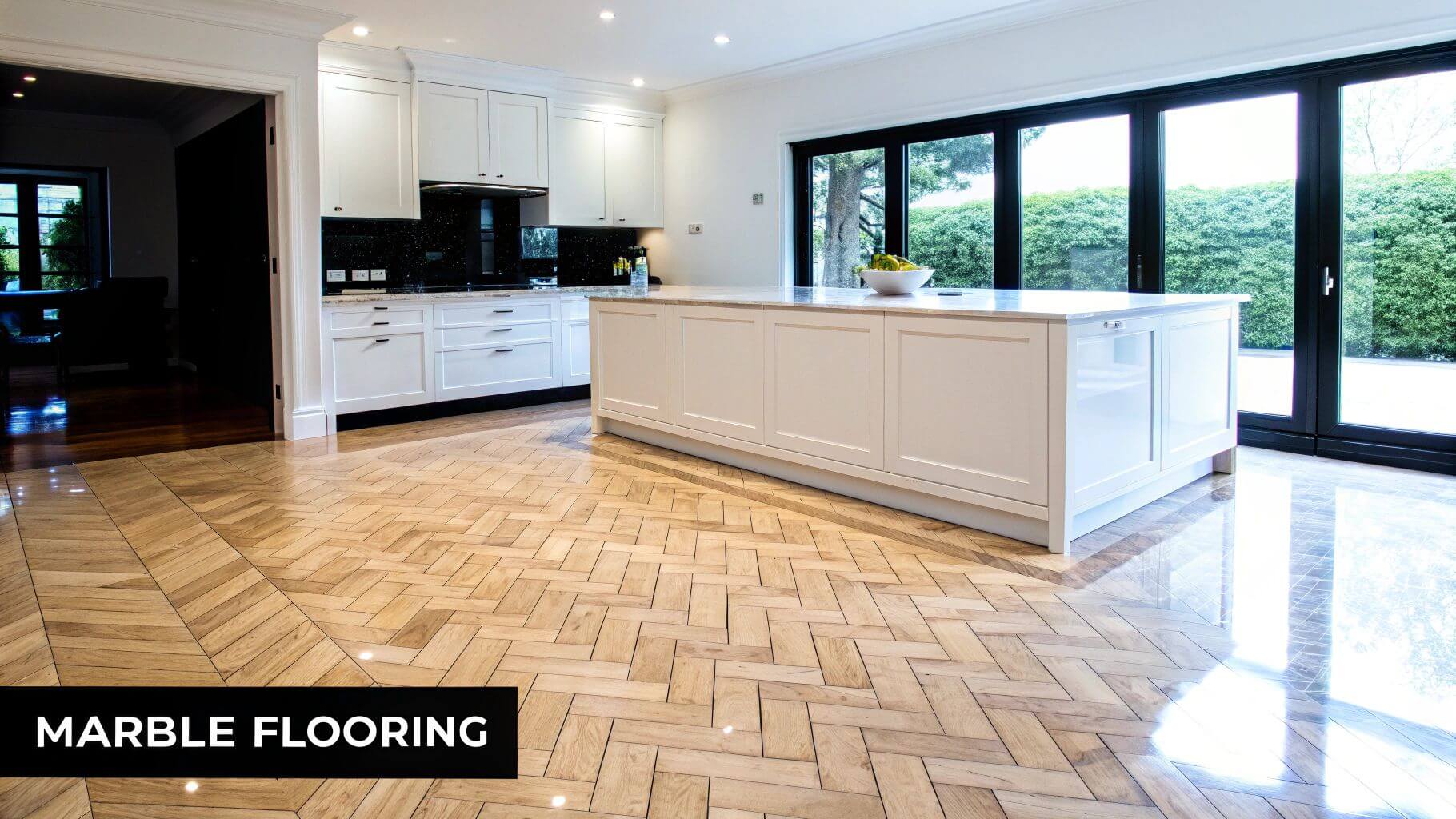
6. White Kitchen with Marble Flooring
While countertops and backsplashes command significant attention, this design strategy grounds the entire kitchen in opulence by featuring marble underfoot. A white kitchen with marble flooring creates a seamless, light-filled environment that feels both expansive and supremely luxurious. This approach elevates the floor from a functional surface to a primary design statement, establishing a sophisticated foundation that enhances every other element in the room.
The use of marble flooring hearkens back to the grand halls of European palaces and historic villas, bringing a sense of timeless grandeur into a modern residential setting. Options range from classic Carrara or Calacatta tiles laid in elegant patterns like herringbone or checkerboard, to large-format slabs that minimize grout lines for a monolithic look. This design choice is a hallmark of high-end projects by renowned suppliers like Ann Sacks and Walker Zanger, who specialize in premium stone applications.
Strategic Analysis: Why This Combination Endures
The strength of this design lies in its ability to create an all-encompassing luxury experience. White cabinetry and walls maximize light, while the marble floor provides a continuous, reflective surface that enhances the room’s brightness and scale. Unlike other flooring materials, marble introduces natural veining and subtle tonal variations that prevent the all-white scheme from feeling sterile, adding organic texture and visual depth.
Key Insight: This design succeeds by treating the floor as the “fifth wall.” It establishes a cohesive and high-impact visual that unifies the space, making it feel custom-built and architecturally integrated rather than decorated. It is a commitment to a foundational material that defines the room’s character.
Actionable Takeaways & Implementation
Implementing marble flooring requires careful planning and an understanding of its practical demands. As a natural stone, it requires sealing and specific care, but its beauty and durability make it a worthy investment for a statement kitchen. Proper subfloor preparation is also a critical step in any successful home renovation. Learn more about how to plan home renovation for success on hauteliving.com.
- Material Focus: Select a finish that balances aesthetics with safety. A honed or brushed finish offers better slip resistance than a polished one, which is crucial in a kitchen environment.
- Comfort and Maintenance: Consider installing radiant in-floor heating. This not only adds luxurious comfort underfoot but also helps water evaporate more quickly, keeping the surface dry.
- Installation Precision: Use larger tiles (e.g., 12×24 or 24×24) to reduce the number of grout lines, creating a more seamless and easier-to-clean surface. Ensure the subfloor is perfectly level to prevent cracking.
- Maintenance Protocol: Protect your investment with a strict care regimen.
- Seal tile and grout: Use a high-quality penetrating sealer upon installation and reapply as recommended by the manufacturer.
- Daily care: Sweep or vacuum regularly to remove grit that can scratch the surface.
- Gentle cleaning: Only use pH-neutral, non-acidic cleaners specifically formulated for stone.
- Protective measures: Place high-quality, absorbent mats in front of the sink and stove to catch spills and provide cushioning.
This approach is ideal for homeowners aiming for a truly high-end, unified aesthetic and who are prepared for the requisite maintenance to preserve the stone’s timeless beauty.
6 White Kitchen Designs with Marble Features Comparison
| Kitchen Style | Implementation Complexity 🔄 | Resource Requirements ⚡ | Expected Outcomes 📊 | Ideal Use Cases 💡 | Key Advantages ⭐ |
|---|---|---|---|---|---|
| Classic All-White Kitchen with Carrara Marble Countertops | Medium (regular sealing, careful maintenance) | High (authentic marble, professional installation) | Bright, timeless, elegant, increases resale value | Homeowners valuing classic elegance and natural patina, baking enthusiasts | Timeless design, natural cool surface, versatile with styles |
| White Kitchen with Marble Waterfall Island | High (expert fabrication, complex installation) | Very High (extra marble volume, premium slabs) | Dramatic focal point, luxury feel, adds value | Modern luxury homes, open floor plans, statement seekers | Stunning centerpiece, protects island edges, unique artistic impact |
| White Kitchen with Marble Slab Backsplash | Very High (structural prep, precise measurement) | Very High (large slabs, structural support) | High-end, gallery-like aesthetic, spacious feel | Luxury renovations, low-use kitchens, well-ventilated spaces | Seamless look, easy cleaning (no grout), luxurious impact |
| White Kitchen with Mixed Marble Patterns | High (complex sourcing & coordination) | High (multiple marble types & fabrications) | Custom, layered, visually rich and dynamic | Experienced designers, large kitchens, custom and curated designs | Visual interest, budget flexibility on statement pieces |
| Modern White Kitchen with Marble-Look Porcelain | Low-Medium (easier fabrication and install) | Medium (engineered materials, large slabs) | Durable, low-maintenance, consistent marble aesthetic | Busy families, budget-conscious, low-maintenance luxury seekers | Maintenance-free, stain/etch resistant, cost-effective |
| White Kitchen with Marble Flooring | Medium-High (subfloor prep & sealing required) | Medium-High (marble tiles/slabs & radiant heating) | Luxurious foundation, timeless elegance | Traditional/transitional homes, warmer climates with radiant heat | Luxurious ambiance, compatible with radiant heating, durable |
Crafting Your Perfect White and Marble Kitchen
As we have journeyed through these distinct and inspiring examples, it becomes clear that white kitchens with marble are far from a monolithic design concept. Instead, this classic pairing serves as a sophisticated foundation for a vast spectrum of aesthetic expressions, from the quiet luxury of traditional design to the bold statements of modern minimalism. The success of these spaces is not accidental; it is the result of deliberate choices and a deep understanding of materials, light, and layout.
Synthesizing the Core Strategies
The most impactful designs we analyzed share several key principles. They demonstrate a masterful balance between the stark purity of white and the dynamic, organic veining of marble. Whether it was the seamless continuity of a slab backsplash or the architectural drama of a waterfall island, each successful execution treated marble not just as a surface, but as a central artistic feature. This strategic approach elevates the kitchen from a purely functional room to a curated space that reflects a refined design sensibility.
Furthermore, a critical takeaway is the importance of texture and tone. The most compelling white kitchens with marble avoid a sterile, clinical feel by layering various sheens and subtle tonal shifts. Consider the interplay between matte cabinetry, a polished marble countertop, and the metallic gleam of hHow to Find Architect: 8 Inspiring Ways to Style a Modern White Living Room in 2025ardware. These nuanced details create visual depth and a sense of warmth that is essential for a space that is both a high-performance work area and the heart of the home.
Actionable Takeaways for Your Project
To translate these insights into your own design, begin by defining the primary function and feeling you want your kitchen to evoke. This will guide every subsequent decision, from material selection to lighting design.
- Prioritize Your Materiality: Your choice between natural marble and high-performance porcelain is fundamental. If you value the unique, evolving character and authenticity of natural stone and are prepared for its maintenance, options like Carrara or Calacatta are unparalleled. If your lifestyle demands durability, stain resistance, and consistency, modern porcelain slabs offer stunningly realistic alternatives without the upkeep.
- Identify Your Focal Point: Will it be a book-matched marble slab backsplash that reads like a piece of art? Or a grand, monolithic island that anchors the room? Establishing a clear focal point prevents the design from feeling cluttered and ensures the marble makes its intended impact.
- Integrate Lighting Strategically: Proper lighting is non-negotiable. It highlights the depth and subtlety of the marble’s veining, prevents the white cabinetry from feeling flat, and ensures functional task lighting. Plan for a layered approach with ambient, task, and accent lighting.
Mastering these concepts allows you to move beyond simply selecting finishes and into the realm of true design artistry. By thoughtfully applying these strategies, you are empowered to create a bespoke white and marble kitchen that is not only visually stunning but also a timeless testament to your personal style and a valuable asset to your home.
Ready to transform these insights into a flawlessly executed reality? The nation’s top-tier interior designers and architects specialize in creating luxurious, high-end kitchens. Find the perfect professional partner for your project on the Haute Design network.